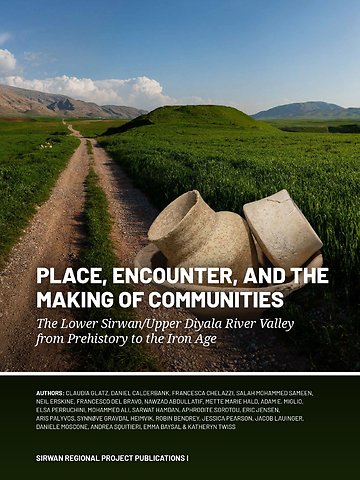
Place, Encounter, and the Making of Communities
The Lower Sirwan/Upper Diyala River Valley from Prehistory to the Iron Age
Samenvatting
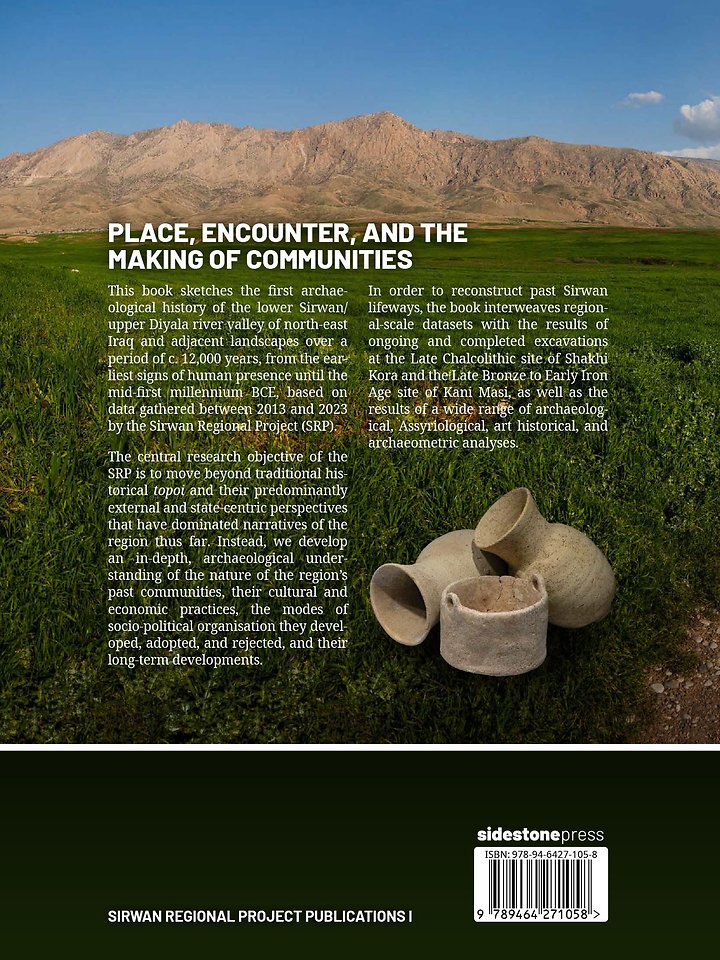
This book sketches the first archaeological history of the lower Sirwan/upper Diyala river valley of north-east Iraq and adjacent landscapes over a period of c. 12,000 years, from the earliest signs of human presence until the mid-first millennium BCE, based on data gathered between 2013 and 2023 by the Sirwan Regional Project (SRP).
The central research objective of the SRP is to move beyond traditional historical topoi and their predominantly external and state-centric perspectives that have dominated narratives of the region thus far. Instead, we develop an in-depth, archaeological understanding of the nature of the region’s past communities, their cultural and economic practices, the modes of socio-political organisation they developed, adopted, and rejected, and their long-term developments.
In order to reconstruct past Sirwan lifeways, the book interweaves regional-scale datasets with the results of ongoing and completed excavations at the Late Chalcolithic site of Shakhi Kora and the Late Bronze to Early Iron Age site of Kani Masi, as well as the results of a wide range of archaeological, Assyriological, art historical, and archaeometric analyses.
Specificaties
Inhoudsopgave
Author Contributions
Chapter 1: The Sirwan Regional Project: Research Context, Themes, and Approaches
1.1 Introduction
1.2 Infrastructures of life
1.3 Multiple temporalities and intersecting narratives
1.4 History of archaeological research
1.5 SRP Research themes and approaches
1.6 Scope and structure of the book
Chapter 2: Prehistoric Sirwan Landscapes
2.1 Introduction
2.2 Epipalaeolithic
2.3 Early Neolithic
2.4 Late Neolithic and Early Chalcolithic
2.5 Conclusions
Chapter 3: The Late Chalcolithic in the Lower Sirwan Region
3.1 Introduction
3.2 Excavations at Shakhi Kora (SRP191)
3.3 The lower Sirwan region in the Late Chalcolithic
3.4. Conclusions
Chapter 4: The Final Fourth and Third millennium BCE in the Lower Sirwan Region
4.1 Introduction
4.2 The lower Sirwan region in the Early EB
4.3 The lower Sirwan region in Middle EB
4.4 Conclusions
Chapter 5: The Later Third and Early Second Millennium BCE in the Lower Sirwan Region
5.1 Introduction
5.2 The Kani Masi site cluster
5.3 A village near the Sirwan (SRP094)
5.3.4 A place for the dead (SRP189)
5.4 The lower Sirwan region in the final Early and Middle Bronze Age
5.5 Conclusions
Chapter 6: The Later Second Millennium BCE in the Lower Sirwan Region: Excavations at Kani Masi (SRP046)
6.1 Introduction
6.2 Excavations at Kani Masi (SRP046)
6.2.1 Phase 1: Unbaked mudbrick
6.2.2 Phase 2: Industrial re-interpretation
6.2.3 Phase 3: Commemorations
6.2.4 Phase 4: Baked brick revival
6.2.5 Phase 5: Baked mudbrick re-use
6.2.6 Phase 6: Sporadic later occupations
6.3 Conclusions
Chapter 7: Kani Masi’s Late Bronze Age Pottery: Style, Technology, and Cultural Connectivity
7.1 Introduction
7.2 Collection and recording methods
7.3 Typological structure
7.4. A technological outline
7.4.1 Clay preparation
7.4.2 Forming and finishing techniques
7.4.3 Firing conditions
7.4.4 Understanding standardisation
7.5 Discussion: Chronological implications
7.6 Conclusions
Chapter 8: Food and Food Webs at Late Bronze Age Kani Masi
8.1 Introduction
8.2 Food production locales
8.3 Plants and animals
8.4. Subsistence, food practices, and human-animal relations
8.5 Conclusions
Chapter 9: Death, Ritual, and Memory: Depositional Practices at Late Bronze Age Kani Masi
9.1 Introduction
9.2 Burials and human remains
9.3 Ritual closures
9.4 Commemorative rituals
9.5 Conclusions
Chapter 10: Tokens of Authority: Seals, Sealings and Administrative Practice at Late Bronze Age Kani Masi
10.1 Introduction
10.2 Finds contexts
10.3 Sealing iconography and inscriptions
10.4 Conclusions
Chapter 11: The Later Second and Early First Millennia BCE in the Lower Sirwan Region
11.1 Introduction
11.2 The lower Sirwan region in the Late Bronze Age I-II
11.3 The lower Sirwan region in the Late Bronze Age III
11.4 The lower Sirwan region in the Iron Age
11.5 Conclusions
Chapter 12 Present Pasts: Co-creating a Museum Space, Rural Engagement, and Locally-led Archaeological Site Monitoring
12.1 Introduction
12.2 Archaeological practice and heritage protection
12.2.1 ‘Are You an Archaeologist?’
12.2.2 Engaging rural communities
12.2.3 Locally-embedded archaeological site condition monitoring
12.2.4 A Framework for cultural heritage
12.3 Conclusions
Chapter 13 An Archaeological History of the Early Lower Sirwan Region
13.1 Introduction
13.2 Settlement landscapes
13.3 Livelihoods
13.4 Cultural worlds
13.5 Political landscapes
13.6 Conclusions
Appendix I Catalogue of Prehistoric, Bronze and Iron Age Sites
Appendix II Absolute Dates
Appendix III Chipped stone surface assemblages
Appendix IV Archaeobotanical Data
Appendix V Stone Tools
Appendix VI Zooarchaeology Methods and Data
Appendix VII Biomolecular Analyses
Appendix VIII Osteological Report
Appendix IX Personal ornaments from Kani Masi
Bibliography
Index
Vaak samen gekocht

Anderen die dit kochten, kochten ook
-
 Hugh Newman€ 11,99
 -
Harald Meller€ 29,99
-
Gerrit Dusseldorp€ 25,00
-
Martijn Manders€ 23,99
-
*€ 28,50
-
Wijnand van der Sanden€ 39,50