Thomas Flüeler
Springer Netherlands
e druk, 2014
9789400789081
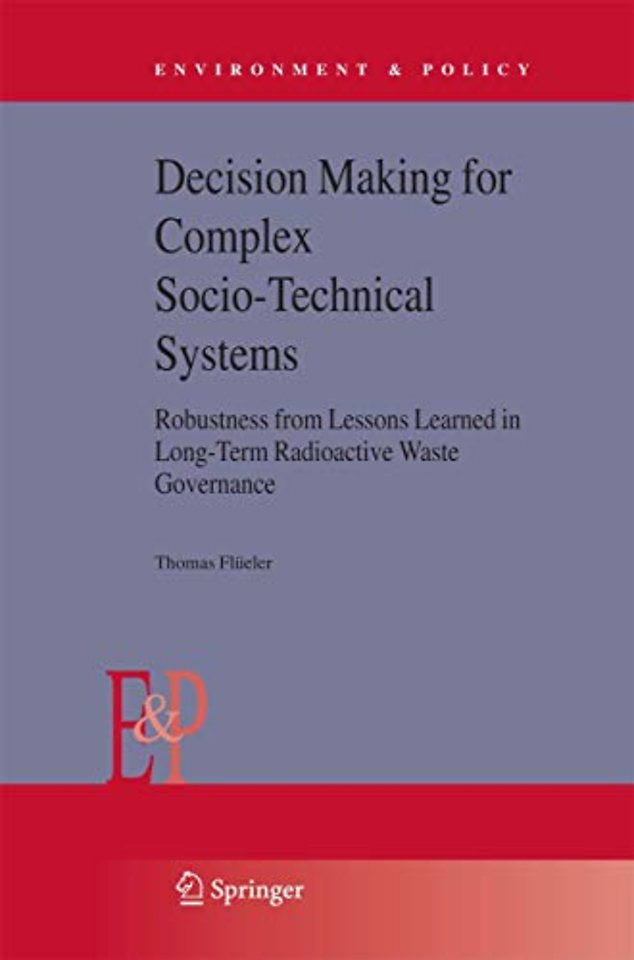
Decision Making for Complex Socio-Technical Systems
Robustness from Lessons Learned in Long-Term Radioactive Waste Governance
Specificaties
Paperback, blz.
|
Engels
Springer Netherlands |
e druk, 2014
ISBN13: 9789400789081
Rubricering
Onderdeel van serie
Environment & Policy
Levertijd ongeveer 8 werkdagen
Samenvatting
The long-term governance of radioactive waste continues to be a major complex and unresolved socio-technical issue. Previous technocratic approaches have so far failed. This empirically based study provides a novel approach to complementing technical expertise and economic/political power with stakeholder involvement. Inclusive participation is shown to be an asset that strengthens the processes, enhances robustness and facilitates sustainable decision making, thus adding value for all involved.
Specificaties
ISBN13:9789400789081
Taal:Engels
Bindwijze:paperback
Uitgever:Springer Netherlands
Serie:Environment & Policy
Inhoudsopgave
Preface. Summary. Introduction.
Part I: Overall Issue and Methodology. 1. Setting And Topics At Issue. 2. Objectives And Aim. 3. Research Political Embedding. 4. Issues Under Investigation, Evidence And Validation.
Part II: Perspective 'From Below': Risk Perception of The Public. 5. Insights From Risk Perception Research. 6. Risk Perception In Radioactive Waste Issues.
Part III: Perspective 'From Above': Decision Processes. 7. Insights From Decision Science. 8. Development Of Decision Making In Technical Systems. 9. Decisions In Radioactive Waste Management. 10. Siting As An Example Of Sub-Optimum Decision-Making.
Part IV: Conclusions and Further Development. 11. Patterns Of Arguments In Radioactive Waste Governance. 12. Fundamentals Of A Comparison Of Disposition Options. 13. Proposal For A Concept Of An Overall System Robustness.
References. Index.
Part I: Overall Issue and Methodology. 1. Setting And Topics At Issue. 2. Objectives And Aim. 3. Research Political Embedding. 4. Issues Under Investigation, Evidence And Validation.
Part II: Perspective 'From Below': Risk Perception of The Public. 5. Insights From Risk Perception Research. 6. Risk Perception In Radioactive Waste Issues.
Part III: Perspective 'From Above': Decision Processes. 7. Insights From Decision Science. 8. Development Of Decision Making In Technical Systems. 9. Decisions In Radioactive Waste Management. 10. Siting As An Example Of Sub-Optimum Decision-Making.
Part IV: Conclusions and Further Development. 11. Patterns Of Arguments In Radioactive Waste Governance. 12. Fundamentals Of A Comparison Of Disposition Options. 13. Proposal For A Concept Of An Overall System Robustness.
References. Index.