Steffen Marburg,
Bodo Nolte
Springer Berlin Heidelberg
2008e druk, 2008
9783540774471
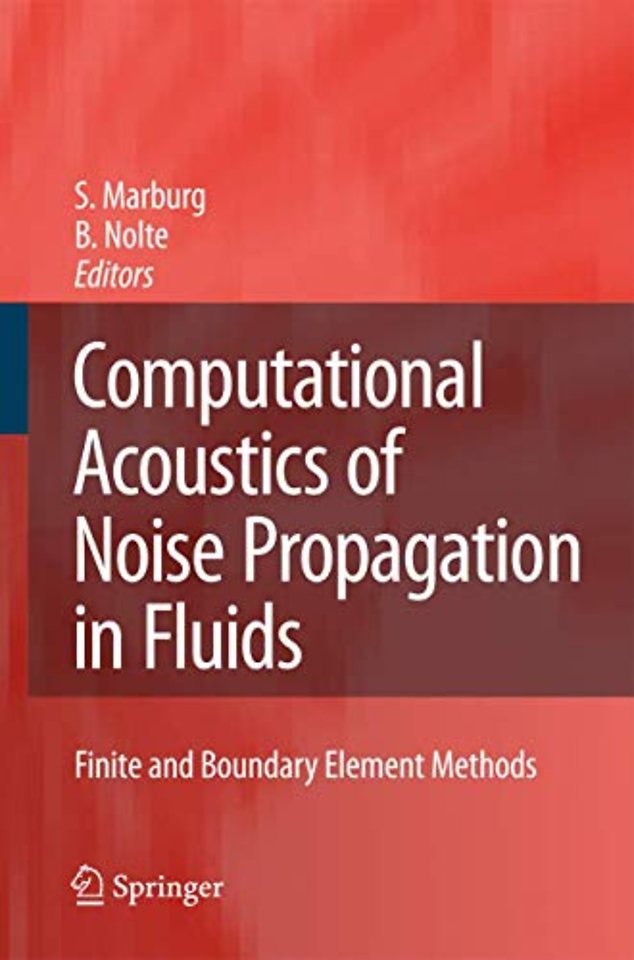
Computational Acoustics of Noise Propagation in Fluids - Finite and Boundary Element Methods
Specificaties
Gebonden, 578 blz.
|
Engels
Springer Berlin Heidelberg |
2008e druk, 2008
ISBN13: 9783540774471
Rubricering
Levertijd ongeveer 8 werkdagen
Samenvatting
The book provides a survey of numerical methods for acoustics, namely the finite element method (FEM) and the boundary element method (BEM). It is the first book summarizing FEM and BEM (and optimization) for acoustics. The book shows that both methods can be effectively used for many other cases, FEM even for open domains and BEM for closed ones. Emphasis of the book is put on numerical aspects and on treatment of the exterior problem in acoustics, i.e. noise radiation.
Specificaties
ISBN13:9783540774471
Taal:Engels
Bindwijze:gebonden
Aantal pagina's:578
Uitgever:Springer Berlin Heidelberg
Druk:2008
Inhoudsopgave
Part I FEM: Numerical Aspects
1 Dispersion, Pollution, and Resolution.
2 Different Types of Finite Elements.
3 Multifrequency Analysis using Matrix Pad´e–via–Lanczos.
4 Computational Aeroacoustics based on Lighthill’s Acoustic Analogy.
Part II FEM: External Problems
5 Computational Absorbing Boundaries.
6 PerfectlyMatched Layers.
7 Infinite Elements.
8 Efficient Infinite Elements based on Jacobi Polynomials.
Part III FEM: Related Problems
9 Fluid–Structure Acoustic Interaction.
10 Energy Finite Element Method.
Part IV BEM: Numerical Aspects
11 Discretization Requirements.
12 Fast Solution Methods.
13 Multi–domain Boundary Element Method in Acoustics.
14 Waveguide Boundary Spectral Finite Elements.
Part V BEM: External Problems
15 Treating the Phenomenon of Irregular Frequencies.
16 A Galerkin-type BE-formulation.
17 Acoustical Radiation and Scattering above an Impedance Plane.
18 Time Domain BEM.
Part VI BEM: Related Problems
19 Coupling a Fast BEM with a FE-Formulation for Fluid–Structure Interaction.
20 Inverse BE-Techniques for the Holographic Identification of Vibro–Acoustic Source Parameters
1 Dispersion, Pollution, and Resolution.
2 Different Types of Finite Elements.
3 Multifrequency Analysis using Matrix Pad´e–via–Lanczos.
4 Computational Aeroacoustics based on Lighthill’s Acoustic Analogy.
Part II FEM: External Problems
5 Computational Absorbing Boundaries.
6 PerfectlyMatched Layers.
7 Infinite Elements.
8 Efficient Infinite Elements based on Jacobi Polynomials.
Part III FEM: Related Problems
9 Fluid–Structure Acoustic Interaction.
10 Energy Finite Element Method.
Part IV BEM: Numerical Aspects
11 Discretization Requirements.
12 Fast Solution Methods.
13 Multi–domain Boundary Element Method in Acoustics.
14 Waveguide Boundary Spectral Finite Elements.
Part V BEM: External Problems
15 Treating the Phenomenon of Irregular Frequencies.
16 A Galerkin-type BE-formulation.
17 Acoustical Radiation and Scattering above an Impedance Plane.
18 Time Domain BEM.
Part VI BEM: Related Problems
19 Coupling a Fast BEM with a FE-Formulation for Fluid–Structure Interaction.
20 Inverse BE-Techniques for the Holographic Identification of Vibro–Acoustic Source Parameters