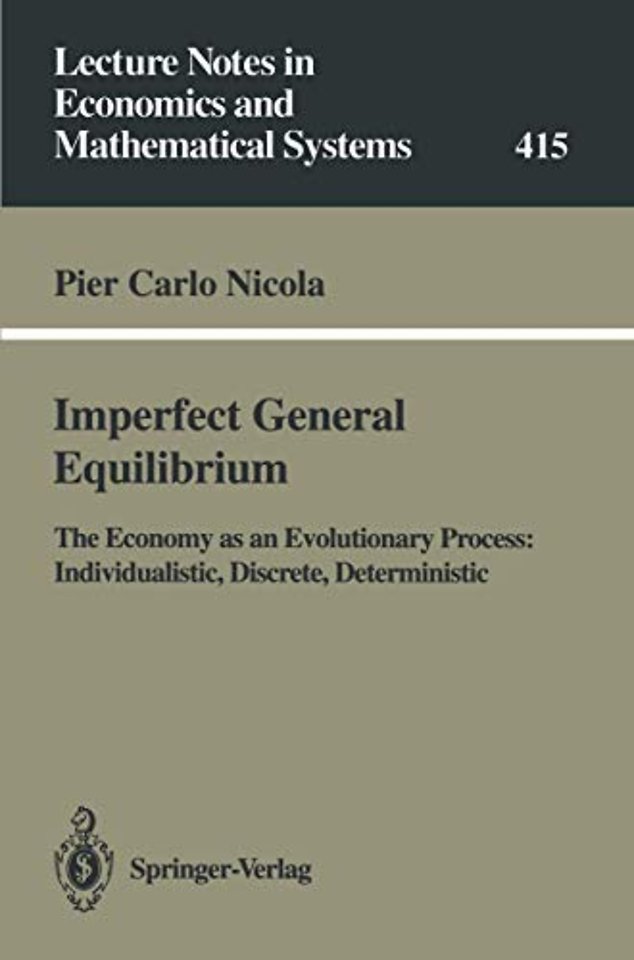
Imperfect General Equilibrium

The Economy as an Evolutionary Process: Individualistic, Discrete, Deterministic

Specificaties
Paperback, 167 blz. | Engels
Springer Berlin Heidelberg | 0e druk, 1994
ISBN13: 9783540581024
Rubricering
Springer Berlin Heidelberg 0e druk, 1994 9783540581024
€ 60,99
Levertijd ongeveer 8 werkdagen

Samenvatting

Economic theory of the last fifty years has been dominated by the paradigm of General Equilibrium Theory, based on the scientific work of Walras-Pareto-Cassel-Wald-Hicks-Arrow-De­ breu-McKenzie. Some of its grounding assumptions are: all prices are fully flexible; an auctioneer appropriately manipulates all prices according to the law of supply and demand; every con­ sumer has only one budget constraint; all agents are perfectly informed; no actions are taken by agents before a vector of prices has been found such that all markets clear. Indeed, when all markets clear every agent can implement her/his chosen (opti­ mal) action and nobody is urged to change his/her decisions. Under these assumptions it is generally said that in a (one pe­ riod, competitive) general equilibrium model there is no place for money. The present monograph takes general equilibrium as the ba­ sis on which to build the model presented. But its first aim is to completely dispense with the Walrasian auctioneer by giving firms the task of choosing their output price~ period after period.

Specificaties

ISBN13:9783540581024
Taal:Engels
Bindwijze:paperback
Aantal pagina's:167
Uitgever:Springer Berlin Heidelberg
Druk:0
Hoofdrubriek:Economie

Inhoudsopgave

1 Meaningful Elements of Economic Thought.- 1.1 Some Predecessors.- 1.2 Walras and Associates.- 1.3 Modern Competitive Theories.- 1.4 Temporary General Equilibrium.- 1.5 General non Competitive Equilibrium 14.- 1.6 Fixed Prices and Rationing.- 1.7 Game Theory and Market Forms.- 1.8 Sequential Equilibria and Rational Expectations.- 2 Introductory Examples.- 2.1 Summary of a One Period Walrasian Model.- 2.2 A “Vital Utility” Index.- 2.3 Numerical Experiments.- 2.3.1 Walrasian Equilibrium.- 2.3.2 Imperfect Equilibrium without Money.- 2.3.3 Imperfect Equilibrium with Money.- 2.4 Conclusion.- 3 Goods, Money, Public Administration.- 3.1 Goods.- 3.2 Money.- 3.3 Prices and Values.- 3.4 Labour.- 3.5 Public Goods and Public Administration.- 4 Firms.- 4.1 Preliminaries.- 4.2 The Firm.- 4.3 Present Choices.- 4.4 Intertemporal Decisions.- 4.5 Existence of an Optimal Program.- 4.6 Revising Decisions.- 4.7 Market Choices by Firms.- 5 Consumers.- 5.1 Preliminaries.- 5.2 Consumers.- 5.2.1 Young Consumers.- 5.2.2 Adult Consumers.- 5.2.3 Retired Consumers.- 5.3 Conclusion.- 6 Imperfect General Equilibrium.- 6.1 General Environment.- 6.2 The Network of Exchanges.- 6.3 Imperfect Temporary General Equilibrium.- 6.4 Updating Prices.- 7 Dynamics and Growth, Stationary Equilibria.- 7.1 Some Elements on Evolutionary Processes.- 7.2 Stationary Equilibria.- 7.3 Endogenous Cycles. Chaos.- 8 Numeric Simulations. Cycles and Quasi-Chaos.- 8.1 Society and the Computer.- 8.2 Main Features.- 8.3 Firms’ Decisions.- 8.3.1 Current Decisions of Firms.- 8.3.2 Current Production of Firms.- 8.4 Labour Rationing.- 8.5 Consumers’ Decisions.- 8.6 Effective Transactions.- 8.7 Updating Parameters in Calendar Time.- 9 Micro-Analysis versus Macro-Synthesis.- 9.1 Microeconomics and Macroeconomics.- 9.2 Aggregation.- 9.3 Aggregations in the Imperfect Model.- 9.3.1 Imperfect Aggregate Model without Money.- 9.3.2 Imperfect Aggregate Monetary Model.- 10 Epilogue.- A.1 Linear Spaces.- A.2 Topological Spaces and Metric Spaces.- A.3 Linear Topological Spaces.- A.4 Normed Spaces and Banach Spaces.- References.- Name Index.
€ 60,99
Levertijd ongeveer 8 werkdagen

Rubrieken

    Personen

      Trefwoorden

        Imperfect General Equilibrium