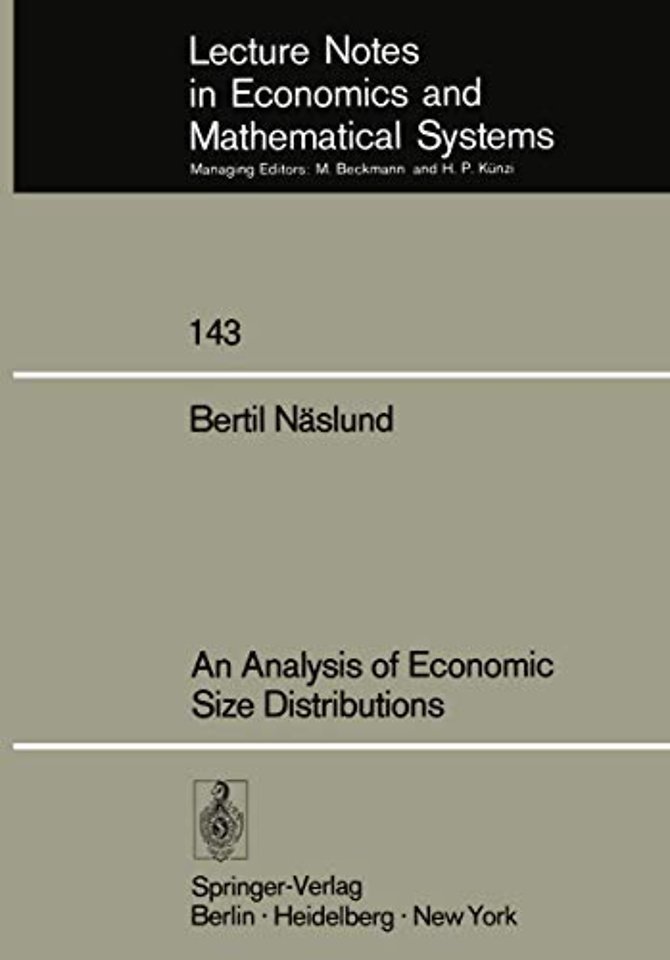
An Analysis of Economic Size Distributions

Specificaties
Paperback, 106 blz. | Engels
Springer Berlin Heidelberg | 0e druk, 1977
ISBN13: 9783540081425
Rubricering
Springer Berlin Heidelberg 0e druk, 1977 9783540081425
€ 60,99
Levertijd ongeveer 8 werkdagen

Samenvatting

The basic idea behind this book is that in a market economy there is endless variety, people die and are born, new products and processes emerge and old ones disappear etc. Some firms grow others decline. Some people get high salaries others get unemployed. Opportunities, disasters and capabilities are to a large extent random. An economy has a certain amount of resources to divide among its members. These resources may vary over time but the rate of change is fairly small. The number of persons in society may also vary but the rate of change is limited. For a society such as the one described above I was interested in deriving equilibrium distributions of various kinds and make some tests of the distributions found against data for different countries. I have studied the following types of distributions a) Income distribution b) Functional distribution of income c) Size distributions of firms. Since the above mentioned distributions are related; another main purpose of the book has been to develop a similar method for the analysis of all three distributions in order to simplify the understanding of their relations.

Specificaties

ISBN13:9783540081425
Taal:Engels
Bindwijze:paperback
Aantal pagina's:106
Uitgever:Springer Berlin Heidelberg
Druk:0
Hoofdrubriek:Economie

Inhoudsopgave

Preface.- Background and Summary.- 1 Introduction.- 1.1 The log normal distribution.- 1.2 The Pareto distribution.- 1.3 Randomness and economic markets.- 1. 4- A more precise presentation.- 1.5 The derivation of an equilibrium distribution by maximizing entropy.- 1.6 Conclusions.- 1 Equilibrium.- 2 Some Equilibrium Conditions for Statistical Markets.- 2.1 A formulation considering explicit market transactions.- 2.2 More general formulations.- 2.2a Constrained maximization.- 2.2b Dividing society into systems.- 2.3 The information theory approach.- 2.4- Conclusions.- 2.5 Appendix.- 3 Size Distributions of Income.- 3.1 The consumption function.- 3.2 Empirical tests.- 3.3 Conclusions.- 4 The Functional Distribution of Income.- 4.1 Neo-classical theory.- 4.2 Neo-Keynesian theory.- 4.3 Derivation of the functional distribution of income.- 4.4 Conclusions.- 5 Size Distributions and the Optimal Size of Firms.- 5.1 The theory of the firm and size distributions.- 5.2 Some basic facts about the method of analysis.- 5.3 The relation between profit and size.- 5.4 The Pareto distribution.- 5.5 Some data.- 5.6 A relation between the size distributions of income and firms.- 5.7 Conclusions.- 2 Disequilibrium.- 6 The Analysis of Disequilibrium Markets.- 6.1 The equilibrium situation.- 6.2 Disequilibrium.- 6.3 Conclusions.- 7 Economic Growth and Distribution.- 7.1 The origin of growth.- 7.2 An assumption about the transfer of income.- 7.3 Conclusions.- 8 Distribution — Inflation — Unemployment.- 8.1 The background.- 8.2 Inflation and unemployment.- 8.3 Concluding discussion.- 9 Final Remarks.- References.
€ 60,99
Levertijd ongeveer 8 werkdagen

Rubrieken

    Personen

      Trefwoorden

        An Analysis of Economic Size Distributions