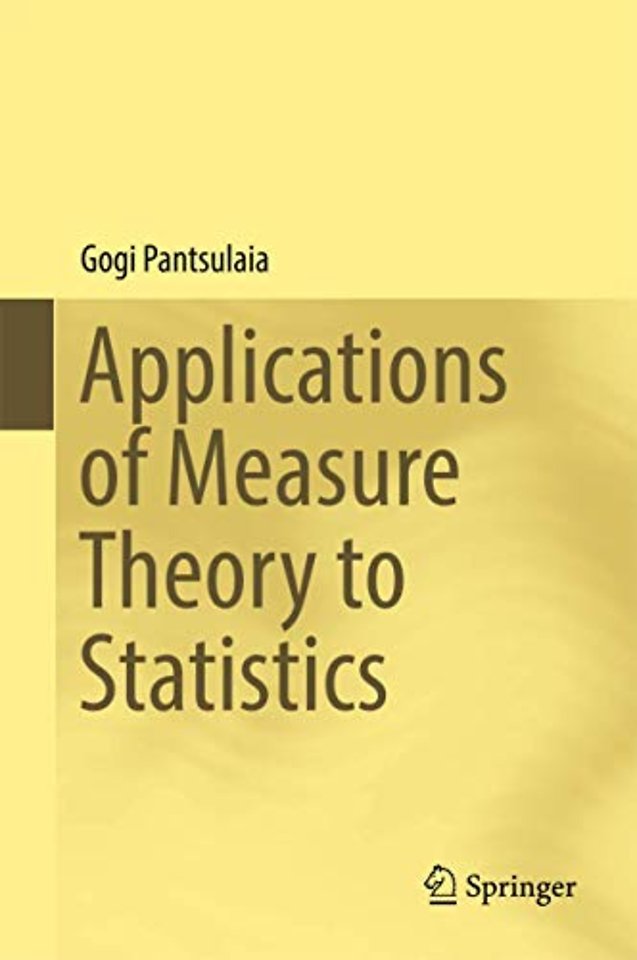
Applications of Measure Theory to Statistics

Specificaties
Gebonden, blz. | Engels
Springer International Publishing | e druk, 2017
ISBN13: 9783319455778
Rubricering
Springer International Publishing e druk, 2017 9783319455778
€ 96,99
Levertijd ongeveer 8 werkdagen

Samenvatting

This book aims to put strong reasonable mathematical senses in notions of objectivity and subjectivity for consistent estimations in a Polish group by using the concept of Haar null sets in the corresponding group. This new approach – naturally dividing the class of all consistent estimates of an unknown parameter in a Polish group into disjoint classes of subjective and objective estimates – helps the reader to clarify some conjectures arising in the criticism of null hypothesis significance testing. The book also acquaints readers with the theory of infinite-dimensional Monte Carlo integration recently developed for estimation of the value of infinite-dimensional Riemann integrals over infinite-dimensional rectangles. The book is addressed both to graduate students and to researchers active in the fields of analysis, measure theory, and mathematical statistics.

Specificaties

ISBN13:9783319455778
Taal:Engels
Bindwijze:gebonden
Uitgever:Springer International Publishing

Inhoudsopgave

<p>1 Calculation of Improper Integrals by Using Uniformly Distributed Sequences.- 2 Infinite-Dimensional Monte-Carlo Integration.- 3 On structure of all real-valued sequences uniformly distributed in [-1/2;1/2] from the point of view of shyness.- 4 On Moore-Yamasaki-Kharazishvili type measures and the infinite powers of Borel diffused probability measures on R.- 5 On objective and strong objective consistent estimates of unknown parameters for statistical structures in a Polish group admitting an invariant metric.- 6 Why Null Hypothesis is rejected for “almost every” infinite sample by the Hypothesis Testing of a maximal reliability?.</p>
€ 96,99
Levertijd ongeveer 8 werkdagen

Rubrieken

    Personen

      Trefwoorden

        Applications of Measure Theory to Statistics