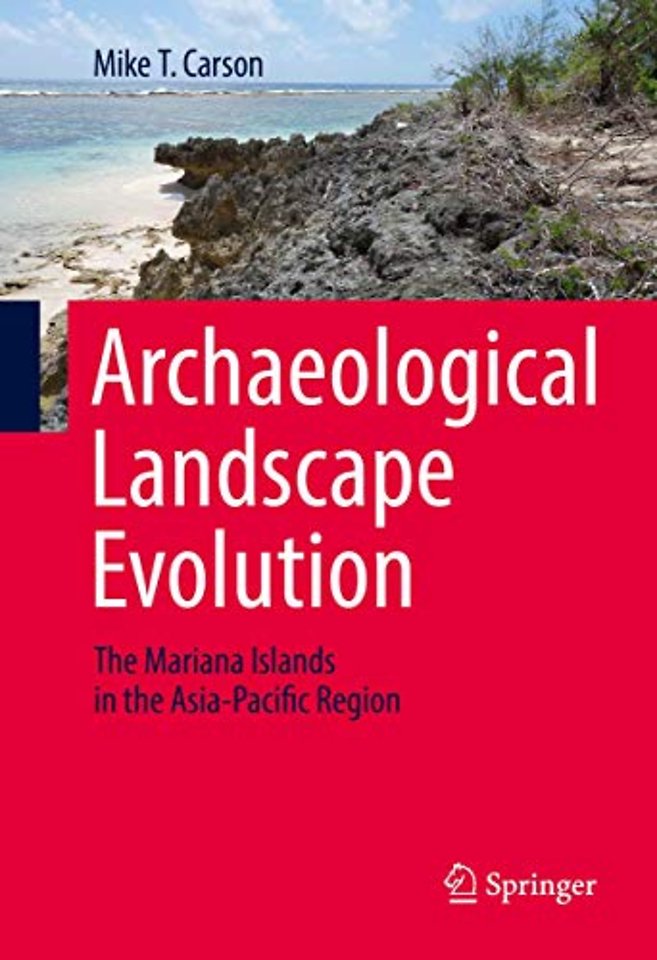
Archaeological Landscape Evolution
The Mariana Islands in the Asia-Pacific Region
Samenvatting
Landscapes have been fundamental
to the human experience world-wide and throughout time, yet how did we as human
beings evolve or co-evolve with our landscapes?
By answering this question, we can understand our place in the complex,
ever-changing world that we inhabit.
This
book guides readers on a journey through the concurrent processes of change in
an integrated natural-cultural history of a landscape. While outlining the general principles for
global application, a richly illustrated case is offered through the Mariana
Islands in the northwest tropical Pacific and furthermore situated in a larger
Asia-Pacific context for a full comprehension of landscape evolution at
variable scales. The author examines what
happened during the first time when human beings encountered the world’s Remote
Oceanic environment in the Mariana Islands about 3500 years ago, followed by a
continuous sequence of changing sea level, climate, water resources, forest
composition, human population growth, and social dynamics. This book provides a high-resolution and
long-term view of the complexities of landscape evolution that affect all of us
today.
Specificaties
Inhoudsopgave
study</p>
<p> </p>
<p>Chapter 1: Landscape
evolution as natural-cultural history</p>
<p>Evolution of an inhabited
landscape</p>
<p>The Marianas landscape as a
model system</p>
<p>Structure and content of
this book</p>
<p>References</p>
<p> </p>
<p>Chapter 2: Global
applicability of landscape evolution</p>
<p>Coastal China</p>
<p>California</p>
<p>Hawaiian Islands</p>
<p>Mariana Islands</p>
<p>References</p>
<p> </p>
<p>Chapter 3: Environmental
setting and dynamics</p>
<p>Geological structure</p>
<p>Sea-level history</p>
<p>Coastal geomorphology</p>
<p>Slope erosion-deposition
patterns</p>
<p>Soil formation</p>
<p>Plant and animal communities</p>
<p>Climate and weather</p>
<p>Water sources</p>
<p>References</p>
<p> </p>
<p>Chapter 4: Marianas
archaeology in local and regional perspectives</p>
<p>Marianas settlement in
Asia-Pacific context</p>
<p>Foundations of Chamorro
heritage</p>
<p>References</p>
<p>
<p>Chapter 5: Coordinating perspectives
of the past</p>
<p>Historical perspectives</p>
<p>Linguistics</p>
<p>Human biology and genetics</p>
<p>Faunal records</p>
<p>Botanical records</p>
<p>References</p>
<p> </p>
<p>Chapter 6: Range of
archaeological material culture</p>
<p>Artefacts</p>
<p>Midden</p>
<p>Structural features</p>
<p>Rock art</p>
<p>Caves</p>
<p>Landscapes</p>
<p>References</p>
<p> </p>
<p>Part Two: Chronological
sequence</p>
<p> </p>
<p>Chapter 7: Building an
archaeological chronology</p>
<p>Use of radiocarbon dating</p>
Marianas chronological
outline<p></p>
<p>References</p>
<p> </p>
<p>Chapter 8: 1500–1100 B.C.,
initial settlement</p>
<p>Site inventory and dating</p>
<p>Landforms</p>
<p>Resource zones</p>
<p>Material culture</p>
<p>Regional context</p>
<p>References</p>
<p> </p>
<p>Chapter 9: 1100–700 B.C.,
changing coastlines</p>
<p>Site inventory and dating</p>
<p>Landforms</p>
<p>Resource zones</p>
Material culture</p>
<p>Regional context</p>
<p>References</p>
<p> </p>
<p>Chapter 10: 700 B.C.–A.D. 1,
broadened horizons</p>
<p>Site inventory and dating</p>
<p>Landforms</p>
<p>Resource zones</p>
<p>Material culture</p>
<p>Regional context</p>
<p>References</p>
<p> </p>
<p> </p>
<p>Chapter 11: A.D. 1–500,
temporary stability</p>
<p>Site inventory and dating</p>
<p>Landforms</p>
<p>Resource zones</p>
Material culture<p></p>
<p>Regional context</p>
<p>References</p>
<p> </p>
<p> </p>
<p>Chapter 12: A.D. 500–1000,
sustained use of coastal and inland zones</p>
<p>Site inventory and dating</p>
<p>Landforms</p>
<p>Resource zones</p>
<p>Material culture</p>
<p>Regional context</p>
<p>References</p>
<p> </p>
<p> </p>
<p>Chapter 13: A.D. 1000–1700,
a sea of islands and monuments</p>
<p>Site inventory and dating</p>
<p>Landforms</p>
<p>Resource zones</p>
<p>Material culture</p>
<p>Regional context</p>
<p>References</p>
<p> </p>
<p> </p>
<p>Chapter 14: A.D.
1700–Present, living with colonialism and globalisation</p>
<p>Site inventory and dating</p>
<p>Landforms</p>
<p>Resource zones</p>
<p>Material culture</p>
<p>Regional context</p>
<p>References</p>
<p> </p>
<p> </p>
<p>Part Three: Pursuing
research questions</p>
<p> </p>
<p>Chapter 15: First inhabiting
of a landscape</p>
<p>Human migration into a new
landscape</p>
<p>Initial inhabiting of a
landscape</p>
<p>Origins of landscape
evolution</p>
<p>References</p>
<p> </p>
<p>Chapter 16: Long-term
human-environment relations</p>
<p>Geology and landforms</p>
<p>Climate</p>
<p>Sea level and coastal
ecology</p>
<p>Water sources</p>
<p>Plant and animal populations</p>
<p>Patterns of residence and
resource use</p>
<p>Material culture</p>
<p>Continuity and change</p>
<p>References</p>
<p> </p>
<p>Chapter 17: Future
directions</p>