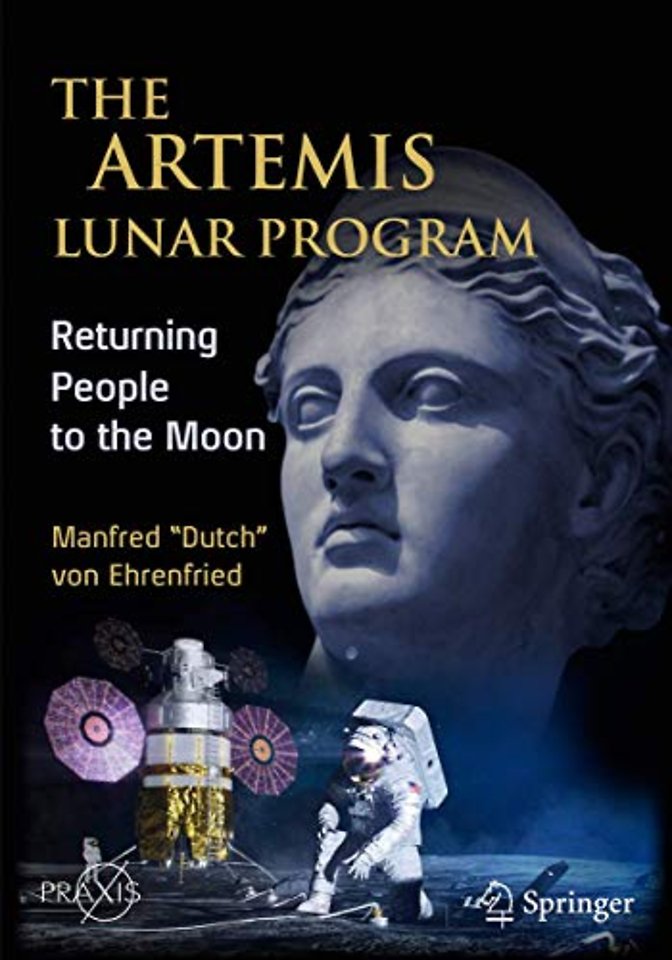
The Artemis Lunar Program
Returning People to the Moon
Samenvatting
This book describes the future of the Artemis Lunar Program from the years 2017 to about 2030. Despite the uncertainty of the times and the present state of space exploration, it is likely that what is presented in this book will actually happen, to one degree or another. As history has taught us, predictions are often difficult, but one can see enough into the future to be somewhat accurate. As the Bible says, “Wesee thru the glass, but darkly.”
All of the elements of the proposed program are described from several perspectives: NASA’s, the commercial space industry and our International partners. Also included are descriptions of the many vehicles, habitats, landers, payloads and experiments. The book tells the story of the buildup of a very small space station in a strange new lunar orbit and the descent of payloads and humans, including the first women and next man, to the lunar surface with the intent to evolve a sustained presence over time.
Specificaties
Inhoudsopgave
<p>Dedication </p>
<p>Acknowledgments </p>
<p>Preface </p>
<p> </p>
<p>1 Introduction</p>
<p>2 The Artemis Lunar Program Overview</p>
<p> 2.1 NASA’s Concept</p>
<p> 2.2 Summary of the Elements</p>
<p> 2.3 The Controversy </p>
<p> 2.4 The Budget</p>
<p> 2.5 Politics</p>
<p>3 Spacecraft, Landers, Rovers and Payloads</p>
3.1 Commercial Spacecraft<p></p>
<p> 3.2 Commercial Lunar Payload Services</p>
<p> 3.3 Commercial Payloads and Instruments</p>
<p> 3.4 Lunar Science Participation</p>
<p> 3.5 Landing Sites</p>
<p>4 Elements, Crew Landers, Launch Vehicles and Upper Stages</p>
<p> 4.1 Propulsion and Power Element</p>
<p> 4.2 Habitat and Logistics Modules </p>
<p> 4.3 Crew Landers and Transfer Element Studies</p>
<p> 4.4 Launch Vehicles </p>
4.5 Upper Stages<p></p>
<p>5 NASA and Commercial Crew Development</p>
<p> 5.1 Crew Selection and Training </p>
<p> 5.2 Commercial Crew ISS Missions</p>
<p> 5.3 Artemis Missions</p>
<p> 5.4 The Next Generation Space Suit</p>
<p> 5.5 Commercial Crew Space Suits</p>
5.6 Crew Health <p></p>
<p>6 Artemis Lessons for Exploration</p>
<p> 6.1 Utility of the Gateway </p>
<p> 6.2 Sustainability</p>
<p> 6.3 Impact on Future Hardware Design</p>
<p> 6.4 Long Duration Science Operations</p>
<p> 6.5 Launch Vehicle Payload Capability</p>
7 Enabling Technology Advances <p></p>
<p> 7.1 NASA Programs</p>
<p> 7.2 Navigation and Precision Landing</p>
<p> 7.3 Deep Space Atomic Clock</p>
<p> 7.4 In-Situ Resource Utilization</p>
<p> 7.5 Lunar Power</p>
<p> 7.6 Protection from Radiation</p>
7.7 Advances in Optical Communications<p></p>
<p> 7.8 Lunar IceCube</p>
<p>8 Artemis Influence on Mars Planning</p>
<p> 8.1 Mission Concepts and Plans</p>
<p> 8.2 Technologies and Capabilities</p>
<p> 8.3 Artemis Science Influence on Mars</p>
<p> 8.4 Robotics</p>
8.5 Regolith Mining and Processing<p></p>
<p> 8.6 3D Printing </p>
<p>9 Conclusions</p>
<p></p>
<p>Appendices</p>
<p>1 The National Space Council’s Role in Artemis and Mars</p>
<p>2 Community Letter to Congress Regarding NASA’s Lunar Discovery </p>
<p> and Exploration Program</p>
<p>3 NASA’s Gateway Memorandum for the Record </p>
<p>4 Near Rectilinear Halo Orbit</p>
<p>5 Solar Electric Propulsion and Hall Effect Thrusters</p>
<p>6 Technology </p>
<p>7 Timeline</p>
<p>8 Artemis Mythology</p>
9 The Moon Village Association<p></p>
<p>10 The Chinese Lunar Program</p>
<p>11 Crew Selection: A History and Prediction </p>
<p>12 Quotes </p>
<p> </p>
<p>References</p>
<p>Glossary</p>
<p>About the Author</p>
<p>Index</p><br><p></p>