,

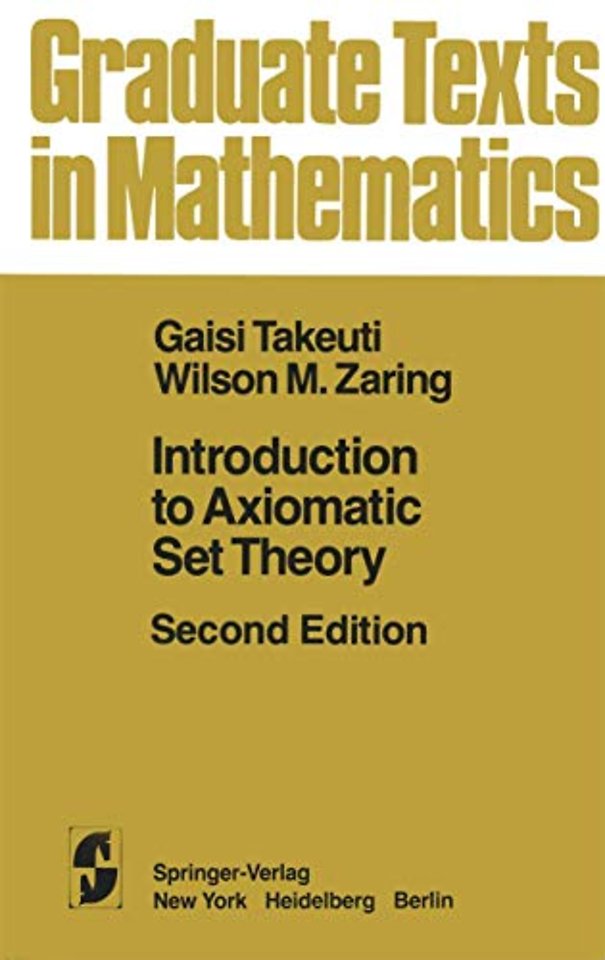
Introduction to Axiomatic Set Theory

Specificaties
Paperback, 246 blz. | Engels
Springer New York | 2e druk, 2011
ISBN13: 9781461381709
Rubricering
Springer New York 2e druk, 2011 9781461381709
Onderdeel van serie Graduate Texts in Mathematics
€ 102,99
Levertijd ongeveer 8 werkdagen

Samenvatting

In 1963, the first author introduced a course in set theory at the University of Illinois whose main objectives were to cover Godel's work on the con­ sistency of the Axiom of Choice (AC) and the Generalized Continuum Hypothesis (GCH), and Cohen's work on the independence of the AC and the GCH. Notes taken in 1963 by the second author were taught by him in 1966, revised extensively, and are presented here as an introduction to axiomatic set theory. Texts in set theory frequently develop the subject rapidly moving from key result to key result and suppressing many details. Advocates of the fast development claim at least two advantages. First, key results are high­ lighted, and second, the student who wishes to master the subject is com­ pelled to develop the detail on his own. However, an instructor using a "fast development" text must devote much class time to assisting his students in their efforts to bridge gaps in the text.

Specificaties

ISBN13:9781461381709
Taal:Engels
Bindwijze:paperback
Aantal pagina's:246
Uitgever:Springer New York
Druk:2

Inhoudsopgave

1 Introduction.- 2 Language and Logic.- 3 Equality.- 4 Classes.- 5 The Elementary Properties of Classes.- 6 Functions and Relations.- 7 Ordinal Numbers.- 8 Ordinal Arithmetic.- 9 Relational Closure and the Rank Function.- 10 The Axiom of Choice and Cardinal Numbers.- 11 Cofinality, the Generalized Continuum Hypothesis, and Cardinal Arithmetic.- 12 Models.- 13 Absoluteness.- 14 The Fundamental Operations.- 15 The Gödel Model.- 16 Silver Machines.- 17 Applications of Silver Machines.- 18 Introduction to Forcing.- 19 Forcing.- Problem List.- Index of Symbols.
€ 102,99
Levertijd ongeveer 8 werkdagen

Rubrieken

    Personen

      Trefwoorden

        Introduction to Axiomatic Set Theory