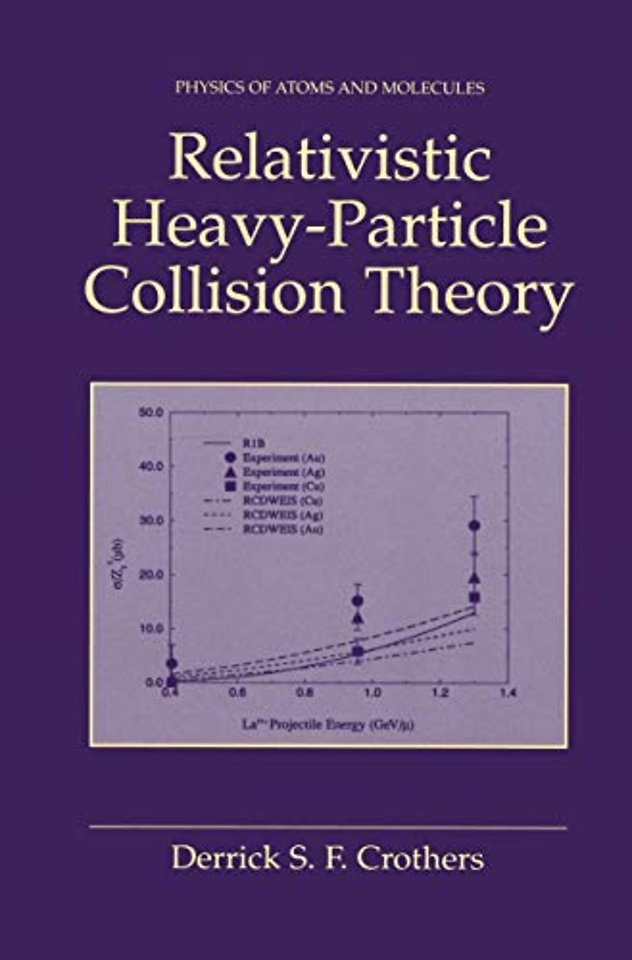
Relativistic Heavy-Particle Collision Theory
Samenvatting
If a heavy particle ion (atom, molecule, muon) collides with another in the gas phase at speeds approaching the speed of light, the time-dependent Dirac equation equation must be used for its description, including quantum electro-dynamic, special relativity and magnetic coupling effects.
In this book we study one electron in the variety of rearrangement collisions: radiative and non-radiative capture, ionization, capture by pair (one electron, one positron) production and antihydrogen production. Our relativistic continuum distorted-wave theory accounts extremely well for the simultaneous behaviour of the electron with respect to the nuclear charges of the projectile and the target.
This is the first book developed in this subject. Containing many diagrams and tables, and fully referenced, it goes beyond chapters in previous books. The relativistic continuum distorted-wave theory developed by the authors group, is shown to be fully Hermitean. Detailed mathematics are provided in nine appendices.