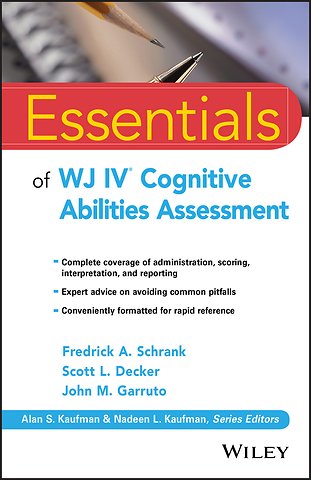
Essentials of WJ IV® Cognitive Abilities Assessment
Samenvatting
The step–by–step guide to administering, scoring, and interpreting the WJ IV
®
Tests of Cognitive Abilities
Essentials of WJ IV® Cognitive Abilities Assessment provides expert, practical advice on how to administer, score, and interpret the WJ IV COG®. Designed to be an easy–to–use reference, the text goes beyond the information found in the WJ IV® examiner′s manual to offer full explanations of the tests and clusters on the WJ IV COG®. This essential guide also explains the meaning of all scores and interpretive features and includes valuable advice on clinical applications and illuminating case studies.
This clearly written and easily accessible resource offers:
Concise chapters with numerous callout boxes highlighting key concepts, numerous examples, and test questions that help you gauge and reinforce your grasp of the information covered.
An in–depth chapter on interpretation of the WJ IV COG® which highlights links to interventions for each test based on contemporary theory and research.
Expert assessment of the tests′ relative strengths and weaknesses.
Illustrative case reports with clinical and school–based populations.
If you′re a school psychologist, clinical psychologist, neuropsychologist, or any professional or graduate student looking to become familiar with the new WJ IV COG®, this is the definitive resource you′ll turn to again and again.
Specificaties
Inhoudsopgave
<p>Acknowledgments xvii</p>
<p>One Overview 1</p>
<p>History and Development 2</p>
<p>1977: The Woodcock–Johnson Psycho–Educational Battery 2</p>
<p>1989: The Woodcock–Johnson Psycho–Educational Battery Revised 4</p>
<p>2001: The Woodcock–Johnson III 6</p>
<p>2014: The Woodcock–Johnson IV 6</p>
<p>Standardization Sample and Psychometric Properties 12</p>
<p>Reliability 12</p>
<p>Validity 14</p>
<p>Further Information on the WJ IV COG 18</p>
<p>Two How to Administer the WJ IV COG 22<br />Melanie A. Bartels Graw</p>
<p>General Testing Information 23</p>
<p>Testing Materials 23</p>
<p>Tests Using the Response Booklet 23</p>
<p>Timed Tests 24</p>
<p>Tests Using the Audio Recording 24</p>
<p>Testing Environment 25</p>
<p>Establishing Rapport 26</p>
<p>Accommodations 27</p>
<p>Order of Administration 28</p>
<p>Core Tests Administration 32</p>
<p>Standard Battery Administration 34</p>
<p>Extended Battery Administration and Selective Testing 36</p>
<p>Time Requirements 38</p>
<p>Suggested Starting Points 38</p>
<p>Basal and Ceiling Criteria 39</p>
<p>Scoring 39</p>
<p>Test Observations 40</p>
<p>Test–by–Test Administration Procedures 41</p>
<p>Test 1: Oral Vocabulary 42</p>
<p>Administration 43</p>
<p>Item Scoring 43</p>
<p>Common Examiner Errors 43</p>
<p>Test 2: Number Series 44</p>
<p>Administration 44</p>
<p>Item Scoring 45</p>
<p>Common Examiner Errors 45</p>
<p>Test 3: Verbal Attention 46</p>
<p>Administration 46</p>
<p>Item Scoring 47</p>
<p>Common Examiner Errors 47</p>
<p>Test 4: Letter–Pattern Matching 48</p>
<p>Administration 48</p>
<p>Item Scoring 48</p>
<p>Common Examiner Errors 49</p>
<p>Test 5: Phonological Processing 49</p>
<p>Administration 50</p>
<p>Item Scoring 51</p>
<p>Common Examiner Errors 51</p>
<p>Test 6: Story Recall 52</p>
<p>Administration 53</p>
<p>Item Scoring 53</p>
<p>Common Examiner Errors 54</p>
<p>Test 7: Visualization 55</p>
<p>Administration 55</p>
<p>Item Scoring 56</p>
<p>Common Examiner Errors 56</p>
<p>Test 8: General Information 57</p>
<p>Administration 57</p>
<p>Item Scoring 58</p>
<p>Common Examiner Errors 58</p>
<p>Test 9: Concept Formation 59</p>
<p>Administration 59</p>
<p>Item Scoring 60</p>
<p>Common Examiner Errors 60</p>
<p>Test 10: Numbers Reversed 61</p>
<p>Administration 61</p>
<p>Item Scoring 62</p>
<p>Common Examiner Errors 62</p>
<p>Test 11: Number–Pattern Matching 63</p>
<p>Administration 63</p>
<p>Item Scoring 64</p>
<p>Common Examiner Errors 64</p>
<p>Test 12: Nonword Repetition 65</p>
<p>Administration 65</p>
<p>Item Scoring 66</p>
<p>Common Examiner Errors 66</p>
<p>Test 13: Visual–Auditory Learning 67</p>
<p>Administration 67</p>
<p>Item Scoring 68</p>
<p>Common Examiner Errors 68</p>
<p>Test 14: Picture Recognition 69</p>
<p>Administration 70</p>
<p>Item Scoring 70</p>
<p>Common Examiner Errors 70</p>
<p>Test 15: Analysis–Synthesis 71</p>
<p>Administration 71</p>
<p>Item Scoring 72</p>
<p>Common Examiner Errors 72</p>
<p>Test 16: Object–Number Sequencing 73</p>
<p>Administration 73</p>
<p>Item Scoring 74</p>
<p>Common Examiner Errors 74</p>
<p>Test 17: Pair Cancellation 75</p>
<p>Administration 75</p>
<p>Item Scoring 76</p>
<p>Common Examiner Errors 76</p>
<p>Test 18: Memory for Words 77</p>
<p>Administration 77</p>
<p>Item Scoring 78</p>
<p>Common Examiner Errors 78</p>
<p>Three How to Score the WJ IV COG 81<br />Melanie A. Bartels Graw</p>
<p>Item Scoring 81</p>
<p>Item Scoring Keys 82</p>
<p>Scoring Multiple Responses 83</p>
<p>Tests Requiring Special Scoring Procedures 83</p>
<p>Test 6: Story Recall 83</p>
<p>Test 13: Visual–Auditory Learning 84</p>
<p>Scoring Guides 84</p>
<p>Obtaining Estimated Age and Grade Equivalent Scores (Optional) 85</p>
<p>Reminders for Scoring Each Test 87</p>
<p>Test 1: Oral Vocabulary 88</p>
<p>Test 2: Number Series 88</p>
<p>Test 3: Verbal Attention 88</p>
<p>Test 4: Letter–Pattern Matching 89</p>
<p>Test 5: Phonological Processing 89</p>
<p>Test 6: Story Recall 90</p>
<p>Test 7: Visualization 91</p>
<p>Test 8: General Information 91</p>
<p>Test 9: Concept Formation 91</p>
<p>Test 10: Numbers Reversed 92</p>
<p>Test 11: Number–Pattern Matching 92</p>
<p>Test 12: Nonword Repetition 93</p>
<p>Test 13: Visual–Auditory Learning 93</p>
<p>Test 14: Picture Recognition 94</p>
<p>Test 15: Analysis–Synthesis 94</p>
<p>Test 16: Object–Number Sequencing 95</p>
<p>Test 17: Pair Cancellation 95</p>
<p>Test 18: Memory for Words 96</p>
<p>Obtaining Derived Scores 96</p>
<p>Score Report 97</p>
<p>Comprehensive Report 97</p>
<p>Profile Report 97</p>
<p>Age/Grade Profile Report 97</p>
<p>Standard Score/Percentile Rank Profile Report 97</p>
<p>Parent Report 100</p>
<p>Examinee Data Record 100</p>
<p>Roster Report 100</p>
<p>Creating a Comprehensive Report Using the WIIIP 100</p>
<p>Step 1: Creating or Selecting a Caseload Folder 101</p>
<p>Step 2: Adding an Examinee 101</p>
<p>Step 3: Selecting Test Records for Data Entry 101</p>
<p>Step 4: Change or Review Report Options 109</p>
<p>Scoring Options 109</p>
<p>Step 5: Selecting a Report Type 114</p>
<p>Step 6: Selecting Criteria to Create a Comprehensive Report 116</p>
<p>Product 116</p>
<p>Examinee Selection 116</p>
<p>Test Record/Checklist 117</p>
<p>Normative Basis 117</p>
<p>Options 119</p>
<p>Variations 120</p>
<p>Comparisons 121</p>
<p>Report Style 124</p>
<p>Interventions 126</p>
<p>Score Selection Template 127</p>
<p>Grouping Options 132</p>
<p>Output Format 132</p>
<p>Step 7: Generating a Report 133</p>
<p>Four How to Interpret the WJ IV COG 144<br />Fredrick A. Schrank</p>
<p>Level 1: Tests Measuring One or More Narrow Cognitive Abilities 147</p>
<p>Test 1: Oral Vocabulary 148</p>
<p>Test 2: Number Series 151</p>
<p>Test 3: Verbal Attention 153</p>
<p>Test 4: Letter–Pattern Matching 155</p>
<p>Test 5: Phonological Processing 157</p>
<p>Test 6: Story Recall 160</p>
<p>Test 7: Visualization 164</p>
<p>Test 8: General Information 166</p>
<p>Test 9: Concept Formation 168</p>
<p>Test 10: Numbers Reversed 169</p>
<p>Test 11: Number–Pattern Matching 171</p>
<p>Test 12: Nonword Repetition 172</p>
<p>Test 13: Visual–Auditory Learning 175</p>
<p>Test 14: Picture Recognition 177</p>
<p>Test 15: Analysis–Synthesis 178</p>
<p>Test 16: Object–Number Sequencing 179</p>
<p>Test 17: Pair Cancellation 181</p>
<p>Test 18: Memory for Words 182</p>
<p>Level 2: Clusters Measuring Broad and Narrow Cognitive Abilities and Cognitive Efficiency 184</p>
<p>Comprehension–Knowledge (Gc) 186</p>
<p>Fluid Reasoning (Gf ) 189</p>
<p>Short–Term Working Memory (Gwm) 191</p>
<p>Perceptual Speed (P) and Cognitive Processing Speed (Gs) 194</p>
<p>Auditory Processing (Ga) 196</p>
<p>Long–Term Storage and Retrieval (Glr) 198</p>
<p>Visual Processing (Gv) 199</p>
<p>Cognitive Efficiency 200</p>
<p>Level 3: Clusters Measuring Intellectual Ability and Scholastic Aptitudes 201</p>
<p>Brief Intellectual Ability (BIA) 203</p>
<p>General Intellectual Ability (GIA) 203</p>
<p>Gf–Gc Composite 205</p>
<p>Scholastic Aptitude Clusters 208</p>
<p>Step–by–Step Interpretation of the WJ IV COG 210</p>
<p>Five Strengths and Weaknesses of the WJ IV COG 222<br />Robert Walrath, John O. Willis, and Ron Dumont</p>
<p>Development and Structure 222</p>
<p>WJ IV COG Composites and Clusters 223</p>
<p>Test Scores and Scoring 224</p>
<p>Test Interpretation 227</p>
<p>Standardization, Reliability, and Validity 229</p>
<p>Strengths of the WJ IV COG 231</p>
<p>Manuals 231</p>
<p>Three Conormed Batteries 231</p>
<p>Variety of Tests 233</p>
<p>Statistical Strengths 233</p>
<p>User Friendliness 233</p>
<p>Weaknesses of the WJ IV COG 234</p>
<p>GIA versus Gf–Gc 234</p>
<p>Online Score Report 235</p>
<p>Comparisons between Scores 236</p>
<p>Record Form 237</p>
<p>Concluding Comment 238</p>
<p>Six Illustrative Case Studies 241<br />Scott L. Decker</p>
<p>Case 1. Jon General Cognitive Ability and Intra–Cognitive Variations 243</p>
<p>Case 2. José Adding Cluster Information to the Core Tests 245</p>
<p>Case 3. Tanya Evaluating the Practical Implications of a Head Injury 248</p>
<p>Case 4. Jack Determining the Educational Implications of a Traumatic Brain Injury 253</p>
<p>Chapter Summary 258</p>
<p>Seven Illustrative Case Studies 259<br />John M. Garruto</p>
<p>Case 1. Jacob Analysis of the GIA, Gf–Gc, CHC, and Scholastic Aptitude Clusters and Tests 259</p>
<p>Brief Look at Jacob s Complete Profile 267</p>
<p>Case 2. Danielle A Disability–Attenuated GIA 271</p>
<p>Brief Look at Danielle s Complete Profile 277</p>
<p>Case 3. Arnold Accepting or Rejecting the Null Hypothesis 280</p>
<p>Brief Look at Arnold s Complete Profile 283</p>
<p>Chapter Summary 285</p>
<p>Appendix The WJ IV Gf–Gc Composite and Its Use in the Identification of Specific Learning Disabilities 287<br />Fredrick A. Schrank, Kevin S. McGrew, and Nancy Mather</p>
<p>Origins of the Gf–Gc Composite in Contemporary CHCTheory 288</p>
<p>The General Intellectual Ability (GIA) Compared to the Gf–Gc Composite 289</p>
<p>The Gf–Gc Composite as a Measure of Intellectual Development 291</p>
<p>Empirical Research Supports Gf and Gc as the "King and Queen" of CHC Abilities 291</p>
<p>Relationship of the GIA and Gf–Gc Composite to Other Intelligence Tests 295</p>
<p>Gf–Gc Composite/Other Ability Comparison Procedure in Specific Learning Disability Determination 298</p>
<p>Use of the Gf–Gc Composite in SLD–Identification Models 301</p>
<p>Ability/Achievement Discrepancy Model 301</p>
<p>Response–to–Intervention Model 302</p>
<p>Pattern of Strengths and Weaknesses Model 303</p>
<p>Summary and Discussion 303</p>
<p>References 307</p>
<p>About the Authors 333</p>
<p>About the Contributors 335</p>
<p>Index 337</p>
Anderen die dit kochten, kochten ook
-
 Tim Fransen€ 24,99
 -
Derk Sauer€ 22,99
-
Jitske Kramer€ 27,50
-
Annegreet van Bergen€ 17,50
-
Allard Droste€ 25,00
-
Lammert Kamphuis€ 18,99