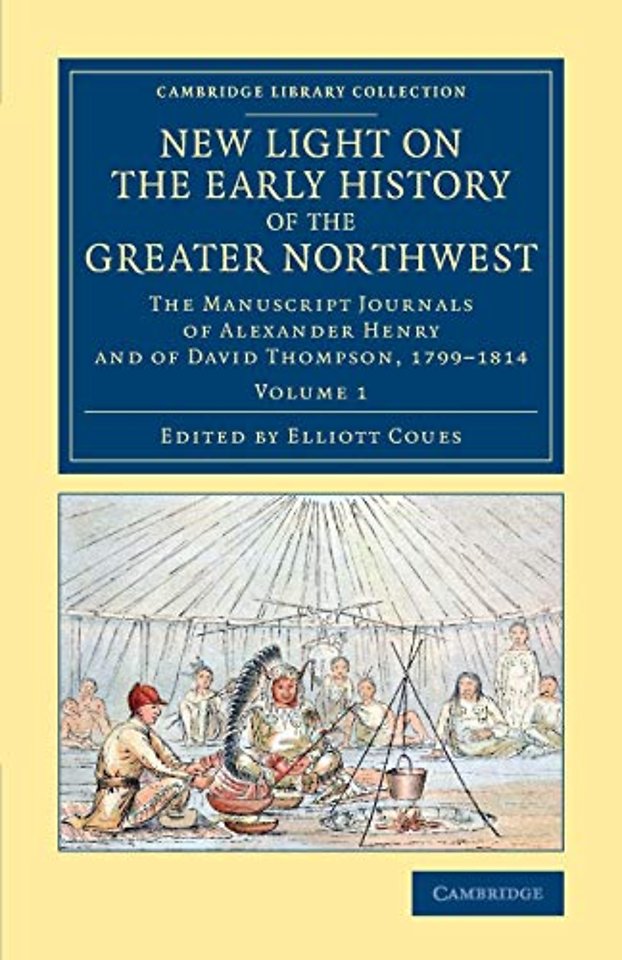
New Light on the Early History of the Greater Northwest
The Manuscript Journals of Alexander Henry and of David Thompson, 1799–1814
Samenvatting
During the 1890s Elliott Coues (1842–1899), one of America's greatest ornithologists, edited several exploration narratives about the American Northwest, including Lewis and Clark's Travels. Coues tracked down the manuscript journals of two of Lewis and Clark's contemporaries, fur trader Alexander Henry (1765–1814) and geographer David Thompson (1770–1857), employees of the Northwest Company. Coues' abridged and edited version of Henry's text, accompanied by notes that draw heavily on Thompson's scientific records, appeared in 1897 in three volumes; in this reissue the index volume is included in Volume 2. Despite the deep prejudice evident in Henry's writing, Coues judged it a reliable account of his unscrupulous business dealings, and of the harsh realities he observed among many different First Nations peoples. Volume 1 covers the period from 1799 to 1808, when Henry travelled along the Red River and set up the Pembina River trading post.