,

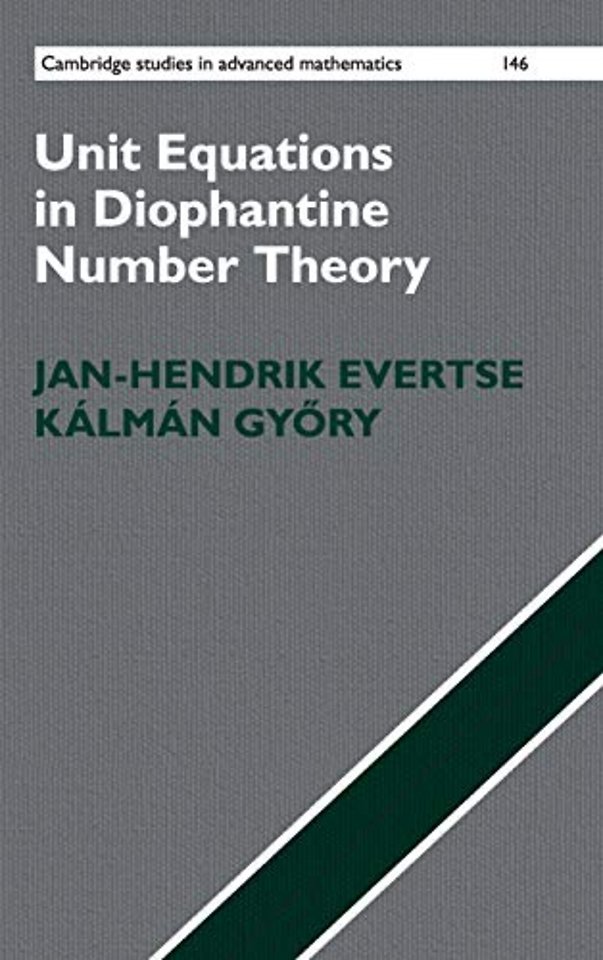
Unit Equations in Diophantine Number Theory

Specificaties
Gebonden, 378 blz. | Engels
Cambridge University Press | e druk, 2015
ISBN13: 9781107097605
Rubricering
Cambridge University Press e druk, 2015 9781107097605
Onderdeel van serie Cambridge Studies in
€ 93,23
Levertijd ongeveer 8 werkdagen

Samenvatting

Diophantine number theory is an active area that has seen tremendous growth over the past century, and in this theory unit equations play a central role. This comprehensive treatment is the first volume devoted to these equations. The authors gather together all the most important results and look at many different aspects, including effective results on unit equations over number fields, estimates on the number of solutions, analogues for function fields and effective results for unit equations over finitely generated domains. They also present a variety of applications. Introductory chapters provide the necessary background in algebraic number theory and function field theory, as well as an account of the required tools from Diophantine approximation and transcendence theory. This makes the book suitable for young researchers as well as experts who are looking for an up-to-date overview of the field.

Specificaties

ISBN13:9781107097605
Taal:Engels
Bindwijze:Gebonden
Aantal pagina's:378

Inhoudsopgave

Preface; Summary; Glossary of frequently used notation; Part I. Preliminaries: 1. Basic algebraic number theory; 2. Algebraic function fields; 3. Tools from Diophantine approximation and transcendence theory; Part II. Unit equations and applications: 4. Effective results for unit equations in two unknowns over number fields; 5. Algorithmic resolution of unit equations in two unknowns; 6. Unit equations in several unknowns; 7. Analogues over function fields; 8. Effective results for unit equations over finitely generated domains; 9. Decomposable form equations; 10. Further applications; References; Index.
€ 93,23
Levertijd ongeveer 8 werkdagen

Rubrieken

    Personen

      Trefwoorden

        Unit Equations in Diophantine Number Theory