Joan M. Harwell,
JM Harwell,
Rebecca Williams Jackson
John Wiley & Sons
3e druk, 2008
9780787997557
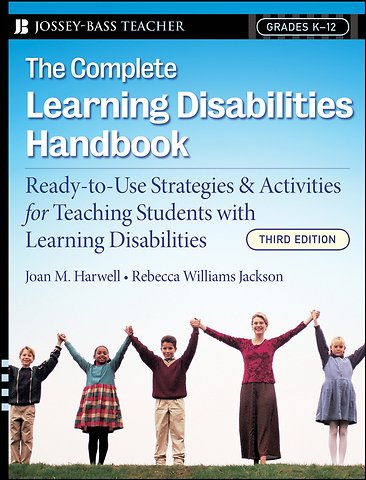
The Complete Learning Disabilities Handbook – Ready–to–Use Strategies and Activities for Teaching Students with Learning Disabilities 3e
Ready–to–Use Strategies and Activities for Teaching Students with Learning Disabilities
Specificaties
Paperback, 416 blz.
|
Engels
John Wiley & Sons |
3e druk, 2008
ISBN13: 9780787997557
Rubricering
Levertijd ongeveer 15 werkdagen
Samenvatting
The third edition of this classic resource is a comprehensive source of information, strategies, and activities for working with learning disabled students. The book offers special educators, classroom teachers, and parents a wealth of new and proven suggestions and ready–to–use materials for helping LD students of all ages learn and perform at their fullest potential.
Specificaties
ISBN13:9780787997557
Taal:Engels
Bindwijze:paperback
Aantal pagina's:416
Uitgever:John Wiley & Sons
Druk:3
Hoofdrubriek:Mens en maatschappij
Inhoudsopgave
<p>Acknowledgments xv<br /><br />About the Authors xvii<br /><br />About This Book xix<br /><br />1 An Overview of the Field of Learning Disabilities 1<br /><br />History of Learning Disabilities 2<br /><br />Causal Factors 6<br /><br />Incidence 8<br /><br />Primary Characteristics of Learning Disabilities 8<br /><br />Comorbid or Co–occurring Conditions 9<br /><br />Attention Deficit Hyperactivity Disorder 9<br /><br />Conduct Disorder 10<br /><br />Tourette Syndrome 10<br /><br />Prognosis 10<br /><br />Programs and Settings for the Learning Disabled 11<br /><br />Facts About Learning Disabilities 12<br /><br />Summary 14<br /><br />List of Major Organizations for the Learning Disabled 14<br /><br />Periodicals on Learning Disabilities 15<br /><br />2 Research in the Field of Learning Disabilities 17<br /><br />Overview of the Brain, Biology, and Behavior 17<br /><br />Brain Injury 20<br /><br />Structural Brain Differences 22<br /><br />Biochemical Infl uences 25<br /><br />Research on Memory 27<br /><br />Research on Metacognition 28<br /><br />Research on Phonological Processing Problems 42<br /><br />Research on Maturation and Retention 43<br /><br />Research on Communication Problems 45<br /><br />Research on Self–Concept, Self–Esteem, and Self–Efficacy 45<br /><br />Research on Teachers Perceptions 46<br /><br />Research on Social Competence and Social Skills Training 46<br /><br />Summary 47<br /><br />3 Understanding the Laws 48<br /><br />Parental Rights 50<br /><br />Parents as Advocates 53<br /><br />Student Rights 53<br /><br />Teacher Rights and Obligations 53<br /><br />Behavioral Goals and Behavioral Improvement Plans 54<br /><br />Student and Parental Rights Regarding Suspension or Expulsion 56<br /><br />Summary 57<br /><br />4 Early Childhood Education for At–Risk Students 58<br /><br />Special Education Services from Birth Through Age Two 62<br /><br />Special Education Services for Children Ages Three Through Five 63<br /><br />Assessment of Young Children 64<br /><br />The Components of an Effective Early Childhood Education Program 65<br /><br />Maturation and Readiness for Kindergarten 66<br /><br />Summary 67<br /><br />5 The Student Study Team Process 68<br /><br />The Case for Early Intervention 69<br /><br />Recognizing the Need 69<br /><br />Talking with Parents 69<br /><br />Parent and Student Preparation for the Student Study Team (SST) 71<br /><br />Predictable Parental Feelings and Reactions 74<br /><br />Initiating a Request for a Student Study Meeting 74<br /><br />The Student Study Team Process 74<br /><br />The Roles of the SST Members 76<br /><br />Digital Classroom Accommodations 83<br /><br />Sensory Accommodations 85<br /><br />6 Formal Assessment and Identifi cation of the Student with Learning Disabilities 86<br /><br />The Multidisciplinary Team Process 86<br /><br />Roles of the Members of the Multidisciplinary Team 87<br /><br />Guidelines for Assessment 88<br /><br />Intellectual Assessment 89<br /><br />Intelligence Quotient (IQ) 89<br /><br />Visual Perception 91<br /><br />Auditory Perception 93<br /><br />Memory 94<br /><br />Academic Assessment 94<br /><br />Commonly Used Tests 95<br /><br />Classroom and Playground Observations 96<br /><br />Time–on–Task Assessment 100<br /><br />Language Assessment 102<br /><br />Health Assessment 103<br /><br />Behavioral Assessment 103<br /><br />Summary 104<br /><br />7 Planning for the Student with Learning Disabilities 110<br /><br />Eligibility Issues 111<br /><br />The Discrepancy Model 113<br /><br />Exclusionary Criteria 114<br /><br />Assessment Scores and Their Implication for Learning 115<br /><br />Eligible or Not Eligible? Developing the Individual Education Plan (IEP) 117<br /><br />Choosing the Appropriate Educational Setting ( Least Restrictive Environment ) 117<br /><br />Determining the Number of Hours 118<br /><br />Writing Appropriate, Measurable Objectives 119<br /><br />The Purpose of Goals 119<br /><br />Dissenting Opinions 120<br /><br />Reviews of the IEP 120<br /><br />The Annual Review 120<br /><br />The Triennial Review 120<br /><br />Special Reviews 120<br /><br />Due Process 120<br /><br />8 Classroom Management for Teachers 127<br /><br />Creating an Attractive and Useful Classroom 127<br /><br />Planning the First Week s Activities 128<br /><br />Behavioral Management Considerations 129<br /><br />Positive Reinforcement 129<br /><br />Rules 130<br /><br />Settling Students After a Recess 132<br /><br />Projecting a Positive Feeling 132<br /><br />Finding Better Ways to Talk to Students 133<br /><br />Preventing Misbehavior 134<br /><br />Keep the Environment Consistent and Structured 134<br /><br />Help Students Succeed 134<br /><br />Use Rewards, Contracts, Tokens, and Reinforcers 135<br /><br />Rewards 135<br /><br />Contracts 136<br /><br />Lotteries 136<br /><br />Token Economies 136<br /><br />Handling Misbehavior 138<br /><br /> Ball in Your Court Technique 139<br /><br />Timeout 139<br /><br />Crisis Management 140<br /><br />Four Types of Challenging Students 140<br /><br />Record Keeping 143<br /><br />Using the Classroom Aide Effectively 144<br /><br />Twenty Tips for Successful Classroom Management 144<br /><br />Sample Approaches to Handling Inappropriate Behaviors 146<br /><br />Summary 149<br /><br />9 Academic Management Considerations 150<br /><br />Curriculum, Setting, and Students Needs 151<br /><br />Getting to Know Your Students Academic Needs Quickly Through Informal Testing 152<br /><br />Goal Setting and Effective Lesson Design 152<br /><br />Planning the School Day 155<br /><br />Planning for Flexibility 156<br /><br />Scheduling and Pacing 156<br /><br />Using a Variety of Activities 156<br /><br />Grouping Students 156<br /><br />Allowing Students Some Choice in Assignments and Rewards 156<br /><br />Transforming Passive Students into Participatory Students 157<br /><br />Overcoming Failure Syndrome 157<br /><br />Planning Cooperative Learning Tasks 158<br /><br />Suggestions for Maximizing Educational Results 159<br /><br />Improving Lesson Results Through Feedback 160<br /><br />Improving Learning Through Specifi c Teaching Techniques 161<br /><br />Tests That Teach 161<br /><br />Story Mapping, Advanced Organizers, and Webs 162<br /><br />Mnemonics 164<br /><br />Use of Higher–Level Thinking Activities 164<br /><br />Issues of Grading and Evaluation 165<br /><br />Tips for Academic Management 166<br /><br />10 Interventions for Specific Problems 168<br /><br />Visual Perceptual Deficits 169<br /><br />Auditory Processing Deficits 172<br /><br />Spatial Awareness Deficits 174<br /><br />Conceptual Deficits 175<br /><br />Memory Deficits 177<br /><br />Students with Poor Work Habits 180<br /><br />Interventions for Other Common LD Classroom Problems 182<br /><br />Students with Poor Social Relationships or Behaviors 185<br /><br />Students with Dyslexia 191<br /><br />Sample History Assignment 193<br /><br />Students with ADD or ADHD 194<br /><br />Medical Treatment of ADD and ADHD 194<br /><br />Behavioral Considerations for Students with ADD or ADHD 196<br /><br />Tips for Classroom Teachers 197<br /><br />11 Reading and the Student with Learning Disabilities 199<br /><br />Who Will Have Trouble Learning to Read? 200<br /><br />Elements of a Balanced Literacy Program 200<br /><br />Phonemic Awareness 201<br /><br />Sample Phonemic Awareness Lesson 1: Kindergarten Grade 1 202<br /><br />Sample Phonemic Awareness Lesson 2: Kindergarten Grade 1 203<br /><br />Sample Phonemic Awareness Lesson 3: Grades 1 2 (Instructional Level) 205<br /><br />Sample Phonemic Awareness Lesson 4: Any Grade to High School 206<br /><br />A Step–by–Step Guide for Teaching Reading to Students with Learning Disabilities 207<br /><br />Letter Recognition and Sound Knowledge 210<br /><br />Working with the Nonreader 211<br /><br />Working with the Emergent Reader 216<br /><br />Materials for Beginning and Emergent Readers 218<br /><br />Working with the Guided Reader 220<br /><br />Tips for Teaching Reading 228<br /><br />12 Writing, Spelling, and Speaking 256<br /><br />Printing 259<br /><br />Teaching the Mechanics of Writing 260<br /><br />Sample Interactive Writing Lesson (Instructional Level 1.3) 262<br /><br />Sample Writing Lesson (Instructional Level 2.5) 265<br /><br />Spelling for Young Students with Learning Disabilities 266<br /><br />Materials 266<br /><br />Methods 267<br /><br />Speaking Activities for Young Students with Learning Disabilities 270<br /><br />Handwriting Skills for Older Students with Learning Disabilities 271<br /><br />The Mechanics of Writing for Older Students with Learning Disabilities 274<br /><br />Letter Writing 277<br /><br />E–mails and Digital Communication 278<br /><br />Report Writing 278<br /><br />Journal Writing 279<br /><br />Spelling Activities for Older Students with Learning Disabilities 280<br /><br />Speaking Opportunities for Older Students with Learning Disabilities 285<br /><br />Sample Lesson: Recognizing Nouns 286<br /><br />Sample Lesson: Recognizing Verbs 288<br /><br />Writing Activities 290<br /><br />My Accident 291<br /><br />Title of My Story 292<br /><br />13 Teaching Mathematically Challenged Students 297<br /><br />Diagnosing a Student s Difficulties 297<br /><br />Teaching Techniques 299<br /><br />Levels of Understanding: Concrete, Representational, and Abstract 299<br /><br />Incorporating Reading into the Math Curriculum 303<br /><br />Teaching Specific Skills 305<br /><br />Counting Symbols and One–to–One Correspondence 305<br /><br />Beginning Addition 306<br /><br />Counting and Understanding the Numbers 0 100 307<br /><br />Recognizing and Counting Coins 309<br /><br />Place Value: Ones and Tens Place 309<br /><br />Counting by Fives 311<br /><br />Time by the Hour 312<br /><br />Time by Hour and Minute 312<br /><br />Beginning Subtraction 314<br /><br />Doing and Undoing: Plus and Minus 314<br /><br />Building Numbers 316<br /><br />Addition and Regrouping 317<br /><br />More and Less 317<br /><br />Simple Story Problems 318<br /><br />Subtraction With and Without Regrouping 318<br /><br />Rounding Numbers to the Nearest 10 or Nearest 100 320<br /><br />Recognizing and Spelling Number Words 320<br /><br />Place Value Through Thousands 323<br /><br />Linear Measurement 323<br /><br />Simple Multiplication Techniques 324<br /><br />Simple Division Techniques 327<br /><br />Doing and Undoing (Multiplication and Division) 327<br /><br />Liquid Measurement 328<br /><br />Fractions 328<br /><br />Estimating 331<br /><br />More Complex Story Problems 331<br /><br />More Complex Division 332<br /><br />Relating Fractions to Decimals 332<br /><br />Making Change 333<br /><br />Summary 333<br /><br />14 Adolescents and Adults with Learning Disabilities 335<br /><br />Understanding the Changing Needs of the Adolescent 335<br /><br />School Changes 335<br /><br />Physical Changes 336<br /><br />Efforts to Engage the Junior High Student in the Educational Process 337<br /><br />Departmentalization (School Within a School) 337<br /><br />Personal Efforts of Individual Teachers 338<br /><br />Curriculum for the Junior High School 339<br /><br />Basic Skills 340<br /><br />Strategies to Increase Metacognition and Learning 341<br /><br />The Art of Counseling Adolescent Students 341<br /><br />Teaching Students to Be Their Own Advocates 343<br /><br />Transition IEPs 346<br /><br />Understanding the Needs of the High School Student with Learning Disabilities 346<br /><br />Work–Study Program 347<br /><br />Continuation Schools and Independent Study Programs 348<br /><br />Life and Social Skills 348<br /><br />Understanding the Needs of the Young Adult with Learning Disabilities 348<br /><br />Services Available to Students Going to College 350<br /><br />Vocational Rehabilitation Services for the Learning Disabled 351<br /><br />Adult Education Opportunities 351<br /><br />15 The Role of the Family 352<br /><br />The Role of Parents as Parents 352<br /><br />The Home Environment 353<br /><br />Providing Worthwhile Activities 354<br /><br />The Role of Parents as Teachers 354<br /><br />Supervision of Homework 354<br /><br />Helping at School 356<br /><br />The Role of Parents as Advocates 356<br /><br />Tips for Helping Your Child 357<br /><br />16 Education in the New Millennium 359<br /><br />Increased Mainstreaming 359<br /><br />Increased Use of Technology 360<br /><br />Class Size 361<br /><br />Teacher Preparation Trends and Issues 362<br /><br />Professional Salaries and Working Conditions 362<br /><br />Conclusion 363<br /><br />References 365<br /><br />Further Reading 373<br /><br />Index 377</p>
Anderen die dit kochten, kochten ook
-
 Jitske Kramer€ 27,50
 -
Farid Tabarki€ 24,99
-
Joris Krijger€ 22,99
-
David Mandel€ 36,50
-
Lucho Rubio Repáraz€ 37,50
-
Pieter Cobelens€ 7,50