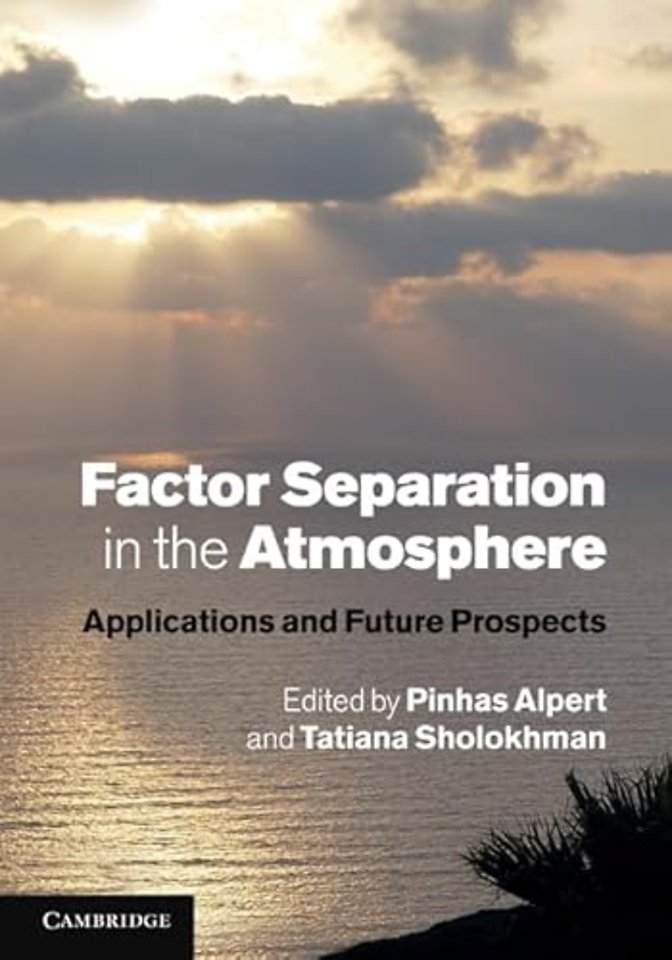
,

Factor Separation in the Atmosphere

Applications and Future Prospects

Specificaties
Gebonden, 292 blz. | Engels
Cambridge University Press | e druk, 2011
ISBN13: 9780521191739
Rubricering
Cambridge University Press e druk, 2011 9780521191739
€ 125,26
Levertijd ongeveer 8 werkdagen

Samenvatting

Modeling atmospheric processes in order to forecast the weather or future climate change is an extremely complex and computationally intensive undertaking. One of the main difficulties is that there are a huge number of factors that need to be taken into account, some of which are still poorly understood. The Factor Separation (FS) method is a computational procedure that helps deal with these nonlinear factors. In recent years many scientists have applied FS methodology to a range of modeling problems, including paleoclimatology, limnology, regional climate change, rainfall analysis, cloud modeling, pollution, crop growth, and other forecasting applications. This book is the first to describe the fundamentals of the method, and to bring together its many applications in the atmospheric sciences. The main audience is researchers and graduate students using the FS method, but it is also of interest to advanced students, researchers, and professionals across the atmospheric sciences.

Specificaties

ISBN13:9780521191739
Taal:Engels
Bindwijze:Gebonden
Aantal pagina's:292

Inhoudsopgave

1. Introduction Pinhas Alpert; 2. The Factor Separation method and the fractional approach Pinhas Alpert and Tatiana Sholokhman; 3. Investigation of the FS features for basic mathematical functions Pinhas Alpert and Tatiana Sholokhman; 4. Factor Separation and paleoclimates André Berger, Martin Claussen and Qiuzhen Yin; 5. Meso-meteorology: Factor Separation examples in atmospheric meso-scale motions Pinhas Alpert; 6. Using the Factor Separation method for land-use land-cover change impacts on weather and climate process with the Regional Atmospheric Modeling System Adriana Beltrán-Przekurat, Roger A. Piekle, Sr, Joseph L. Eastman, Gemma T. Narisma, A. J. Pitman, Ming Lei and Dev Niyogi; 7. Application of Factor Separation to heavy rainfall and cyclogenesis: Mediterranean examples Romu Romero; 8. Experience in applying Factor Separation analysis to assessing urban land-use and aerosol impacts on precipitation Susan C. van den Heever, Christopher M. Rozoff and William R. Cotton; 9. Free and forced thermocline oscillations in Lake Tanganyika Olivier Gourgue, Eric Deleersnijder, Vincent Legat, Emmanuel Marchal and Laurent White; 10. Application of the Factor Separation method to quantify the effect of waste heat, vapour and pollution on cumulus convection Gerhard W. Reuter; 11. The use of Factor Separation method for climate variable interaction studies in hydrological land surface models and crop yield models Dev Niyogi, R. Mera, Yongkang Xue, G. Wilkerson and F. Booker; 12. Linear model for the sea breeze Tatiana Sholokhman and Pinhas Alpert; 13. Experience and conclusions from the Factor Separation method: ensemble data assimilation and forecasting applications Dorita Rostkier-Edelstein and Joshua P. Hacker; 14. Tagging systematic errors arising from different components of dynamics and physics in forecast models T. N. Krishnamurti and Vinay Kumar; 15. Some difficulties and prospects Pinhas Alpert and Tatiana Sholokhman; 16. Summary Pinhas Alpert; Index.
€ 125,26
Levertijd ongeveer 8 werkdagen

Rubrieken

    Personen

      Trefwoorden

        Factor Separation in the Atmosphere