Perumal (University of Wales Swansea, UK) Nithiarasu,
P Nithiarasu,
Roland W. (University College, Swansea) Lewis,
Kankanhalli N. (Indian Institute of Technology, Madras, India) Seetharamu
e.a.
John Wiley & Sons
2e druk, 2016
9780470756256
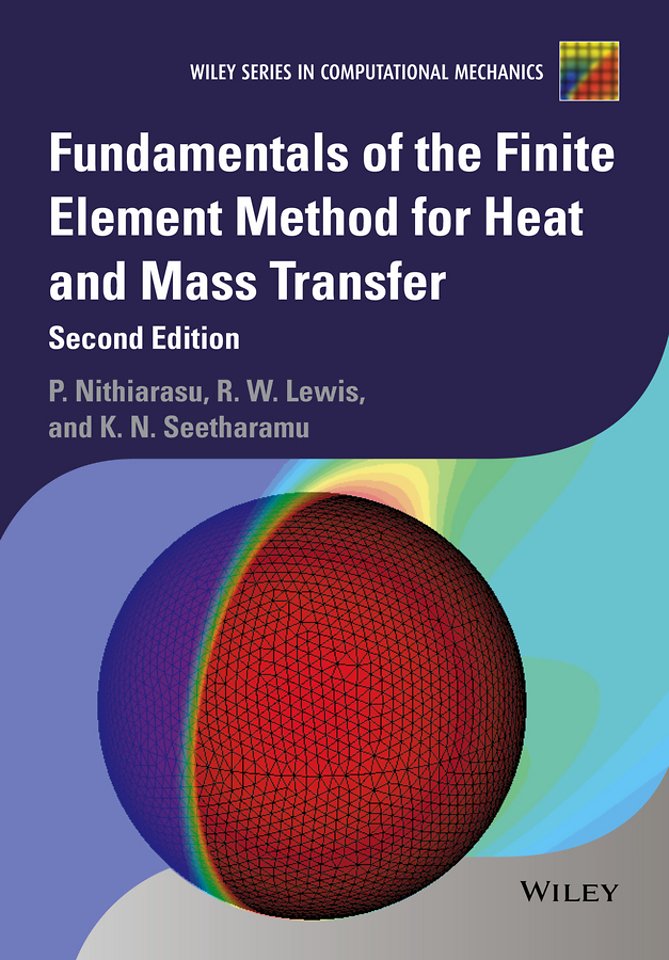
Fundamentals of the Finite Element Method for Heat and Mass Transfer 2e
Specificaties
Gebonden, 464 blz.
|
Engels
John Wiley & Sons |
2e druk, 2016
ISBN13: 9780470756256
Rubricering
Onderdeel van serie
Wiley Series in Computational Mechanics
Levertijd ongeveer 8 werkdagen
Samenvatting
Fundamentals of the Finite Element Method for Heat and Mass Transfer, Second Edition is a comprehensively updated new edition and is a unique book on the application of the finite element method to heat and mass transfer.
Addresses fundamentals, applications and computer implementation
Educational computer codes are freely available to download, modify and use
Includes a large number of worked examples and exercises
Fills the gap between learning and research
Specificaties
ISBN13:9780470756256
Taal:Engels
Bindwijze:gebonden
Aantal pagina's:464
Uitgever:John Wiley & Sons
Druk:2
Inhoudsopgave
Preface to the Second Edition xii
<p>Series Editor s Preface xiv</p>
<p>1 Introduction 1</p>
<p>1.1 Importance of Heat and Mass Transfer 1</p>
<p>1.2 Heat Transfer Modes 2</p>
<p>1.3 The Laws of Heat Transfer 3</p>
<p>1.4 Mathematical Formulation of Some Heat Transfer Problems 5</p>
<p>1.4.1 Heat Transfer from a Plate Exposed to Solar Heat Flux 5</p>
<p>1.4.2 Incandescent Lamp 7</p>
<p>1.4.3 Systems with a Relative Motion and Internal Heat Generation 8</p>
<p>1.5 Heat Conduction Equation 10</p>
<p>1.6 Mass Transfer 13</p>
<p>1.7 Boundary and Initial Conditions 13</p>
<p>1.8 Solution Methodology 15</p>
<p>1.9 Summary 15</p>
<p>1.10 Exercises 16</p>
<p>References 17</p>
<p>2 Some Basic Discrete Systems 19</p>
<p>2.1 Introduction 19</p>
<p>2.2 Steady–state Problems 20</p>
<p>2.2.1 Heat Flow in a Composite Slab 20</p>
<p>2.2.2 Fluid Flow Network 23</p>
<p>2.2.3 Heat Transfer in Heat Sinks 26</p>
<p>2.3 Transient Heat Transfer Problem 28</p>
<p>2.4 Summary 31</p>
<p>2.5 Exercises 31</p>
<p>References 36</p>
<p>3 The Finite Element Method 39</p>
<p>3.1 Introduction 39</p>
<p>3.2 Elements and Shape Functions 42</p>
<p>3.2.1 One–dimensional Linear Element 43</p>
<p>3.2.2 One–dimensional Quadratic Element 46</p>
<p>3.2.3 Two–dimensional Linear Triangular Element 49</p>
<p>3.2.4 Area Coordinates 53</p>
<p>3.2.5 Quadratic Triangular Element 55</p>
<p>3.2.6 Two–dimensional Quadrilateral Elements 58</p>
<p>3.2.7 Isoparametric Elements 63</p>
<p>3.2.8 Three–dimensional Elements 72</p>
<p>3.3 Formulation (Element Characteristics) 76</p>
<p>3.3.1 Ritz Method (Heat Balance Integral Method Goodman s Method) 78</p>
<p>3.3.2 Rayleigh Ritz Method (Variational Method) 79</p>
<p>3.3.3 The Method of Weighted Residuals 82</p>
<p>3.3.4 Galerkin Finite ElementMethod 86</p>
<p>3.4 Formulation for the Heat Conduction Equation 89</p>
<p>3.4.1 Variational Approach 90</p>
<p>3.4.2 The GalerkinMethod 93</p>
<p>3.5 Requirements for Interpolation Functions 94</p>
<p>3.6 Summary 100</p>
<p>3.7 Exercises 100</p>
<p>References 102</p>
<p>4 Steady–State Heat Conduction in One–dimension 105</p>
<p>4.1 Introduction 105</p>
<p>4.2 PlaneWalls 105</p>
<p>4.2.1 Homogeneous Wall 105</p>
<p>4.2.2 CompositeWall 107</p>
<p>4.2.3 Finite Element Discretization 108</p>
<p>4.2.4 Wall with Varying Cross–sectional Area 110</p>
<p>4.2.5 Plane Wall with a Heat Source: Solution by Linear Elements 112</p>
<p>4.2.6 Plane Wall with Heat Source: Solution by Quadratic Elements 115</p>
<p>4.2.7 Plane Wall with a Heat Source: Solution by Modified Quadratic Equations (Static Condensation) 117</p>
<p>4.3 Radial Heat Conduction in a Cylinder Wall 118</p>
<p>4.4 Solid Cylinder with Heat Source 120</p>
<p>4.5 Conduction Convection Systems 123</p>
<p>4.6 Summary 126</p>
<p>4.7 Exercises 127</p>
<p>References 129</p>
<p>5 Steady–state Heat Conduction in Multi–dimensions 131</p>
<p>5.1 Introduction 131</p>
<p>5.2 Two–dimensional Plane Problems 132</p>
<p>5.2.1 Triangular Elements 132</p>
<p>5.3 Rectangular Elements 142</p>
<p>5.4 Plate with Variable Thickness 145</p>
<p>5.5 Three–dimensional Problems 146</p>
<p>5.6 Axisymmetric Problems 148</p>
<p>5.6.1 Galerkin Method for Linear Triangular Axisymmetric Elements 150</p>
<p>5.7 Summary 153</p>
<p>5.8 Exercises 153</p>
<p>References 155</p>
<p>6 Transient Heat Conduction Analysis 157</p>
<p>6.1 Introduction 157</p>
<p>6.2 Lumped Heat Capacity System 157</p>
<p>6.3 Numerical Solution 159</p>
<p>6.3.1 Transient Governing Equations and Boundary and Initial Conditions 159</p>
<p>6.3.2 The GalerkinMethod 160</p>
<p>6.4 One–dimensional Transient State Problem 162</p>
<p>6.4.1 Time Discretization–Finite Difference Method (FDM) 163</p>
<p>6.4.2 Time Discretization–Finite ElementMethod (FEM) 168</p>
<p>6.5 Stability 169</p>
<p>6.6 Multi–dimensional Transient Heat Conduction 169</p>
<p>6.7 Summary 171</p>
<p>6.8 Exercises 171</p>
<p>References 173</p>
<p>7 Laminar Convection Heat Transfer 175</p>
<p>7.1 Introduction 175</p>
<p>7.1.1 Types of Fluid Motion Assisted Heat Transport 176</p>
<p>7.2 Navier–Stokes Equations 177</p>
<p>7.2.1 Conservation of Mass or Continuity Equation 177</p>
<p>7.2.2 Conservation ofMomentum 179</p>
<p>7.2.3 Energy Equation 183</p>
<p>7.3 Nondimensional Form of the Governing Equations 184</p>
<p>7.4 The Transient Convection–Diffusion Problem 188</p>
<p>7.4.1 Finite Element Solution to the Convection–Diffusion Equation 189</p>
<p>7.4.2 A Simple Characteristic Galerkin Method for Convection–Diffusion Equation 191</p>
<p>7.4.3 Extension to Multi–dimensions 197</p>
<p>7.5 Stability Conditions 202</p>
<p>7.6 Characteristic Based Split (CBS) Scheme 202</p>
<p>7.6.1 Spatial Discretization 208</p>
<p>7.6.2 Time–step Calculation 211</p>
<p>7.6.3 Boundary and Initial Conditions 211</p>
<p>7.6.4 Steady and Transient Solution Methods 213</p>
<p>7.7 Artificial Compressibility Scheme 214</p>
<p>7.8 Nusselt Number, Drag and Stream Function 215</p>
<p>7.8.1 Nusselt Number 215</p>
<p>7.8.2 Drag Calculation 216</p>
<p>7.8.3 Stream Function 217</p>
<p>7.9 Mesh Convergence 218</p>
<p>7.10 Laminar Isothermal Flow 219</p>
<p>7.11 Laminar Nonisothermal Flow 231</p>
<p>7.11.1 Forced Convection Heat Transfer 232</p>
<p>7.11.2 Buoyancy–driven Convection Heat Transfer 238</p>
<p>7.11.3 Mixed Convection Heat Transfer 240</p>
<p>7.12 Extension to Axisymmetric Problems 243</p>
<p>7.13 Summary 246</p>
<p>7.14 Exercises 247</p>
<p>References 249</p>
<p>8 Turbulent Flow and Heat Transfer 253</p>
<p>8.1 Introduction 253</p>
<p>8.1.1 Time Averaging 254</p>
<p>8.1.2 Relationship between , , T and T 256</p>
<p>8.2 Treatment of Turbulent Flows 257</p>
<p>8.2.1 Reynolds Averaged Navier–Stokes (RANS) 257</p>
<p>8.2.2 One–equation Models 258</p>
<p>8.2.3 Two–equation Models 259</p>
<p>8.2.4 Nondimensional Form of the Governing Equations 260</p>
<p>8.3 Solution Procedure 262</p>
<p>8.4 Forced Convective Flow and Heat Transfer 263</p>
<p>8.5 Buoyancy–driven Flow 272</p>
<p>8.6 Other Methods for Turbulence 275</p>
<p>8.6.1 Large Eddy Simulation (LES) 275</p>
<p>8.7 Detached Eddy Simulation (DES) and Monotonically Integrated LES (MILES)278</p>
<p>8.8 Direct Numerical Simulation (DNS) 278</p>
<p>8.9 Summary 279</p>
<p>References 279</p>
<p>9 Heat Exchangers 281</p>
<p>9.1 Introduction 281</p>
<p>9.2 LMTD and Effectiveness–NTU Methods 283</p>
<p>9.2.1 LMTD Method 283</p>
<p>9.2.2 Effectiveness NTU Method 285</p>
<p>9.3 Computational Approaches 286</p>
<p>9.3.1 System Analysis 286</p>
<p>9.3.2 Finite Element Solution to Differential Equations 289</p>
<p>9.4 Analysis of Heat Exchanger Passages . 289</p>
<p>9.5 Challenges 297</p>
<p>9.6 Summary 299</p>
<p>References 299</p>
<p>10 Mass Transfer 301</p>
<p>10.1 Introduction 301</p>
<p>10.2 Conservation of Species 302</p>
<p>10.2.1 Nondimensional Form 304</p>
<p>10.2.2 Buoyancy–driven Mass Transfer 305</p>
<p>10.2.3 Double–diffusive Natural Convection 306</p>
<p>10.3 Numerical Solution 307</p>
<p>10.4 TurbulentMass Transport 317</p>
<p>10.5 Summary 319</p>
<p>References 319</p>
<p>11 Convection Heat and Mass Transfer in Porous Media 321</p>
<p>11.1 Introduction 321</p>
<p>11.2 Generalized Porous Medium Flow Approach 324</p>
<p>11.2.1 Nondimensional Scales 327</p>
<p>11.2.2 Limiting Cases 329</p>
<p>11.3 Discretization Procedure 329</p>
<p>11.3.1 Temporal Discretization 330</p>
<p>11.3.2 Spatial Discretization 331</p>
<p>11.3.3 Semi– and Quasi–Implicit Forms 332</p>
<p>11.4 Nonisothermal Flows 333</p>
<p>11.5 PorousMedium–Fluid Interface 342</p>
<p>11.6 Double–diffusive Convection 347</p>
<p>11.7 Summary 349</p>
<p>References 349</p>
<p>12 Solidification 353</p>
<p>12.1 Introduction 353</p>
<p>12.2 Solidification via Heat Conduction 354</p>
<p>12.2.1 The Governing Equations 354</p>
<p>12.2.2 Enthalpy Formulation 354</p>
<p>12.3 Convection During Solidification 356</p>
<p>12.3.1 Governing Equations and Discretization 358</p>
<p>12.4 Summary 363</p>
<p>References 364</p>
<p>13 Heat and Mass Transfer in Fuel Cells 365</p>
<p>13.1 Introduction 365</p>
<p>13.1.1 Fuel Cell Types 367</p>
<p>13.2 Mathematical Model 368</p>
<p>13.2.1 Anodic and Cathodic Compartments 371</p>
<p>13.2.2 Electrolyte Compartment 373</p>
<p>13.3 Numerical Solution Algorithms 373</p>
<p>13.3.1 Finite ElementModeling of SOFC 374</p>
<p>13.4 Summary 378</p>
<p>References 378</p>
<p>14 An Introduction to Mesh Generation and Adaptive Finite Element Methods 379</p>
<p>14.1 Introduction 379</p>
<p>14.2 Mesh Generation 380</p>
<p>14.2.1 Advancing Front Technique (AFT) 381</p>
<p>14.2.2 Delaunay Triangulation 382</p>
<p>14.2.3 Mesh Cosmetics 387</p>
<p>14.3 Boundary Grid Generation 390</p>
<p>14.3.1 Boundary Grid for a Planar Domain 390</p>
<p>14.3.2 NURBS Patches 391</p>
<p>14.4 Adaptive Refinement Methods 392</p>
<p>14.5 Simple Error Estimation and Mesh Refinement 393</p>
<p>14.5.1 Heat Conduction 394</p>
<p>14.6 Interpolation Error Based Refinement 397</p>
<p>14.6.1 Anisotropic Adaptive Procedure 398</p>
<p>14.6.2 Choice of Variables and Adaptivity 399</p>
<p>14.7 Summary 401</p>
<p>References 402</p>
<p>15 Implementation of Computer Code 405</p>
<p>15.1 Introduction 405</p>
<p>15.2 Preprocessing 406</p>
<p>15.2.1 Mesh Generation 406</p>
<p>15.2.2 Linear Triangular Element Data 408</p>
<p>15.2.3 Element Area Calculation 409</p>
<p>15.2.4 Shape Functions and Their Derivatives 410</p>
<p>15.2.5 Boundary Normal Calculation 411</p>
<p>15.2.6 MassMatrix and Mass Lumping 412</p>
<p>15.2.7 Implicit Pressure or Heat Conduction Matrix 414</p>
<p>15.3 Main Unit 416</p>
<p>15.3.1 Time–step Calculation 416</p>
<p>15.3.2 Element Loop and Assembly 419</p>
<p>15.3.3 Updating Solution 420</p>
<p>15.3.4 Boundary Conditions 421</p>
<p>15.3.5 Monitoring Steady State 422</p>
<p>15.4 Postprocessing 423</p>
<p>15.4.1 Interpolation of Data 424</p>
<p>15.5 Summary 424</p>
<p>References 424</p>
<p>A Gaussian Elimination 425</p>
<p>Reference 426</p>
<p>B Green s Lemma 427</p>
<p>C Integration Formulae 429</p>
<p>C.1 Linear Triangles 429</p>
<p>C.2 Linear Tetrahedron 429</p>
<p>D Finite Element Assembly Procedure 431</p>
<p>E Simplified Form of the Navier Stokes Equations 435</p>
<p>F Calculating Nodal Values of Second Derivatives 437</p>
<p>Index 439</p>
<p>Series Editor s Preface xiv</p>
<p>1 Introduction 1</p>
<p>1.1 Importance of Heat and Mass Transfer 1</p>
<p>1.2 Heat Transfer Modes 2</p>
<p>1.3 The Laws of Heat Transfer 3</p>
<p>1.4 Mathematical Formulation of Some Heat Transfer Problems 5</p>
<p>1.4.1 Heat Transfer from a Plate Exposed to Solar Heat Flux 5</p>
<p>1.4.2 Incandescent Lamp 7</p>
<p>1.4.3 Systems with a Relative Motion and Internal Heat Generation 8</p>
<p>1.5 Heat Conduction Equation 10</p>
<p>1.6 Mass Transfer 13</p>
<p>1.7 Boundary and Initial Conditions 13</p>
<p>1.8 Solution Methodology 15</p>
<p>1.9 Summary 15</p>
<p>1.10 Exercises 16</p>
<p>References 17</p>
<p>2 Some Basic Discrete Systems 19</p>
<p>2.1 Introduction 19</p>
<p>2.2 Steady–state Problems 20</p>
<p>2.2.1 Heat Flow in a Composite Slab 20</p>
<p>2.2.2 Fluid Flow Network 23</p>
<p>2.2.3 Heat Transfer in Heat Sinks 26</p>
<p>2.3 Transient Heat Transfer Problem 28</p>
<p>2.4 Summary 31</p>
<p>2.5 Exercises 31</p>
<p>References 36</p>
<p>3 The Finite Element Method 39</p>
<p>3.1 Introduction 39</p>
<p>3.2 Elements and Shape Functions 42</p>
<p>3.2.1 One–dimensional Linear Element 43</p>
<p>3.2.2 One–dimensional Quadratic Element 46</p>
<p>3.2.3 Two–dimensional Linear Triangular Element 49</p>
<p>3.2.4 Area Coordinates 53</p>
<p>3.2.5 Quadratic Triangular Element 55</p>
<p>3.2.6 Two–dimensional Quadrilateral Elements 58</p>
<p>3.2.7 Isoparametric Elements 63</p>
<p>3.2.8 Three–dimensional Elements 72</p>
<p>3.3 Formulation (Element Characteristics) 76</p>
<p>3.3.1 Ritz Method (Heat Balance Integral Method Goodman s Method) 78</p>
<p>3.3.2 Rayleigh Ritz Method (Variational Method) 79</p>
<p>3.3.3 The Method of Weighted Residuals 82</p>
<p>3.3.4 Galerkin Finite ElementMethod 86</p>
<p>3.4 Formulation for the Heat Conduction Equation 89</p>
<p>3.4.1 Variational Approach 90</p>
<p>3.4.2 The GalerkinMethod 93</p>
<p>3.5 Requirements for Interpolation Functions 94</p>
<p>3.6 Summary 100</p>
<p>3.7 Exercises 100</p>
<p>References 102</p>
<p>4 Steady–State Heat Conduction in One–dimension 105</p>
<p>4.1 Introduction 105</p>
<p>4.2 PlaneWalls 105</p>
<p>4.2.1 Homogeneous Wall 105</p>
<p>4.2.2 CompositeWall 107</p>
<p>4.2.3 Finite Element Discretization 108</p>
<p>4.2.4 Wall with Varying Cross–sectional Area 110</p>
<p>4.2.5 Plane Wall with a Heat Source: Solution by Linear Elements 112</p>
<p>4.2.6 Plane Wall with Heat Source: Solution by Quadratic Elements 115</p>
<p>4.2.7 Plane Wall with a Heat Source: Solution by Modified Quadratic Equations (Static Condensation) 117</p>
<p>4.3 Radial Heat Conduction in a Cylinder Wall 118</p>
<p>4.4 Solid Cylinder with Heat Source 120</p>
<p>4.5 Conduction Convection Systems 123</p>
<p>4.6 Summary 126</p>
<p>4.7 Exercises 127</p>
<p>References 129</p>
<p>5 Steady–state Heat Conduction in Multi–dimensions 131</p>
<p>5.1 Introduction 131</p>
<p>5.2 Two–dimensional Plane Problems 132</p>
<p>5.2.1 Triangular Elements 132</p>
<p>5.3 Rectangular Elements 142</p>
<p>5.4 Plate with Variable Thickness 145</p>
<p>5.5 Three–dimensional Problems 146</p>
<p>5.6 Axisymmetric Problems 148</p>
<p>5.6.1 Galerkin Method for Linear Triangular Axisymmetric Elements 150</p>
<p>5.7 Summary 153</p>
<p>5.8 Exercises 153</p>
<p>References 155</p>
<p>6 Transient Heat Conduction Analysis 157</p>
<p>6.1 Introduction 157</p>
<p>6.2 Lumped Heat Capacity System 157</p>
<p>6.3 Numerical Solution 159</p>
<p>6.3.1 Transient Governing Equations and Boundary and Initial Conditions 159</p>
<p>6.3.2 The GalerkinMethod 160</p>
<p>6.4 One–dimensional Transient State Problem 162</p>
<p>6.4.1 Time Discretization–Finite Difference Method (FDM) 163</p>
<p>6.4.2 Time Discretization–Finite ElementMethod (FEM) 168</p>
<p>6.5 Stability 169</p>
<p>6.6 Multi–dimensional Transient Heat Conduction 169</p>
<p>6.7 Summary 171</p>
<p>6.8 Exercises 171</p>
<p>References 173</p>
<p>7 Laminar Convection Heat Transfer 175</p>
<p>7.1 Introduction 175</p>
<p>7.1.1 Types of Fluid Motion Assisted Heat Transport 176</p>
<p>7.2 Navier–Stokes Equations 177</p>
<p>7.2.1 Conservation of Mass or Continuity Equation 177</p>
<p>7.2.2 Conservation ofMomentum 179</p>
<p>7.2.3 Energy Equation 183</p>
<p>7.3 Nondimensional Form of the Governing Equations 184</p>
<p>7.4 The Transient Convection–Diffusion Problem 188</p>
<p>7.4.1 Finite Element Solution to the Convection–Diffusion Equation 189</p>
<p>7.4.2 A Simple Characteristic Galerkin Method for Convection–Diffusion Equation 191</p>
<p>7.4.3 Extension to Multi–dimensions 197</p>
<p>7.5 Stability Conditions 202</p>
<p>7.6 Characteristic Based Split (CBS) Scheme 202</p>
<p>7.6.1 Spatial Discretization 208</p>
<p>7.6.2 Time–step Calculation 211</p>
<p>7.6.3 Boundary and Initial Conditions 211</p>
<p>7.6.4 Steady and Transient Solution Methods 213</p>
<p>7.7 Artificial Compressibility Scheme 214</p>
<p>7.8 Nusselt Number, Drag and Stream Function 215</p>
<p>7.8.1 Nusselt Number 215</p>
<p>7.8.2 Drag Calculation 216</p>
<p>7.8.3 Stream Function 217</p>
<p>7.9 Mesh Convergence 218</p>
<p>7.10 Laminar Isothermal Flow 219</p>
<p>7.11 Laminar Nonisothermal Flow 231</p>
<p>7.11.1 Forced Convection Heat Transfer 232</p>
<p>7.11.2 Buoyancy–driven Convection Heat Transfer 238</p>
<p>7.11.3 Mixed Convection Heat Transfer 240</p>
<p>7.12 Extension to Axisymmetric Problems 243</p>
<p>7.13 Summary 246</p>
<p>7.14 Exercises 247</p>
<p>References 249</p>
<p>8 Turbulent Flow and Heat Transfer 253</p>
<p>8.1 Introduction 253</p>
<p>8.1.1 Time Averaging 254</p>
<p>8.1.2 Relationship between , , T and T 256</p>
<p>8.2 Treatment of Turbulent Flows 257</p>
<p>8.2.1 Reynolds Averaged Navier–Stokes (RANS) 257</p>
<p>8.2.2 One–equation Models 258</p>
<p>8.2.3 Two–equation Models 259</p>
<p>8.2.4 Nondimensional Form of the Governing Equations 260</p>
<p>8.3 Solution Procedure 262</p>
<p>8.4 Forced Convective Flow and Heat Transfer 263</p>
<p>8.5 Buoyancy–driven Flow 272</p>
<p>8.6 Other Methods for Turbulence 275</p>
<p>8.6.1 Large Eddy Simulation (LES) 275</p>
<p>8.7 Detached Eddy Simulation (DES) and Monotonically Integrated LES (MILES)278</p>
<p>8.8 Direct Numerical Simulation (DNS) 278</p>
<p>8.9 Summary 279</p>
<p>References 279</p>
<p>9 Heat Exchangers 281</p>
<p>9.1 Introduction 281</p>
<p>9.2 LMTD and Effectiveness–NTU Methods 283</p>
<p>9.2.1 LMTD Method 283</p>
<p>9.2.2 Effectiveness NTU Method 285</p>
<p>9.3 Computational Approaches 286</p>
<p>9.3.1 System Analysis 286</p>
<p>9.3.2 Finite Element Solution to Differential Equations 289</p>
<p>9.4 Analysis of Heat Exchanger Passages . 289</p>
<p>9.5 Challenges 297</p>
<p>9.6 Summary 299</p>
<p>References 299</p>
<p>10 Mass Transfer 301</p>
<p>10.1 Introduction 301</p>
<p>10.2 Conservation of Species 302</p>
<p>10.2.1 Nondimensional Form 304</p>
<p>10.2.2 Buoyancy–driven Mass Transfer 305</p>
<p>10.2.3 Double–diffusive Natural Convection 306</p>
<p>10.3 Numerical Solution 307</p>
<p>10.4 TurbulentMass Transport 317</p>
<p>10.5 Summary 319</p>
<p>References 319</p>
<p>11 Convection Heat and Mass Transfer in Porous Media 321</p>
<p>11.1 Introduction 321</p>
<p>11.2 Generalized Porous Medium Flow Approach 324</p>
<p>11.2.1 Nondimensional Scales 327</p>
<p>11.2.2 Limiting Cases 329</p>
<p>11.3 Discretization Procedure 329</p>
<p>11.3.1 Temporal Discretization 330</p>
<p>11.3.2 Spatial Discretization 331</p>
<p>11.3.3 Semi– and Quasi–Implicit Forms 332</p>
<p>11.4 Nonisothermal Flows 333</p>
<p>11.5 PorousMedium–Fluid Interface 342</p>
<p>11.6 Double–diffusive Convection 347</p>
<p>11.7 Summary 349</p>
<p>References 349</p>
<p>12 Solidification 353</p>
<p>12.1 Introduction 353</p>
<p>12.2 Solidification via Heat Conduction 354</p>
<p>12.2.1 The Governing Equations 354</p>
<p>12.2.2 Enthalpy Formulation 354</p>
<p>12.3 Convection During Solidification 356</p>
<p>12.3.1 Governing Equations and Discretization 358</p>
<p>12.4 Summary 363</p>
<p>References 364</p>
<p>13 Heat and Mass Transfer in Fuel Cells 365</p>
<p>13.1 Introduction 365</p>
<p>13.1.1 Fuel Cell Types 367</p>
<p>13.2 Mathematical Model 368</p>
<p>13.2.1 Anodic and Cathodic Compartments 371</p>
<p>13.2.2 Electrolyte Compartment 373</p>
<p>13.3 Numerical Solution Algorithms 373</p>
<p>13.3.1 Finite ElementModeling of SOFC 374</p>
<p>13.4 Summary 378</p>
<p>References 378</p>
<p>14 An Introduction to Mesh Generation and Adaptive Finite Element Methods 379</p>
<p>14.1 Introduction 379</p>
<p>14.2 Mesh Generation 380</p>
<p>14.2.1 Advancing Front Technique (AFT) 381</p>
<p>14.2.2 Delaunay Triangulation 382</p>
<p>14.2.3 Mesh Cosmetics 387</p>
<p>14.3 Boundary Grid Generation 390</p>
<p>14.3.1 Boundary Grid for a Planar Domain 390</p>
<p>14.3.2 NURBS Patches 391</p>
<p>14.4 Adaptive Refinement Methods 392</p>
<p>14.5 Simple Error Estimation and Mesh Refinement 393</p>
<p>14.5.1 Heat Conduction 394</p>
<p>14.6 Interpolation Error Based Refinement 397</p>
<p>14.6.1 Anisotropic Adaptive Procedure 398</p>
<p>14.6.2 Choice of Variables and Adaptivity 399</p>
<p>14.7 Summary 401</p>
<p>References 402</p>
<p>15 Implementation of Computer Code 405</p>
<p>15.1 Introduction 405</p>
<p>15.2 Preprocessing 406</p>
<p>15.2.1 Mesh Generation 406</p>
<p>15.2.2 Linear Triangular Element Data 408</p>
<p>15.2.3 Element Area Calculation 409</p>
<p>15.2.4 Shape Functions and Their Derivatives 410</p>
<p>15.2.5 Boundary Normal Calculation 411</p>
<p>15.2.6 MassMatrix and Mass Lumping 412</p>
<p>15.2.7 Implicit Pressure or Heat Conduction Matrix 414</p>
<p>15.3 Main Unit 416</p>
<p>15.3.1 Time–step Calculation 416</p>
<p>15.3.2 Element Loop and Assembly 419</p>
<p>15.3.3 Updating Solution 420</p>
<p>15.3.4 Boundary Conditions 421</p>
<p>15.3.5 Monitoring Steady State 422</p>
<p>15.4 Postprocessing 423</p>
<p>15.4.1 Interpolation of Data 424</p>
<p>15.5 Summary 424</p>
<p>References 424</p>
<p>A Gaussian Elimination 425</p>
<p>Reference 426</p>
<p>B Green s Lemma 427</p>
<p>C Integration Formulae 429</p>
<p>C.1 Linear Triangles 429</p>
<p>C.2 Linear Tetrahedron 429</p>
<p>D Finite Element Assembly Procedure 431</p>
<p>E Simplified Form of the Navier Stokes Equations 435</p>
<p>F Calculating Nodal Values of Second Derivatives 437</p>
<p>Index 439</p>