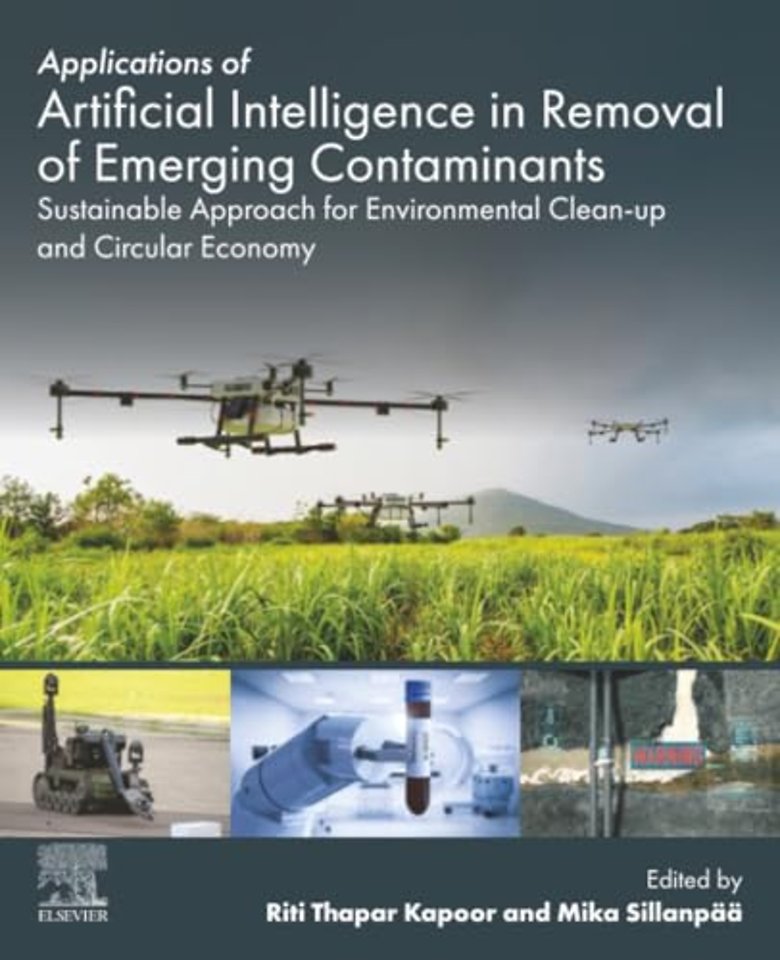
1. Artificial intelligence: Introduction of technology, tools and need and significance for environmental sustainability<br>2. Artificial intelligence: historical background, types of tool and application for sustainable future<br>3. Artificial intelligence in pollution control and management: status and future prospects<br>4. Recent advances in use of artificial intelligence for optimization and automation of adsorption processes for wastewater treatment<br>5. Artificial intelligence and machine learning-based monitoring and design of biological wastewater treatment system<br>6. Applications of artificial intelligence tools for the adsorption of dyes from industrial effluent<br>7. Application of AI tools and smart technology in adsorption of heavy metals by using biochar<br>8. Current applications and future impacts of artificial intelligence and machine learning tools in removal of emerging contaminants<br>9. Applications of AI for the adsorption of pharmaceutical compounds from wastewater<br>10. Use of AI tools for the adsorption of organic pollutants from wastewater<br>11. Use of machine learning methods for dye adsorption prediction onto agricultural waste /biochar/ activated carbon<br>12. Comparison between conventional methods and artificial intelligence tools for wastewater treatment<br>13. Artificial neural networks (ANN) for the prediction of biochar yield and its application in bioremediation<br>14. Application of different AI models like fuzzy logic, genetic programming, model tree for prediction and removal of contaminants from wastewater treatment plants<br>15. Challenges with artificial intelligence and machine learning methods for implementation in water treatment and monitoring<br>16. Artificial intelligence technologies for forecasting air pollution and human health<br>17. Applications of artificial intelligence-based modeling for bioenergy system<br>18. Use of artificial intelligence tools in agro-waste management<br>19. Application of artificial intelligence and machine learning technologies for development of circular economy<br>20. Artificial intelligence: economical approaches for waste management and disposal<br>21. Artificial intelligence and machine learning tools: Patents and technologies transferred to the industries<br>22. Case studies from developed and developing nations: economic evaluation of contaminants removal/ waste recycling by AI tools<br>23. Case study on the use of artificial intelligence tools to reduce pesticides/synthetic fertilizers application in agricultural fields<br>24. Role of AI tools in a future bioeconomy for environmental clean-up: regulations and policy framework