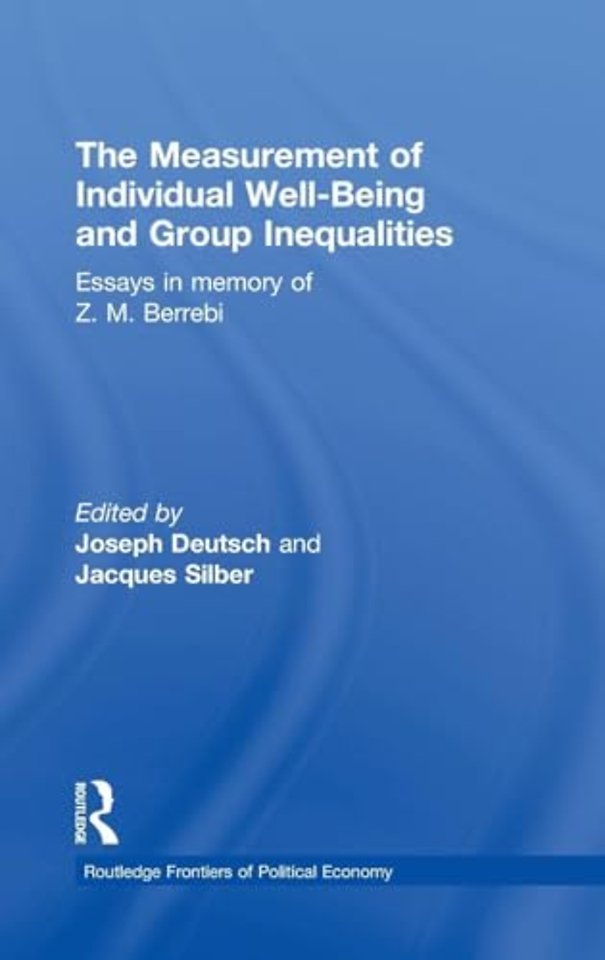
Measurement of Individual Well-Being and Group Inequalities
Essays in Memory of Z. M. Berrebi
Samenvatting
Although most traditional economic theory puts the individual at the centre of analysis, more recent approaches have acknowledged the importance of a wider sense of identity as a determinant of individual behaviour. Whether it is ethnicity, religion or gender, group membership is a central part of human life. This book presents new advances in areas which consider both the individual and the group when measuring inequalities and well-being.
The first part of the book covers topics such as relative deprivation and happiness, domains where even economists have now recognized the importance of reference groups in the assessment of individuals’ well-being. The second part is devoted to the concept of polarization, a growing field of inquiry among economists. The third part looks at income and wage intra-generational mobility, while the fourth part reports on recent advances in measuring the significant differences between and within groups. The book concludes with several chapters devoted to poverty and social exclusion, stressing in particular the need for a multidimensional approach to these topics.
This collection offers a fresh look at the way individual well-being should be measured, by emphasizing the role of reference groups and the idea of polarization, as well as stressing the impact on well-being of changes over time to the relative position of individuals. This book should be of interest to graduate students and researchers working in the field of development economics, inequality and poverty.