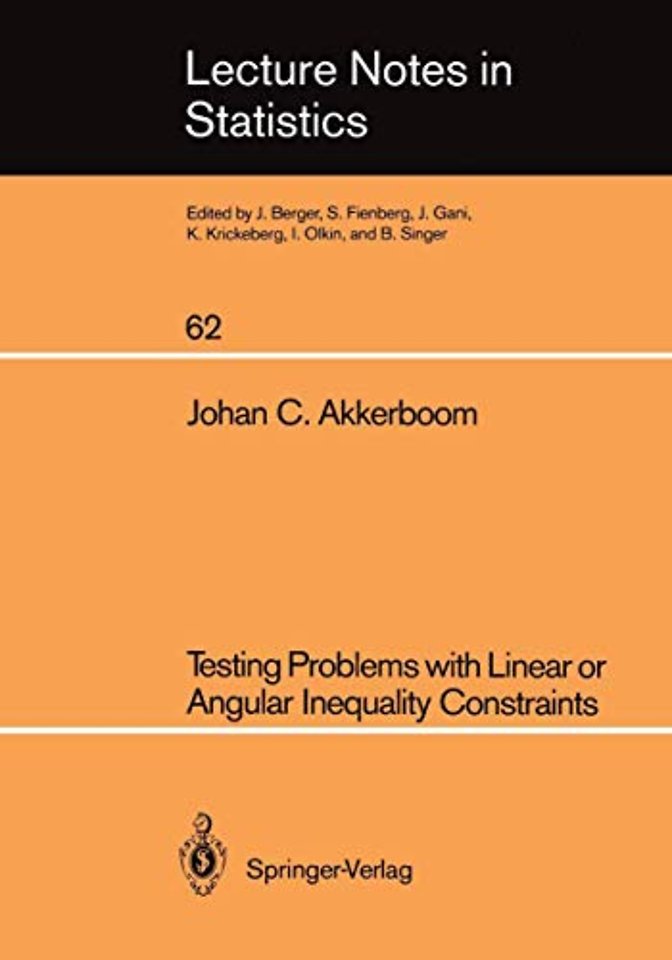
Testing Problems with Linear or Angular Inequality Constraints

Specificaties
Paperback, 291 blz. | Engels
Springer New York | 0e druk, 1990
ISBN13: 9780387972329
Rubricering
Springer New York 0e druk, 1990 9780387972329
Onderdeel van serie Lecture Notes in Statistics
€ 120,99
Levertijd ongeveer 8 werkdagen

Samenvatting

Represents a self-contained account of a new promising and generally applicable approach to a large class of one-sided testing problems, where the alternative is restricted by at least two linear inequalities. It highlights the geometrical structure of these problems. It gives guidance in the construction of a so-called Circular Likelihood Ratio (CLR) test, which is obtained if the linear inequalities, or polyhedral cone, are replaced by one suitable angular inequality, or circular cone. Such a test will often constitute a nice and easy-to-use compromise between the LR-test and a suitable linear test against the original alternative. The book treats both theory and practice of CLR-tests. For cases with up to 13 linear inequalities, it evaluates the power of CLR-tests, derives the most stringent CLR-test, and provides tables of critical values. It is of interest both to the specialist in order- restricted inference and to the statistical consultant in need of simple and powerful one-sided tests. Many examples are worked out for ANOVA, goodness-of-fit, and contingency table problems. Case studies are devoted to Mokken's one- dimensional scaling model, one-sided treatment comparison in a two-period crossover trial, and some real data ANOVA- layouts (biology and educational psychology).

Specificaties

ISBN13:9780387972329
Taal:Engels
Bindwijze:paperback
Aantal pagina's:291
Uitgever:Springer New York
Druk:0

Inhoudsopgave

1 Testing problems with linear inequality constraints.- 1.0 General introduction and outline of results.- 1.0.1 Various shortcuts through the study.- 1.1* Notations.- 1.2 Testing statistical hypotheses.- 1.2.1 The Neyman-Pearson approach to testing statistical hypotheses.- 1.2.2 The selection of a test for (H0,H1): restricting principles.- 1.2.3 The selection of a test for (H0,H1): ordering principles.- 1.3 Cases from statistical practice.- 1.3.1 Test expectancy in educational psychology.- 1.3.2 Predatory behavior of hungry beetles.- 1.3.3 The assumption of double monotony in Mokken’s latent trait model.- 1.4 The general problem with the alternative restricted by linear inequalities.- 1.5 The canonical form: testing against the pointed polyhedral cone K.- 1.6 Particular classes of testing problems with the alternative restricted by linear inequalities.- 1.6.1 Testing against the positive orthant in IRm; the combination of m independent one-sample tests.- 1.6.2 Testing homogeneity against upward trend.- 1.6.3 Testing additivity of effects against positive interaction in a two-way analysis of variance.- 1.6.4 Testing goodness of fit for a multinomial distribution with the alternative restricted by stochastic inequality.- 1.6.5 Testing homogeneity against stochastic trend in a doubly-ordered k-by-m contingency table.- 1.6.6 Testing independence against stochastic positive association in a doubly-ordered k-by-m contingency table.- 1.7 Problems with the null hypothesis restricted by linear inequalities.- 2 The main problem: testing against the pointed polyhedral cone K.- 2.0 Introduction and summary.- 1) Sections marked by an asterisk may be skipped at cursory reading.- 2.1* Linear inequality constraints and the geometry of polyhedral cones.- 2.1.1 Extreme half-spaces and extreme rays.- 2.1.2 Partitioning a polyhedral cone by its facets.- 2.1.3 Orthogonal projection onto a closed convex cone.- 2.1.4 Orthogonal projection onto a polyhedral cone.- 2.2 Linear tests.- 2.2.1 Minimizing the maximum shortcoming over K within and with respect to the class of somewhere most powerful (similar size-?) tests.- 2.2.2 The minimax ray and the minimax angle of K.- 2.3 Likelihood ratio tests.- 2.3.1 The E12- and E2-statistics for testing against a closed convex cone.- 2.3.2 The null distributions of E12 and E2.- 2.3.3 The LR-test for the combination of tests problem.- 2.3.4 The LR-test against upward trend in a one-way analysis of variance.- 2.4 Testing a polyhedral-cone-shaped null hypothesis.- 2.4.1 The LR-tests.- 2.4.2 The union-intersection test ?2=1).- 3 A modification of the main problem: testing against a circular cone.- 3.0 Introduction and summary.- 3.1* An angular inequality constraint and the geometry of circular cones.- 3.2 Likelihood ratio tests for the modified problem.- 3.2.1 The $$\tilde E_1^2$$-and $${\tilde E^2}$$-statistics for testing against a circular cone.- 3.2.2 The null distributions of $$\tilde E_1^2$$ and $${\tilde E^2}$$.- 3.3* Computation of critical values of the likelihood ratio test statistics for the modified problem.- 3.3.1 Tables of critical values.- 3.3.2 The program CRVCLRI (?2=1).- 3.3.3 Evaluating a mixture of Beta-distributions with parameters assuming successive half-integer values.- 3.4 A reduction of the modified problem by sufficiency and invariance.- 3.5 Easy-to-use combination procedures for the reduced modified problem.- 3.6* Other procedures for the reduced modified problem (?2=1).- 3.7 Some theory about the power properties of invariant tests (?2=1).- 3.7.1 Admissibility with respect to the class of translation-invariant tests.- 3.7.2 Some monotonicity properties of the power function of the LR-test.- 3.7.3 Power properties when the test statistic preserves a partial order.- 3.8 Testing a circular-cone-shaped null hypothesis.- 4 Circular likelihood ratio tests for the main problem.- 4.0 Introduction and summary.- 4.1 Replacing the polyhedral cone K by some circular cone.- 4.2* Computation of the power of circular likelihood ratio (CLR-) tests (?2=1).- 4.3 Minimization of the maximum shortcoming of CLR-tests over K (?2=1).- 4.3.1 The criterion MS-CLR level-?.- 4.3.2 The criteria AMS-CLR level-? and EAMS-CLR level-?.- 4.3.3 The maximum shortcoming on half-lines and the MS-CLR test.- 4.4 The minimax ray and angle of K for some particular cases.- 4.4.1 The positive orthant.- 4.4.2 Upward trend.- 4.4.3 Positive interaction in a two-way analysis of variance.- 4.4.4 Multinomial distributions stochastically larger than a specified multinomial distribution.- 4.4.5 Stochastic trend in a k-by-m table.- 4.4.6 Stochastic positive association in a k-by-m table.- 4.5 The maximin ray and angle of K for some particular cases.- 4.5.1 A duality correspondence.- 4.5.2 Pairs of dual problems.- 4.6 The use of CLR-tests.- 4.6.1 An example: the symmetrical one-sided multiple comparison problem.- 4.6.2 CLR-tests for the general problem or for the reversed general problem.- 4.7 Power comparisons.- 4.7.1 The symmetrical one-sided multiple comparison problem.- 4.7.2 Testing homogeneity against upward trend.- 4.8 Graphs of the minimax angle and the maximin angle of K for some particular cases.- 5 Applications.- 5.1 One-sided treatment comparison in the two-period crossover trial with binary outcomes.- 5.1.1 Testing exchangeability against a restricted alternative.- 5.1.2 The asymptotic problem of testing against the polyhedral cone K.- 5.1.3 The geometry of K and its circumscribed cone.- 5.1.4 The geometry of K and its inscribed cone.- 5.1.5 Linear tests.- 5.1.6 Replacing K by some circular cone; circular likelihood ratio tests.- 5.2 Test expectancy in educational psychology.- 5.3 Predatory behavior of hungry beetles.- 5.4 The assumption of double monotony in Mokken’s latent trait model.- References and Author Index.- Appendices.
€ 120,99
Levertijd ongeveer 8 werkdagen

Rubrieken

    Personen

      Trefwoorden

        Testing Problems with Linear or Angular Inequality Constraints