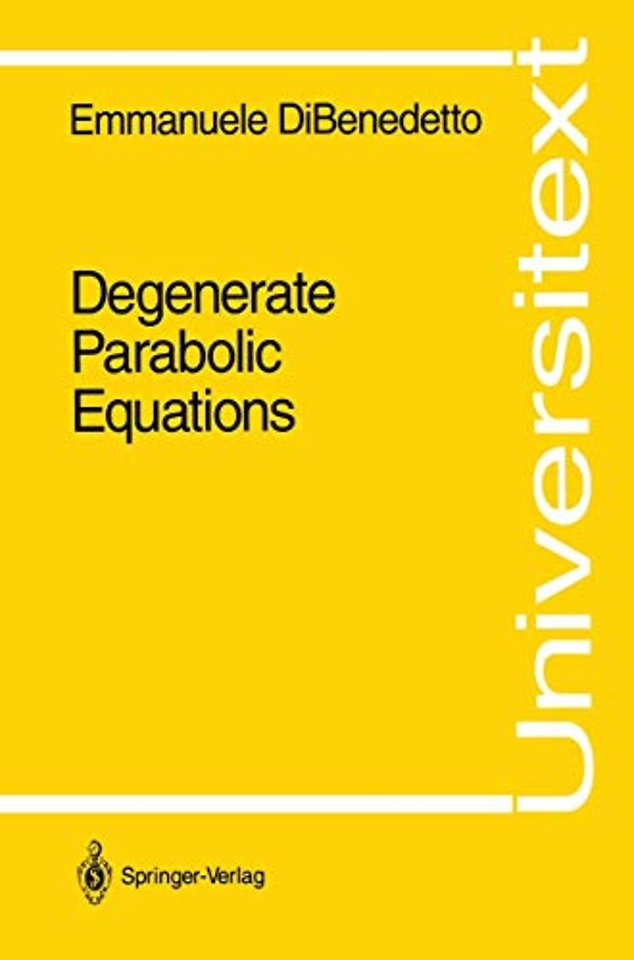
Emmanuele DiBenedetto
Springer New York
0e druk, 1993
9780387940205
Degenerate Parabolic Equations
Specificaties
Paperback, 388 blz.
|
Engels
Springer New York |
0e druk, 1993
ISBN13: 9780387940205
Rubricering
Onderdeel van serie
Universitext
Levertijd ongeveer 8 werkdagen
Samenvatting
Mathematicians have only recently begun to understand the local structure of solutions of degenerate and singular parabolic partial differential equations. The problem originated in the mid '60s with the work of DeGiorgi, Moser, Ladyzenskajia and Uraltzeva. This book will be an account of the developments in this field over the past five years. It evolved out of the 1990-Lipschitz Lectures given by Professor DiBenedetto at the Institut für angewandte Mathematik of the University, Bonn.
Specificaties
ISBN13:9780387940205
Taal:Engels
Bindwijze:paperback
Aantal pagina's:388
Uitgever:Springer New York
Druk:0
Serie:Universitext
Inhoudsopgave
I. Notation and function spaces.- §1. Some notation.- §2. Basic facts aboutW1,p(?) andWo1,p(?).- §3. Parabolic spaces and embeddings.- §4. Auxiliary lemmas.- §5. Bibliographical notes.- II. Weak solutions and local energy estimates.- §1. Quasilinear degenerate or singular equations.- §2. Boundary value problems.- §3. Local integral inequalities.- §4. Energy estimates near the boundary.- §5. Restricted structures: the levelskand the constant ?.- §6. Bibliographical notes.- III. Hölder continuity of solutions of degenerate parabolic equations.- §1. The regularity theorem.- §2. Preliminaries.- §3. The main proposition.- §4. The first alternative.- §5. The first alternative continued.- §6. The first alternative concluded.- §7. The second alternative.- §8. The second alternative continued.- §9. The second alternative concluded.- §10. Proof of Proposition 3.1.- §11. Regularity up tot= 0.- §12. Regularity up toST. Dirichlet data.- §13. Regularity atST. Variational data.- §14. Remarks on stability.- §15. Bibliographical notes.- IV. Hölder continuity of solutions of singular parabolic equations.- §1. Singular equations and the regularity theorems.- §2. The main proposition.- §3. Preliminaries.- §4. Rescaled iterations.- §5. The first alternative.- §6. Proof of Lemma 5.1. Integral inequalities.- §7. An auxiliary proposition.- §8. Proof of Proposition 7.1 when (7.6) holds.- §9. Removing the assumption (6.1).- §10. The second alternative.- §11. The second alternative concluded.- §12. Proof of the main proposition.- §13. Boundary regularity.- §14. Miscellaneous remarks.- §15. Bibliographical notes.- V. Boundedness of weak solutions.- §1. Introduction.- §2. Quasilinear parabolic equations.- §3. Sup-bounds.- §4. Homogeneous structures. 2.- §5. Homogeneous structures. The singular case 1 <p< 2.- §6. Energy estimates.- §7. Local iterative inequalities.- §8. Local iterative inequalities $$
\left( {p > max\left\{ {1;\frac{{2N}}
{{N + 2}}} \right\}} \right)
$$.- §9. Global iterative inequalities.- §10. Homogeneous structures and $$
1 < p \leqslant max\left\{ {1;\frac{{2N}}
{{N + 2}}} \right\}
$$.- §11. Proof of Theorems 3.1 and 3.2.- §12. Proof of Theorem 4.1.- §13. Proof of Theorem 4.2.- §14. Proof of Theorem 4.3.- §15. Proof of Theorem 4.5.- §16. Proof of Theorems 5.1 and 5.2.- §17. Natural growth conditions.- §18. Bibliographical notes.- VI. Harnack estimates: the casep>2.- §1. Introduction.- §2. The intrinsic Harnack inequality.- §3. Local comparison functions.- §4. Proof of Theorem 2.1.- §5. Proof of Theorem 2.2.- §6. Global versus local estimates.- §7. Global Harnack estimates.- §8. Compactly supported initial data.- §9. Proof of Proposition 8.1.- §10. Proof of Proposition 8.1 continued.- §11. Proof of Proposition 8.1 concluded.- §12. The Cauchy problem with compactly supported initial data.- §13. Bibliographical notes.- VII. Harnack estimates and extinction profile for singular equations.- §1. The Harnack inequality.- §2. Extinction in finite time (bounded domains).- §3. Extinction in finite time (in RN).- §4. An integral Harnack inequality for all 1 2).- §4. Hölder continuity ofDu (the case 1 <p< 2).- §5. Some algebraic Lemmas.- §6. Linear parabolic systems with constant coefficients.- §7. The perturbation lemma.- §8. Proof of Proposition 1.1-(i).- §9. Proof of Proposition 1.1-(ii).- §10. Proof of Proposition 1.1-(iii).- §11. Proof of Proposition 1.1 concluded.- §12. Proof of Proposition 1.2-(i).- §13. Proof of Proposition 1.2 concluded.- §14. General structures.- §15. Bibliographical notes.- X. Parabolicp-systems: boundary regularity.- §1. Introduction.- §2. Flattening the boundary.- §3. An iteration lemma.- §4. Comparing w and y (the casep> 2).- §5. Estimating the local average of |Dw| (the casep> 2).- §6. Estimating the local averages of w (the casep> 2).- §7. Comparing w and y (the case max $$
\left\{ {1;\tfrac{{2N}}
{{N + 2}}} \right\} < p < 2
$$).- §8. Estimating the local average of |Dw|.- §9. Bibliographical notes.- XI. Non-negative solutions in ?T. The casep>2.- §1. Introduction.- §2. Behaviour of non-negative solutions as |x| ? ? and as t ? 0.- §3. Proof of (2.4).- §4. Initial traces.- §5. Estimating |Du|p?1 in ?T.- §6. Uniqueness for data inLloc1(RN).- §7. Solving the Cauchy problem.- §8. Bibliographical notes.- XII. Non-negative solutions in ?T. The case 1 The uniqueness theorem.- §6. An auxiliary proposition.- §7. Proof of the uniqueness theorem.- §8. Solving the Cauchy problem.- §9. Compactness in the space variables.- §10. Compactness in thetvariable.- §11. More on the time—compactness.- §12. The limiting process.- §13. Bounded solutions. A counterexample.- §14. Bibliographical notes.
\left( {p > max\left\{ {1;\frac{{2N}}
{{N + 2}}} \right\}} \right)
$$.- §9. Global iterative inequalities.- §10. Homogeneous structures and $$
1 < p \leqslant max\left\{ {1;\frac{{2N}}
{{N + 2}}} \right\}
$$.- §11. Proof of Theorems 3.1 and 3.2.- §12. Proof of Theorem 4.1.- §13. Proof of Theorem 4.2.- §14. Proof of Theorem 4.3.- §15. Proof of Theorem 4.5.- §16. Proof of Theorems 5.1 and 5.2.- §17. Natural growth conditions.- §18. Bibliographical notes.- VI. Harnack estimates: the casep>2.- §1. Introduction.- §2. The intrinsic Harnack inequality.- §3. Local comparison functions.- §4. Proof of Theorem 2.1.- §5. Proof of Theorem 2.2.- §6. Global versus local estimates.- §7. Global Harnack estimates.- §8. Compactly supported initial data.- §9. Proof of Proposition 8.1.- §10. Proof of Proposition 8.1 continued.- §11. Proof of Proposition 8.1 concluded.- §12. The Cauchy problem with compactly supported initial data.- §13. Bibliographical notes.- VII. Harnack estimates and extinction profile for singular equations.- §1. The Harnack inequality.- §2. Extinction in finite time (bounded domains).- §3. Extinction in finite time (in RN).- §4. An integral Harnack inequality for all 1 2).- §4. Hölder continuity ofDu (the case 1 <p< 2).- §5. Some algebraic Lemmas.- §6. Linear parabolic systems with constant coefficients.- §7. The perturbation lemma.- §8. Proof of Proposition 1.1-(i).- §9. Proof of Proposition 1.1-(ii).- §10. Proof of Proposition 1.1-(iii).- §11. Proof of Proposition 1.1 concluded.- §12. Proof of Proposition 1.2-(i).- §13. Proof of Proposition 1.2 concluded.- §14. General structures.- §15. Bibliographical notes.- X. Parabolicp-systems: boundary regularity.- §1. Introduction.- §2. Flattening the boundary.- §3. An iteration lemma.- §4. Comparing w and y (the casep> 2).- §5. Estimating the local average of |Dw| (the casep> 2).- §6. Estimating the local averages of w (the casep> 2).- §7. Comparing w and y (the case max $$
\left\{ {1;\tfrac{{2N}}
{{N + 2}}} \right\} < p < 2
$$).- §8. Estimating the local average of |Dw|.- §9. Bibliographical notes.- XI. Non-negative solutions in ?T. The casep>2.- §1. Introduction.- §2. Behaviour of non-negative solutions as |x| ? ? and as t ? 0.- §3. Proof of (2.4).- §4. Initial traces.- §5. Estimating |Du|p?1 in ?T.- §6. Uniqueness for data inLloc1(RN).- §7. Solving the Cauchy problem.- §8. Bibliographical notes.- XII. Non-negative solutions in ?T. The case 1 The uniqueness theorem.- §6. An auxiliary proposition.- §7. Proof of the uniqueness theorem.- §8. Solving the Cauchy problem.- §9. Compactness in the space variables.- §10. Compactness in thetvariable.- §11. More on the time—compactness.- §12. The limiting process.- §13. Bounded solutions. A counterexample.- §14. Bibliographical notes.