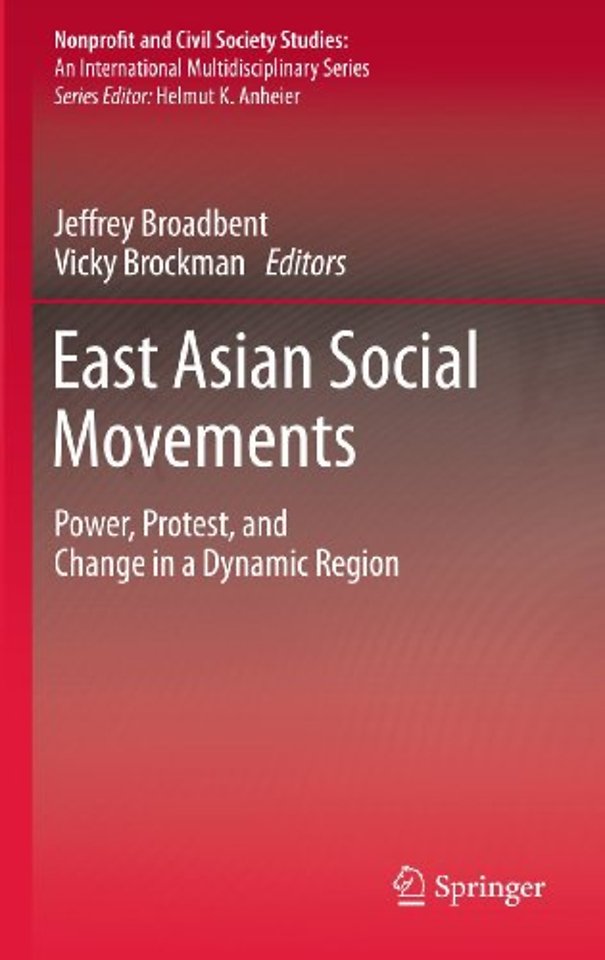
East Asian Social Movements
Power, Protest, and Change in a Dynamic Region
Samenvatting
In the study of civil society and social movements, most cases are based in Western Europe and North America. These two areas of the world have similar histories and political ideals and structures in common which in turn, affect the structure of its civil society. In studying civil society in Asia, a different understanding of history, politics, and society is needed. The region’s long traditions of centralized, authoritarian states buttressed by Confucian and in some cases Communist ideologies may render this concept irrelevant.
The chapters in this international volume cover most of the areas and countries traditionally defined as belonging to East Asia: Japan, Taiwan, South Korea, Hong Kong, Singapore and China. The case studies included in this volume confront the utility of using the Western concept of civil society, represented in its most active form – social movements – to think about East Asia popular politics. Along with providing an array of important case studies of social movements in East Asia, the introduction, chapters and conclusion in the book take up three major theoretical questions:
the effect of the East Asian cultural, social and institutional context upon the mobilization, activities and outcomes of social movements in that region,
the role of social movements in larger transformative processes,
utility of Western social movement concepts in explaining social movements in East Asia.
This book will be of interest to two major groups of readers, those who study East Asia and those who pursue social movements and civil society, as well as politics more generally.
Specificaties
Inhoudsopgave
<P><STRONG>Section 1: Japan </STRONG></P>
<P>1. The Environment Movement in Japan and the Duality of Social Systems.</P>
<P>2. A Comparative Study of Social Movements for a Post-Nuclear Energy Era in Japan and the U.S.</P>
<P>3. The Emergence, Development and Success of the "Association for Holding the Referendum" in Maki</P>
<P>4. The Long-Term Effect of Political Socialization during the Late 1960s Student Protest in Japan.</P>
<P>5. Young Koreans Against Ethnic Discrimination in Japan: A Case Study of the Mintoren Movement.</P>
<P>6. The Day Workers’ Movement in Japan: Symbolic Construction in the "Winter Struggle"</P>
<P><STRONG>Section 2: South Korea</STRONG></P>
<P>7. Democratization and Social Movements in South Korea: A Civil Society Perspective</P>
<P>8. Mesomobilization and the June Uprising: Strategic and Cultural Integration in Pro-democracy Movements in South Korea. </P>
<P><STRONG>Section 3: Taiwan</STRONG></P>
<P>9. Social Movements in Taiwan: A Typological Analysis.</P>
<P><STRONG>Section 4: Hong Kong</STRONG></P>
<P>10. The Reign of Market: Institutional Setting, Business Cycle and Strikes in Hong Kong </P>
<P>11. Social Movement as Cognitive Praxis: The Case of the Student Movement and the Labor Movement in Hong Kong </P>
<P><STRONG>Section 5: China</STRONG></P>
<P>12. State Legitimation and Dynamics of the 1989 Pro-democracy Movement in Beijing</P>
<P>13. Institutionalized Official Hostility and Protest Leader Logic: A case study of a long-term Chinese peasants’ collective protest at Dahe Dam</P>
<P><STRONG>Section 6: Singapore</STRONG></P>
<P>14. Solidarity from Above: State Ideology, Religion and the Absence of Social Movements in Contemporary Singapore</P>
<P><STRONG>Conclusion</STRONG></P>
<P>The Study of East Asian Social Movements: Contributions to Understanding and Theory.</P>
Anderen die dit kochten, kochten ook
-
 Marianne Heemskerk€ 29,95
 -
Jitske Kramer€ 27,50
-
Dirk De Wachter€ 24,99
-
Jo Caudron€ 34,99
-
Babette Porcelijn€ 24,99
-
Andries Baart€ 89,95