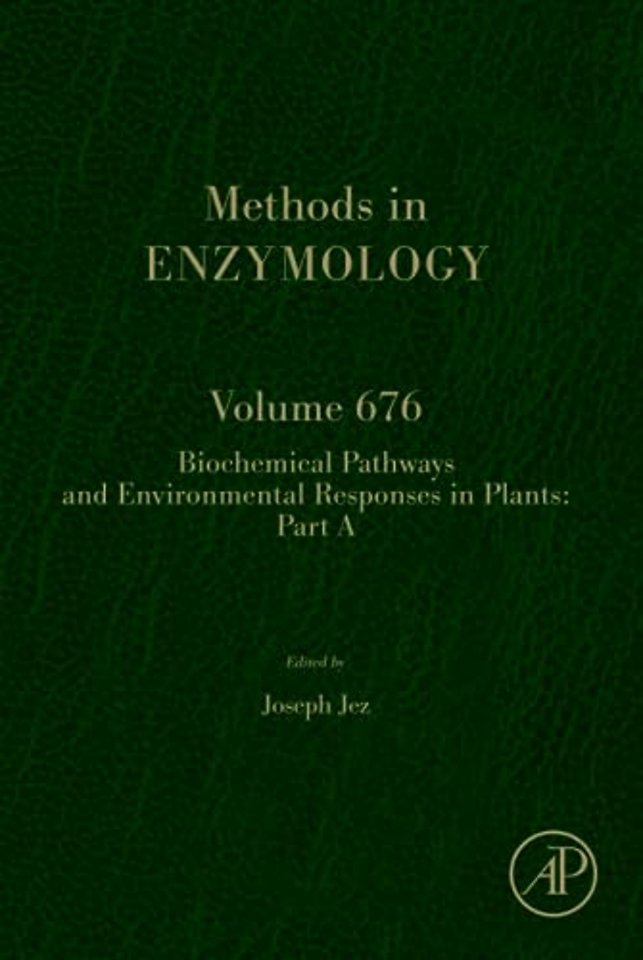

Biochemical Pathways and Environmental Responses in Plants: Part A

Specificaties
Gebonden, blz. | Engels
Elsevier Science | e druk, 2022
ISBN13: 9780323955614
Rubricering
Elsevier Science e druk, 2022 9780323955614
Onderdeel van serie Methods in Enzymology
€ 178,50
Levertijd ongeveer 8 werkdagen

Samenvatting

Biochemical Pathways and Environmental Responses in Plants, Part A, Volume 676 in the Methods in Enzymology series highlights new advances in the field with this new volume presenting interesting chapters on topics such as Structure, function, and engineering of plant polyketide synthases, A sensitive LC-MS/MS assay for enzymatic characterization of methylthioalkylmalate synthase involved in glucosinolate side-chain elongation, Assaying formate-tetrahydrofolate ligase with monoglutamylated and polyglutamylated substrates using a fluorescence-HPLC based assay, An Approach to Nearest Neighbor Analysis of Pigmented Protein Complexes by Using Chemical Crosslinking in Combination with Mass Spectrometry, and much more.

Other chapters cover Biochemical characterization of plant aromatic aminotransferases, Functional Analysis of Phosphoethanolamine N-methyltransferase (PMT) in Plants and Parasites, A structure-guided computational screening approach for predicting plant enzyme-metabolite interactions, Plant metacaspase: an example of microcrystal structure determination and analysis, Biocatalytic system for comparative assessment of functional association of cytochrome P450 monooxygenases with their redox partners, Dirigent Protein Family Function and Structure, and more.

Specificaties

ISBN13:9780323955614
Taal:Engels
Bindwijze:Gebonden

Inhoudsopgave

1. Structure, function, and engineering of plant polyketide synthases <br>Ikuro Abe<br>2. A sensitive LC-MS/MS assay for enzymatic characterization of methylthioalkylmalate synthase involved in glucosinolate side-chain elongation<br>N Bisht<br>3. Assaying formate-tetrahydrofolate ligase with monoglutamylated and polyglutamylated substrates using a fluorescence-HPLC based assay <br>Sanja Roje<br>4. An Approach to Nearest Neighbor Analysis of Pigmented Protein Complexes by Using Chemical Crosslinking in Combination with Mass Spectrometry <br>Haijun Liu<br>5. Biochemical characterization of plant aromatic aminotransferases <br>Hiroshi Maeda<br>6. Functional Analysis of Phosphoethanolamine N-methyltransferase (PMT) in Plants and Parasites <br>Soon Goo Lee<br>7. A structure-guided computational screening approach for predicting plant enzyme-metabolite interactions <br>Cynthia Holland<br>8. Plant metacaspase: an example of microcrystal structure determination and analysis <br>Qun Liu<br>9. Biocatalytic system for comparative assessment of functional association of cytochrome P450 monooxygenases with their redox partners <br>Chang-Jun Liu<br>10. Dirigent Protein Family Function and Structure <br>Norman G. Lewis<br>11. Lignin/Lignan Biosynthesis Structure/Function <br>Norman G. Lewis<br>12. Discovery and characterization of BAHD acylsugar acyltransferases <br>Robert L. Last<br>13. Near-real time determination of BAHD acyl-coenzyme A transferase reaction rates and kinetic parameters using Ellman's reagent <br>Michael Sullivan<br>14. Quantification of N-terminal protein acetyltransferase activity in vitro and in planta <br>Markus Wirtz <br>15. Computational and biochemical methods to measure the activity of carboxysomes and protein organelles in vivo<br>Jeffrey Cameron<br>16. Analysis of Plant Alkaloid-Protein Interactions Using Differential Scanning Fluorimetry and Isothermal Titration Calorimetry <br>Peter Facchini<br>17. A metabolomics strategy for plant specialized metabolites using liquid chromatography-mass spectrometry <br>Kazuki Saito and Tetsuya Mori<br>18. Isoprene measurements to assess the methylerythritol pathway <br>Thomas D. Sharkey<br>19. Analysis of isoprenoid alcohol phosphates by liquid chromatorgraphy-mass spectrometry <br>Peter Dörmann and Katharina Gutbrod<br>20. Using targeted metabolomics to elucidate the indole auxin network in plants <br>Jerry D. Cohen and Adrian D. Hegeman<br>21. Metabolite fingerprinting: A powerful metabolomics approach for marker identification and functional gene annotation <br>Ivo Feussner<br>22. Ex vivo metabolomics, an hypothesis-free approach to identify native substrate(s) of orphan enzymes <br>Kirstin Feussner<br>23. Using stable isotopes and LC-MS for precursor of origin determination in plants <br>Clint Chapple <br>24. Measurement of flux through sulfate assimilation using [35S]sulfate <br>Stanislav Kopriva<br>25. Assessment of the activity of sulfate uptake and assimilation in plants <br>Rüdiger Hell<br>26. Comparison of TLC, HPLC, and direct infusion mass spectrometry methods for the identification and quantification of diacylglycerol molecular species <br>Philip Bates<br>27. Plant sphingolipid analysis <br>Jennifer E. Markham<br>28. Strategies to study the metabolic origins of plant specialized metabolites: the 1,4-naphthoquinones in Lithospermum erythrorhizon <br>Joshua R. Widhalm<br>29. Controlled environments for highly reproducible cannabis ‘omics’ studies <br>Bernd Markus Lange <br>30. Multi-platform approaches for the comprehensive analysis of aroma volatiles in cannabis <br>Bernd Markus Lange <br>31. Systems and strategies for plant protein expression <br>Thomas D. Niehaus <br>32. Programmable Chemical Actuator Control of Soluble and Membrane-Bound Enzymatic Catalysis <br>Katrina Cornish<br>33. CRISPR-Cas mediated genome engineering of cyanobacteria <br>Himadri B. Pakrasi <br>34. Plant Seed Proteome Analysis <br>Hari B. Krishnan<br>35. Proteomics and phosphoproteomics of C3 to CAM transition in the common ice plant <br>Sixue Chen<br>36. Identification of MPK4 interactome using TurboID proteomics <br>Sixue Chen<br>37. A Three-in-One Method for High Throughput Plant Multiomics <br>Sixue Chen <br>38. Assessing simultaneous reversible cysteine oxidation and global abundance in plant tissues <br>Leslie M. Hicks<br>39. Analysis of plant flooding response <br>Simon Gilroy<br>40. Imaging systemic calcium response and its molecular dissection using virus-induced gene silencing <br>Simon Gilroy<br>41. Studying the dynamics of transcriptional complex formation as a function of temperature using small angle x-ray scattering and in vitro assays <br>Chloe Zubieta<br>42. Isolation of novel chemical components and their target plant proteins in metal stress conditions <br>Ryoung Shin<br>43. Inhibition of insect Na+/K+ ATPases by plant-derived cardiac glycosides <br>Georg Petschenka Jander <br>44. High-throughput phenotyping and the use of computer vision to unravel novel phenotypes associated with plant nutrition <br>David Mendoza-Cozatl<br>45. Detection of protein persulfidation in plants by the dimedone switch method <br>Luis C. Romero and Cecilia Gotor<br>46. Using Hyper as a Molecular Probe to Visualize Hydrogen Peroxide in Living Plant Cells: An Updated Method <br>Luis Cárdenas<br>47. Genetically encoded sensors for monitoring the spatiotemporal dynamics of glucose and sucrose <br>Wolf B. Frommer and Nora Zoellner<br>48. Acetylene Reduction Assay for Nitrogenase Activity <br>Senthil Subramanian<br>49. Monitoring lipid-protein interactions in planta using Förster resonance energy transfer <br>Xuemin (Sam) Wang<br>50. Modification of G-protein biochemistry and its effect on plant/environment interaction. <br>Sona Pandey<br>51. RNA-seq analysis of alternative pre-mRNA splicing mediated by photoreceptors in Physcomitrium patens <br>Shih-Long Tu
€ 178,50
Levertijd ongeveer 8 werkdagen

Rubrieken

    Personen

      Trefwoorden

        Biochemical Pathways and Environmental Responses in Plants: Part A