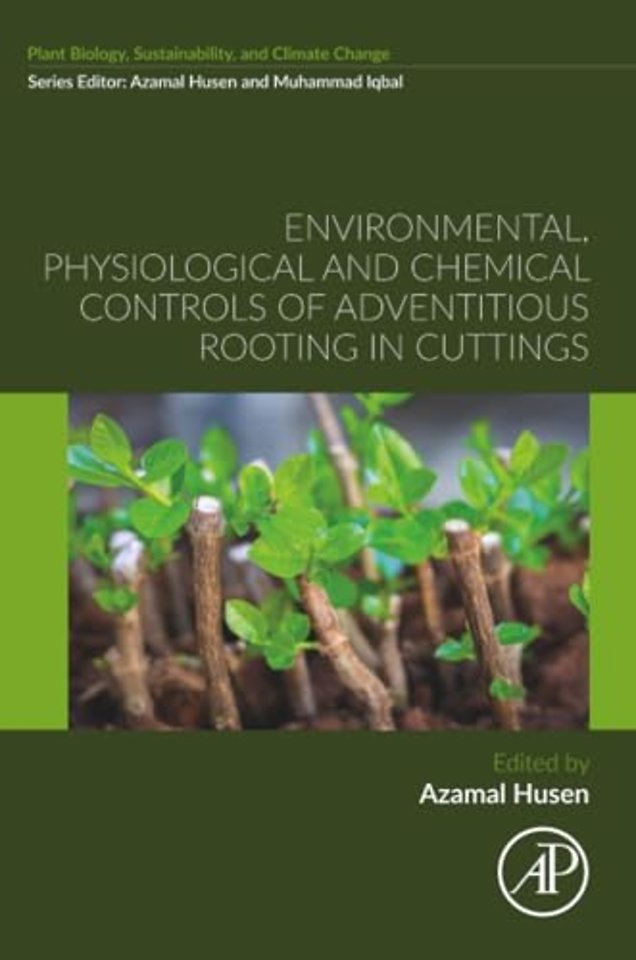
Environmental, Physiological and Chemical Controls of Adventitious Rooting in Cuttings

Specificaties
Paperback, blz. | Engels
Elsevier Science | e druk, 2022
ISBN13: 9780323906364
Rubricering
Elsevier Science e druk, 2022 9780323906364
€ 223,00
Levertijd ongeveer 8 werkdagen

Samenvatting

Environmental, Physiological and Chemical Controls of Adventitious Rooting in Cuttings provides a review of the environmental, physiological and chemical controls of adventitious rooting in cuttings obtained from plants. In plants, adventitious roots, which are highly useful for vegetative propagation (or clonal propagation) are produced mainly from leaves, hypocotyls, stems or shoots. Vegetative propagation may occur naturally by using propagules such as roots, underground and aerial stems, leaves, buds and bulbils. It may also be done artificially through regenerative organs (rhizomes, bulbs, and corms) and by utilizing specialized methods, like cutting, grafting and layering. This book covers the latest tactics surrounding these processes.

As a plethora of factors affect the adventitious rooting of cuttings, adding to the complexity of the phenomenon. The main factors which control adventitious root formation are types of cuttings, presence of leaf area on cuttings, types of hormones and their concentration, duration of hormonal treatment (quick dip, long soak, dry dip, spray dip, or total immerse method), maturation (juvenile or mature), genotype, explant position, and more, all of which are discussed here.

Specificaties

ISBN13:9780323906364
Taal:Engels
Bindwijze:Paperback

Inhoudsopgave

<p>1. Physiology of adventitious root formation in cuttings: An overview<br>2. Environmental control of adventitious rooting in cuttings<br>3. Molecular control of adventitious root formation<br>4. Genetic approach of adventitious root formation in cuttings<br>5. Hormones homeostasis and signaling during adventitious root formation in cuttings<br>6. Transcriptome analysis of auxin induced adventitious root formation in cuttings<br>7. Metabolism during adventitious root primordium initiation and development<br>8. Anatomical changes during adventitious root formation in cuttings<br>9. Involvement of wound response and primary metabolism during adventitious root formation in cuttings<br>10. Role of auxin in adventitious root formation<br>11. Role of hydrogen peroxide in adventitious root formation<br>12. Role of nitric oxide in adventitious root formation<br>13. Role of jasmonic acid in adventitious root formation<br>14. Role of 2,4-D in adventitious root formation<br>15. Role of cytokinins in adventitious root formation<br>16. Role of polyamines in adventitious root formation<br>17. Role of strigolactones in adventitious root formation<br>18. Role of phenolic compounds in adventitious root formation<br>19. Role of Plant Growth-Promoting Rhizobacterium in adventitious root formation<br>20. In vitro micrografting to induce juvenility and improve rooting<br>21. Natural variation in adventitious root formation<br>22. Adventitious root formation in cuttings as influence by genotypes, branch position, leaf area and types of cuttings<br>23. Adventitious root formation in cuttings and effects of maturation (juvenile and mature phages)<br>24. Cloning by cuttings: Hormonal characteristics in relation crown position, rooting competence, and orthotropism as ramets<br>25. Micropropagation in mature trees by manipulation of phase change, stress and culture environment<br>26. Macropropagation in mature trees by manipulation of phase change, stress and culture environment</p>
€ 223,00
Levertijd ongeveer 8 werkdagen

Rubrieken

    Personen

      Trefwoorden

        Environmental, Physiological and Chemical Controls of Adventitious Rooting in Cuttings