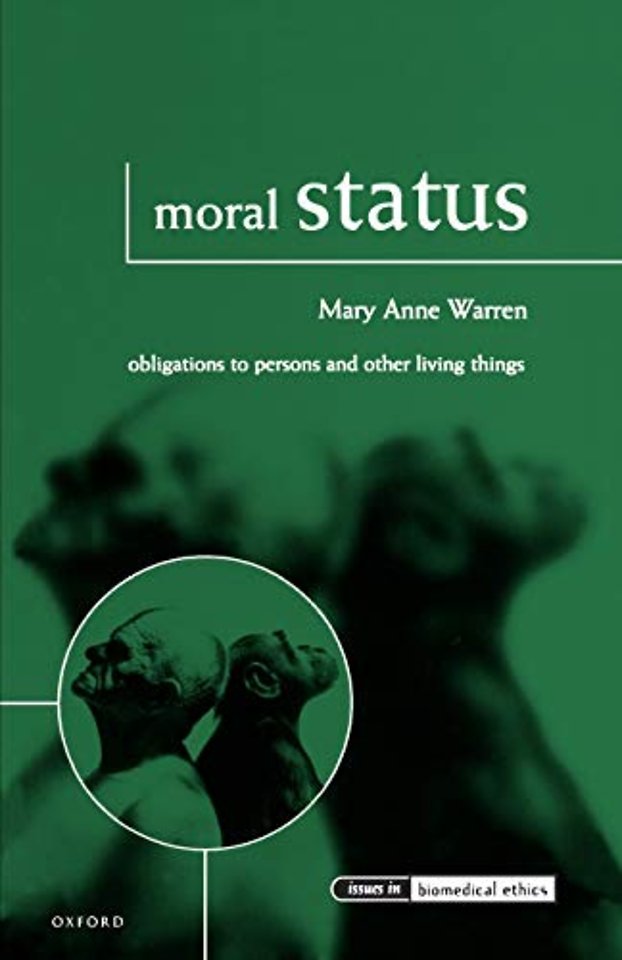
Moral Status
Obligations to Persons and Other Living Things
Samenvatting
Mary Anne Warren explores a theoretical question which lies at the heart of practical ethics: what are the criteria for having moral status? In other words, what are the criteria for being an entity towards which people have moral obligations? Some philosophers maintain that there is one intrinsic property—for instance, life, sentience, humanity, or moral agency. Others believe that relational properties, such as belonging to a human community, are more important.
In Part I of the book, Warren argues that no single property can serve as the sole criterion for moral status; instead, life, sentience, moral agency, and social and biotic relationships are all relevant, each in a different way. She presents seven basic principles, each focusing on a property that can, in combination with others, legitimately affect an agent's moral obligations towards entities of a given type.
In Part II, these principles are applied in an examination of three controversial ethical issues: voluntary euthanasia, abortion
Specificaties
Inhoudsopgave
1. The Concept of Moral Status
2. Reverence for Life
3. Sentience and the Utilitarian Calculus
4. Personhood and Moral Rights
5. The Relevance of Relationships
6. A Multi-Criterial Analysis of Moral Status
Part II: Selected Applications
7. Applying the Principles
8. Euthanasia and the Moral Status of Human Beings
9. Abortion and Human Rights
10. Animal Rights and Human Limitations
11. Conclusion
Bibliography
Index.
Vaak samen gekocht


Anderen die dit boek kochten, kochten ook
-
 Gary Chapman€ 25,99
 -
Sigmund Freud€ 14,90
-
Hans Geybels€ 24,99
-
Bert Breij€ 24,95
-
Elke Lenders€ 19,99
-
Louis Dupré€ 24,99