, , , e.a.

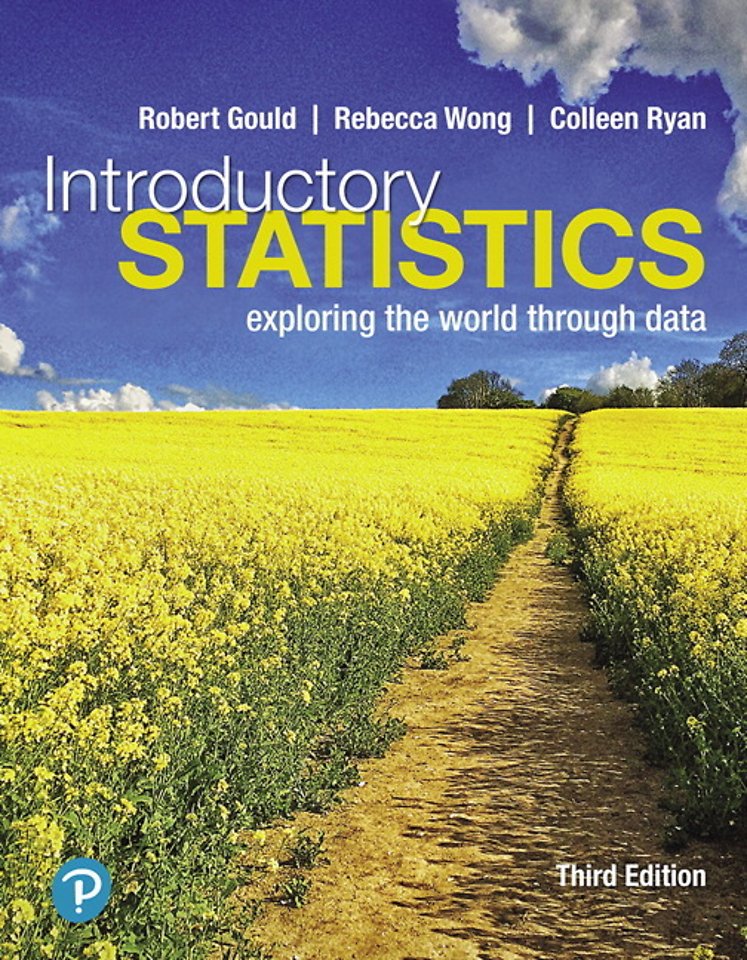
Introductory Statistics

Exploring the World Through Data

Specificaties
Gebonden, blz. | Engels
Pearson Education | e druk, 2019
ISBN13: 9780135188927
Rubricering
Pearson Education e druk, 2019 9780135188927
€ 272,14
Levertijd ongeveer 8 werkdagen

Samenvatting

For courses in Introductory Statistics.

Data analysis for everyone

Data in the real world are dynamic and sometimes messy. This complexity can intimidate students who are new to math and statistics — but it’s also what makes statistics so interesting! 

Embracing these characteristics, Introductory Statistics: Exploring the World Through Data teaches students how to explore and analyze real data to answer real-world problems. Crafted by authors who are active in the classroom and in the statistics education community, the 3rd Edition pairs a clear, conversational writing style with new and frequent opportunities to apply statistical thinking. Its tone and learning aids are designed to equip any student to analyze, interpret, and tell a story about modern data, regardless of the student’s mathematical proficiency.

Also available with MyLab Statistics

MyLab™ Statistics is the teaching and learning platform that empowers you to reach every student. By combining trusted author content with digital tools and a flexible platform, MyLab Statistics personalizes the learning experience and improves results for each student. With MyLab Statistics and StatCrunch®, an integrated web-based statistical software program, students learn the skills they need to interact with the data in the real world. Learn more about MyLab Statistics.

Specificaties

ISBN13:9780135188927
Taal:Engels
Bindwijze:Gebonden

Inhoudsopgave

<div class="c-section-headers-number-list_container"> <h3>1. Introduction to Data</h3> <ul> <li>1.1 What Are Data?</li> <li>1.2 Classifying and Storing Data</li> <li>1.3 Investigating Data</li> <li>1.4 Organizing Categorical Data</li> <li>1.5 Collecting Data to Understand Causality</li> </ul> <h3>2. Picturing Variation with Graphs</h3> <ul> <li>2.1 Visualizing Variation in Numerical Data</li> <li>2.2 Summarizing Important Features of a Numerical Distribution</li> <li>2.3 Visualizing Variation in Categorical Variables</li> <li>2.4 Summarizing Categorical Distributions</li> <li>2.5 Interpreting Graphs</li> </ul> <h3>3. Numerical Summaries of Center and Variation</h3> <ul> <li>3.1 Summaries for Symmetric Distributions</li> <li>3.2 What's Unusual? The Empirical Rule and z-Scores</li> <li>3.3 Summaries for Skewed Distributions</li> <li>3.4 Comparing Measures of Center</li> <li>3.5 Using Boxplots for Displaying Summaries&lt;</li> </ul> <h3>4. Regression Analysis: Exploring Associations between Variables</h3> <ul> <li>4.1 Visualizing Variability with a Scatterplot</li> <li>4.2 Measuring Strength of Association with Correlation</li> <li>4.3 Modeling Linear Trends</li> <li>4.4 Evaluating the Linear Model</li> </ul> <h3>5. Modeling Variation with Probability</h3> <ul> <li>5.1 What Is Randomness?</li> <li>5.2 Finding Theoretical Probabilities</li> <li>5.3 Associations in Categorical Variables</li> <li>5.4 Finding Empirical Probabilities</li> </ul> <h3>6. Modeling Rando Events: The Normal and Binomial Models</h3> <ul> <li>6.1 Probability Distributions Are Models of Random Experiments</li> <li>6.2 The Normal Model</li> <li>6.3 The Binomial Model (Optional)</li> </ul> <h3>7. Survey Sampling and Inference</h3> <ul> <li>7.1 Learning about the World through Surveys</li> <li>7.2 Measuring the Quality of a Survey</li> <li>7.3 The Central Limit Theorem for Sample Proportions</li> <li>7.4 Estimating the Population Proportion with Confidence Intervals</li> <li>7.5 Comparing Two Population Proportions with Confidence</li> </ul> <h3>8. Hypothesis Testing for Population Proportions</h3> <ul> <li>8.1 The Essential Ingredients of Hypothesis Testing</li> <li>8.2 Hypothesis Testing in Four Steps</li> <li>8.3 Hypothesis Tests in Detail</li> <li>8.4 Comparing Proportions from Two Populations</li> </ul> <h3>9. Inferring Population Means</h3> <ul> <li>9.1 Sample Means of Rando Samples</li> <li>9.2 The Central Limit Theorem for Sample Means</li> <li>9.3 Answering Questions about the Mean of a Population</li> <li>9.4 Hypothesis Testing for Means</li> <li>9.5 Comparing Two Population Means</li> <li>9.6 Overview of Analyzing Means</li> </ul> <h3>10. Associations between Categorical Variables</h3> <ul> <li>10.1 The Basic Ingredients for Testing with Categorical Variables</li> <li>10.2 The Chi-Square Test for Goodness of Fit</li> <li>10.3 Chi-Square Tests for Associations between Categorical Variables</li> <li>10.4 Hypothesis Tests When Sample Sizes Are Small</li> </ul> <h3>11. Multiple Comparisons and Analysis of Variance</h3> <ul> <li>11.1 Multiple Comparisons</li> <li>11.2 The Analysis of Variance</li> <li>11.3 The ANOVA Test</li> <li>11.4 Post-Hoc Procedures</li> </ul> <h3>12. Experimental Design: Controlling Variation</h3> <ul> <li>12.1 Variation Out of Control</li> <li>12.2 Controlling Variation in Surveys</li> <li>12.3 Reading Research Papers</li> </ul> <h3>13. Inference without Normality</h3> <ul> <li>13.1 Transforming Data</li> <li>13.2 The Sign Test for Paired Data</li> <li>13.3 Mann-Whitney Test for Two Independent Groups</li> <li>13.4 Randomization Tests</li> </ul> <h3>14. Inference for Regression</h3> <ul> <li>14.1 The Linear Regression Model</li> <li>14.2 Using the Linear Model</li> <li>14.3 Predicting Values and Estimating Means</li> </ul> </div>
€ 272,14
Levertijd ongeveer 8 werkdagen

Rubrieken

    Personen

      Trefwoorden

        Introductory Statistics