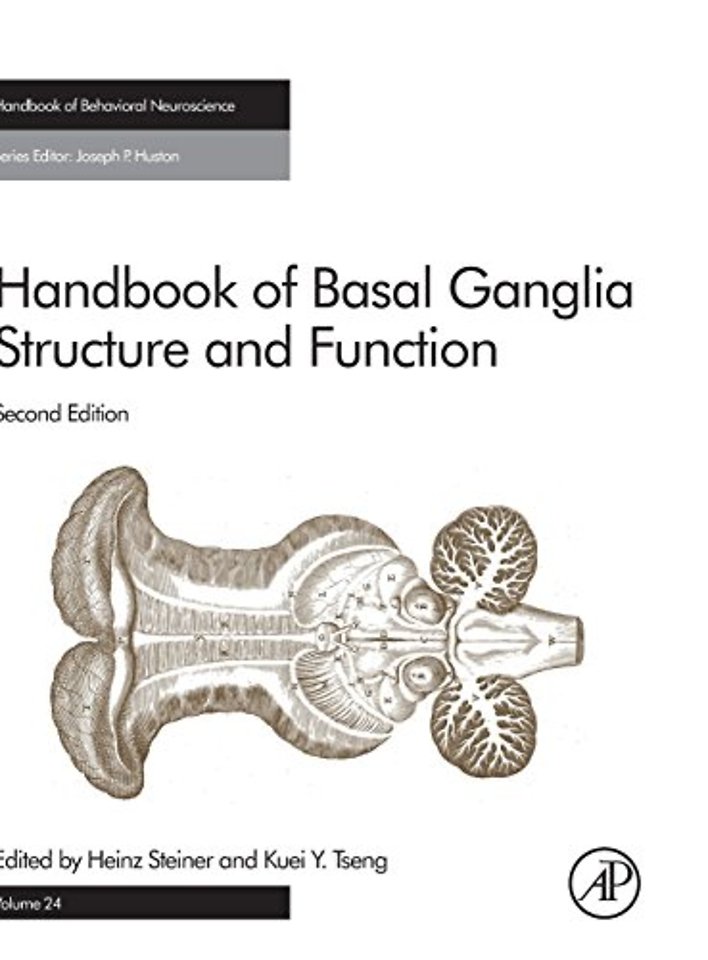
,

Handbook of Basal Ganglia Structure and Function

Specificaties
Gebonden, blz. | Engels
Elsevier Science | e druk, 2016
ISBN13: 9780128022061
Rubricering
Elsevier Science e druk, 2016 9780128022061
€ 175,00
Levertijd ongeveer 8 werkdagen

Samenvatting

Handbook of Basal Ganglia Structure and Function, Second Edition, offers an integrated overview of the structural and functional aspects of the basal ganglia, highlighting clinical relevance. The basal ganglia, a group of forebrain nuclei interconnected with the cerebral cortex, thalamus, and brainstem, are involved in numerous brain functions, such as motor control and learning, sensorimotor integration, reward, and cognition.

These nuclei are essential for normal brain function and behavior, and their importance is further emphasized by the numerous and diverse disorders associated with basal ganglia dysfunction, including Parkinson’s disease, Tourette’s syndrome, Huntington’s disease, obsessive-compulsive disorder, dystonia, and psychostimulant addiction.

This updated edition has been thoroughly revised to provide the most up-to-date account of this critical brain structure. Edited and authored by internationally acclaimed basal ganglia researchers, the new edition contains ten entirely new chapters that offer expanded coverage of anatomy and physiology, detailed accounts of recent advances in cellular/molecular mechanisms and cellular/physiological mechanisms, and critical, deeper insights into the behavioral and clinical aspects of basal ganglia function and dysfunction.

Specificaties

ISBN13:9780128022061
Taal:Engels
Bindwijze:Gebonden

Inhoudsopgave

<p>Part A: The Basal Ganglia System and its Evolution<br>1. History of the Basal Ganglia<br>2. Anatomical Organization of the Basal Ganglia <br>3. Evolution of the Vertebrate Basal Ganglia <br>4. Cell Types in the Basal Ganglia </p> <p>Part B: Anatomy and Physiology of the Striatum<br>5. Striatal Medium Spiny Projection Neurons and their Connections<br>6. Cholinergic Interneurons of the Striatum<br>7. GABAergic Interneurons of the Striatum <br>8. Dopamine Signaling in Striatal Medium Spiny Neurons<br>9. Endocannabinoid Signaling in the Striatum <br>10. Nitric Oxide Signaling in the Striatum <br>11. Adenosine Signaling in the Basal Ganglia </p> <p>Part C: Anatomy and Physiology of Globus Pallidus, Subthalamic Nucleus and Substantia Nigra<br>12. The Globus Pallidus <br>13. The Subthalamic Nucleus<br>14. The Substantia Nigra Pars Reticulata<br>15. Subtypes of Midbrain Dopamine Neurons<br>16. Neurophysiology of Substantia Nigra Dopamine Neurons<br>17. Plasticity in Dopamine Neurons<br>18. Regulation of Extracellular Dopamine: Release and Reuptake </p> <p>Part D: Network Integration<br>19. Organization of Corticostriatal Projection Neuron Types <br>20. Organization of Prefrontal-Striatal Connections <br>21. Gating of Cortical Input to the Striatum <br>22. Corticostriatal Synaptic Plasticity in Physiological and Pathological Conditions <br>23. Organization of the Thalamostriatal Systems <br>24. The Rostromedial Tegmental Nucleus: Connections to the Basal Ganglia<br>25. The Rostromedial Tegmental Nucleus: A Modulator of Dopamine Systems<br>26. Integrative Networks Across Basal Ganglia Circuits </p> <p>Part E: Molecular Signaling in the Basal Ganglia<br>27. Second-Messenger Cascades <br>28. DARPP32/Phosphatase Signaling<br>29. Transsynaptic Regulation of Basal Ganglia Gene Expression<br>30. Psychostimulant-Induced Gene Regulation in Corticostriatal Circuits <br>31. Epigenetics in Neuropathologies of the Basal Ganglia</p> <p>Part F: Basal Ganglia Function and Dysfunction<br>32. Investigating Basal Ganglia Function with Cell-Type-Specific Manipulations<br>33. Basal Ganglia Re-Entrant Loops: Roles in Action Selection and Reinforcement<br>34. Memory Systems in the Basal Ganglia<br>35. Basal Ganglia Dynamics During Action Sequence (Motor) Learning<br>36. Abnormal Activities in Cortico-Basal Ganglia Circuits in Movement Disorders<br>37. Morphological Plasticity in the Striatum Associated with Dopamine Dysfunction<br>38. Neuroinflammation in Movement Disorders<br>39. Basal Ganglia Disorders Related to Striosome/Matrix Compartments<br>40. Drug Addiction: the Neural and Psychological Basis of a Compulsive Incentive Habit<br>41. Parkinson’s Disease: Cross-Talk Between Environmental Factors and Gene Defects <br>42. Parkinson’s Disease: Molecular Determinants of Vulnerability in Dopamine Neurons<br>43. Parkinson’s Disease: Genetics <br>44. Molecular Mechanisms of L-DOPA-Induced Dyskinesia <br>45. Cell Therapy in Parkinson’s Disease: An Update<br>46. Huntington’s Disease: Molecular Basis <br>47. Huntington’s Disease: Insights from Animal Models<br>48. Dystonia<br>49. Tourette Syndrome<br>50. Deep-Brain Stimulation for Neurologic and Psychiatric Disorders </p>
€ 175,00
Levertijd ongeveer 8 werkdagen

Rubrieken

    Personen

      Trefwoorden

        Handbook of Basal Ganglia Structure and Function