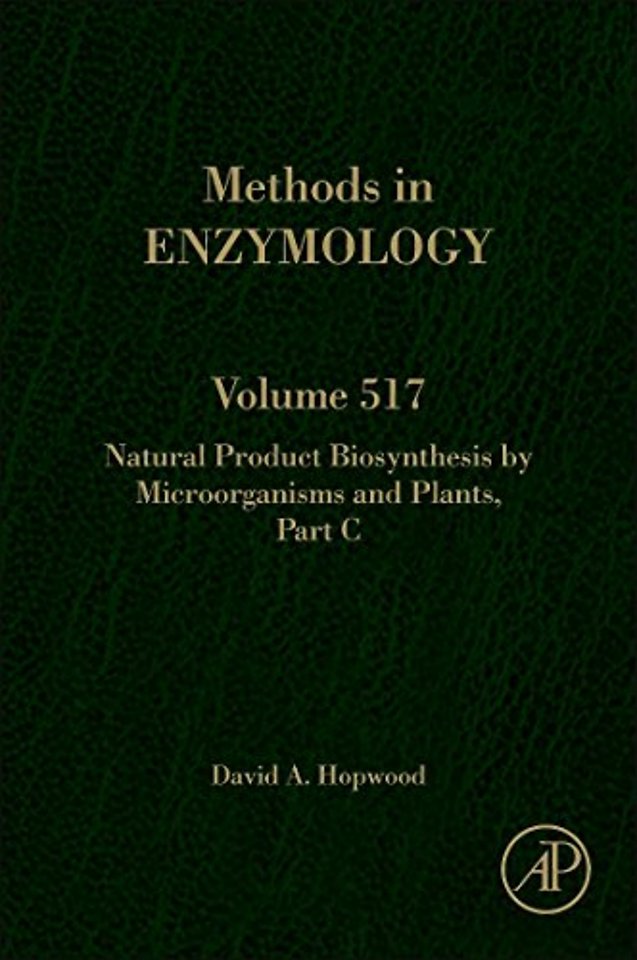
David A. Hopwood
Elsevier Science
e druk, 2012
9780124046344
Natural Product Biosynthesis by Microorganisms and Plants Part C
Specificaties
Gebonden, blz.
|
Engels
Elsevier Science |
e druk, 2012
ISBN13: 9780124046344
Rubricering
Onderdeel van serie
Methods in Enzymology
Levertijd ongeveer 8 werkdagen
Samenvatting
This new volume of Methods in Enzymology continues the legacy of this premier serial by containing quality chapters authored by leaders in the field. The third of 3 volumes covering Natural product biosynthesis by microorganisms and plants.
Specificaties
ISBN13:9780124046344
Taal:Engels
Bindwijze:Gebonden
Uitgever:Elsevier Science
Serie:Methods in Enzymology
Inhoudsopgave
<ol> <li>Methods for the study of endophytic microorganisms from Chinese traditional medicine (TCM) plants</li> <li>Cyanobacteria as a Source of Natural Products</li> <li>Isolating antifungals from fungus-growing ant symbionts using a genome-guided chemistry approach</li> <li>Gamma-butyrolactone and furan signalling systems in Streptomyces</li> <li>Small molecules that mediate interspecies interactions</li> <li>Finding and Analysing Plant Secondary Metabolic Gene Clusters</li> <li>Genomic approaches for interrogating the biochemistry of medicinal plant species</li> <li>Phylogenetic approaches to natural product structure prediction</li> <li>Using a virus-derived system to manipulate plant natural product biosynthetic pathways</li> <li>DNA assembler: a synthetic biology tool for characterizing and engineering natural product gene clusters</li> <li>Reassembly of functionally intact environmental DNA-derived biosynthetic gene clusters</li> <li>A toolkit for heterologous expression of metabolic pathways in Aspergillus oryzae</li> <li>De novo synthesis of high-value sesquiterpenoids in yeast</li> <li>Streptomyces coelicolor as an expression host for heterologous gene clusters</li> <li>Towards awakening cryptic secondary metabolite gene clusters in filamentous fungi</li> <li>Regulatory cross-talk and microbial induction of fungal secondary metabolite clusters</li> <li>Waking up Streptomyces secondary metabolism by genetic disruption of repressors or constitutive expression of activators</li> <li>Use and discovery of chemical elicitors that stimulate biosynthetic gene clusters in Streptomyces bacteria</li> <li>Persister eradication: lessons from the world of natural products<br></li></ol>