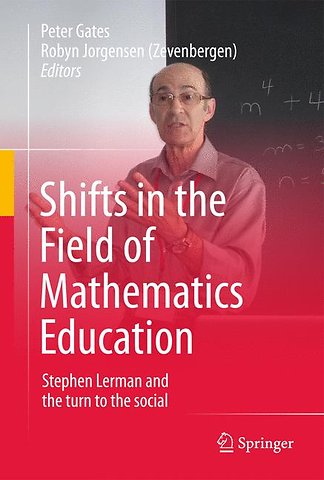
Peter Gates,
Robyn Jorgensen (Zevenbergen)
Springer Nature Singapore
2015e druk, 2014
9789812871787
Shifts in the Field of Mathematics Education
Stephen Lerman and the turn to the social
Specificaties
Gebonden, 244 blz.
|
Engels
Springer Nature Singapore |
2015e druk, 2014
ISBN13: 9789812871787
Rubricering
Levertijd ongeveer 8 werkdagen
Samenvatting
Professor Stephen Lerman has been a leader in the field of mathematics education for thirty years. His work is extensive, making many significant contributions to a number of key areas of research. Stephen retired from South Bank University in 2012, where he had worked for over 20 years, though he continues to work at Loughborough University. In this book several of his long standing colleagues and collaborators reflect on his contribution to mathematics education, and in so doing illustrate how some of Steve’s ideas and interventions have resulted in significant shifts in the domain.
Specificaties
ISBN13:9789812871787
Taal:Engels
Bindwijze:gebonden
Aantal pagina's:244
Uitgever:Springer Nature Singapore
Druk:2015
Hoofdrubriek:Mens en maatschappij
Inhoudsopgave
<p>Chapter 1: Mapping the Field and Documenting the Contribution – Peter Gates and Robyn Jorgensen</p><p>Chapter 2: The social turn from up close and personal - Peter Winbourne</p><p>Chapter 3: Steve Lerman: the man and his work – Gilah Leder</p><p>Chapter 4: Issues of equity and social justice in the construction of Steve Lerman – Peter Gates</p><p>Chapter 5: Tracing advances in the field of mathematics education – Charalampos Sakonidis</p><p>Chapter 6: A speech act in mathematics education – David Wagner</p><p>Chapter 7: Steve through the years</p><p>Chapter 8: International Research Collaboration: An Australian Perspective – Robyn Jorgensen</p><p>Chapter 9: Researching the role of the teacher on creating social just productive classrooms</p><p>that facilitate mathematics learning – Peter Sullivan</p><p>Chapter 10: Turning mathematical knowledge for teaching social – Jill Adler</p><p>Chapter 11: Knowledge construction: Individual or social? - Judith Mousley</p><p>Chapter 12: Intersubjectivity in mathematics teaching: meaning-making from</p><p>constructivist and/or sociocultural perspectives? – Barbara Jaworski</p><p>Chapter 13: Learning as participatory transformation</p><p>– a reflection inspired by Steve Lerman’s papers and practice - João Filipe Matos</p><p>Chapter 14: The philosophy of mathematics education: Stephen Lerman’s contributions - Paul Ernest</p><p>Chapter 15: Leman’s perspective on information and communication technology – Marcelo Borba and Ricardo Scucuglia</p><p>Chapter 16: Troubling Mathematics’ “learners” – Brent Davis</p><p>
Anderen die dit kochten, kochten ook
-
 Jos Ahlers€ 24,95
 -
Japke-d. Bouma€ 19,99
-
Jitske Kramer€ 27,50
-
Marije van den Berg€ 27,50
-
Paul Frissen€ 29,90
-
Floor Milikowski€ 22,99