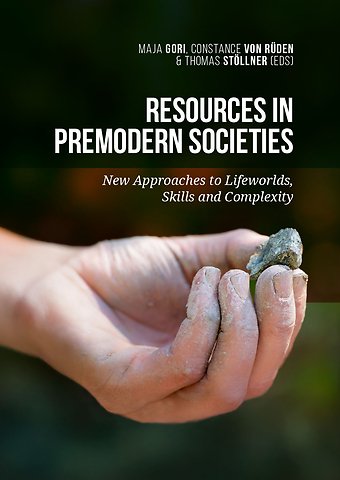
Resources in Premodern Societies
New Approaches to Lifeworlds, Skills and Complexity
Samenvatting
This volume brings together innovative research to explore the profound impact of resources on the development of early societies. Divided into three major themes – lifeworlds in resource landscapes, skill and embodied knowledge, and the role of resources within complex systems – the volume draws on diverse case studies, from Bronze Age Chinese mining to Iron Age preurban resource management and the metallurgy-pastoralism nexus. Contributors reveal how materials were not merely extracted but embedded within cognitive frameworks, cultural traditions, and social transformations. Special emphasis is placed on the relational and evolving nature of craft skills, technological innovations, and the embodied growth of knowledge. Advanced computational approaches focussing on complexity, further illuminate patterns of mobility, resource use, and state formation.
Integrating archaeological, anthropological, and modeling perspectives, this volume offers an interdisciplinary and multi-scalar analysis of resources and their impact on societies in premodern times. It is intended for scholars, researchers, and advanced students in archaeology, anthropology, history, and related disciplines who are interested in material culture, environmental adaptation, cognitive processes, and the dynamics of complex societies.
Specificaties
Inhoudsopgave
Maja Gori, Thomas Stöllner, Constance von Rüden
Lifeworlds in resource landscapes
1. Introduction: Lifeworlds in resource landscapes.
Thomas Stöllner
2. Resources as Life Worlds: How Do Material Resources Shape Cognition and Culture?
Timothy M. LeCain
3. Resource-Scapes: Interwoven practices between appropriation and alienation in premodern mining communities
Thomas Stöllner
4. Linked resources: The metallurgy-pastoralism nexus
Mark Pearce
5. Local Knowledge and Sacralisation of Resources in the Iron Age Apennines (Italy). From Resource Landscapes to Resource Cultures.
Raffaella Da Vela
6. Technology and Social Dynamics of Mining in Bronze Age China
Yiu-Kang Hsu & Haichao Li
7. Urban Mining? A new look at taphonomic processes as key to the reconstruction of waste and resource management in Late La Tène society
Milena Müller Kissing David Brönnimann, Johannes Wimmer, Barbara Stopp, Hannele Rissanen, Norbert Spichtig
Skill, embodiment and the growth of knowledge
8. Introduction. Skill, embodiment and the growth of knowledge
Constance von Rüden & Maja Gori
9. Craft apprenticeship, craft innovation and the relational aspects of skill
Nikolas Papadimitriou & Akis Goumas
10. The Anatomy of a Tradition
Christopher D. Buckley
11. Built from Paint: The Making of Architectural Simulations in the Wall Paintings of Tell el-Daba
Johannes Jungfleisch
Resources and complex systems
12. Introduction: Resources and complex systems
Michail Roos
13. The Challenge of Interdisciplinarity in Agent-Based Modelling with Particular Reference to Archaeology
Edmund Chattoe-Brown
14. Migration in the Cetina Phenomenon? An Agent Based Modelling Approach to Reasons for Mobility in the Adriatic Area between 2500 and 2000 BC
Maja Gori & Frederik Schaff
15. Simulating resource exploitation strategies in Iron Age to Hellenistic communities in southwest Anatolia
Dries Daems & Stef Boogers
16. A Model of the Emergence of the State
Martin Neumann
Vaak samen gekocht
Anderen die dit kochten, kochten ook
-
 Hugh Newman€ 11,99
 -
Harald Meller€ 29,99
-
Gerrit Dusseldorp€ 25,00
-
Martijn Manders€ 23,99
-
*€ 28,50
-
Wijnand van der Sanden€ 39,50