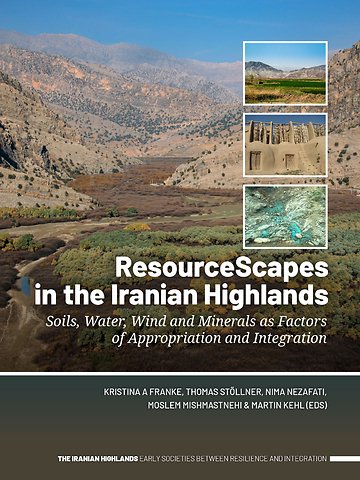
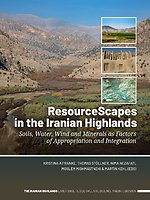
ResourceScapes in the Iranian Highlands
Soils, Water, Wind and Minerals as Factors of Appropriation and Integration
Samenvatting
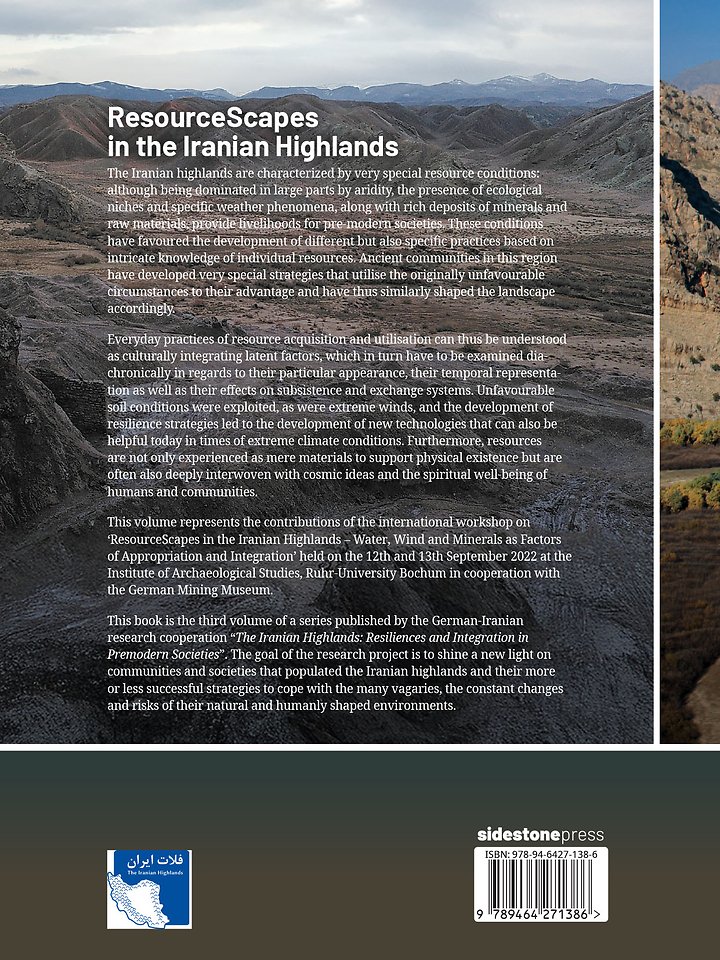
The Iranian highlands are characterized by very special resource conditions: although being dominated in large parts by aridity, the presence of ecological niches and specific weather phenomena, along with rich deposits of minerals and raw materials, provide livelihoods for pre-modern societies. These conditions have favoured the development of different but also specific practices based on intricate knowledge of individual resources. Ancient communities in this region have developed very special strategies that utilise the originally unfavourable circumstances to their advantage and have thus similarly shaped the landscape accordingly.
Everyday practices of resource acquisition and utilisation can thus be understood as culturally integrating latent factors, which in turn have to be examined diachronically in regards to their particular appearance, their temporal representation as well as their effects on subsistence and exchange systems. Unfavourable soil conditions were exploited, as were extreme winds, and the development of resilience strategies led to the development of new technologies that can also be helpful today in times of extreme climate conditions. Furthermore, resources are not only experienced as mere materials to support physical existence but are often also deeply interwoven with cosmic ideas and the spiritual well-being of humans and communities.
This volume represents the contributions of the international workshop on ‘ResourceScapes in the Iranian Highlands – Water, Wind and Minerals as Factors of Appropriation and Integration’ held on the 12th and 13th September 2022 at the Institute of Archaeological Studies, Ruhr-University Bochum in cooperation with the German Mining Museum.
This book is the third volume of a series published by the German-Iranian research cooperation The Iranian Highlands: Resiliences and Integration in Premodern Societies. The goal of the research project it is to shine a new light on communities and societies that populated the Iranian highlands and their more or less successful strategies to cope with the many vagaries, the constant changes and risks of their natural and humanly shaped environments.
Specificaties
Inhoudsopgave
Kristina A Franke, Thomas Stöllner, Nima Nezafati, Moslem Mishmastnehi, and Martin Kehl
Part I: Fundamentals of a specific environment: climate, vegetation, soils and land-use, and potentials and practices in wind and water use
I-1 Soil Resources as Determinants of Archaeological Site Location in Iran
Martin Kehl, Babak Rafiei-Alavi, Zahra Lorzadeh, Yaser Jebreili
I-2 Hydro-Political Borders and Division of Space in the History of Iran
Majid Labbaf Khaneiki, Abdullah Saif Al-Ghafri
I-3 Holocene ecological changes in the Shahrizor Plain, Northern Iraq. New results from a plant macro study
Manfred Rösch, Eileen Eckmeier, Anette Kadereit, Elena Marinova, Maria Rabbani, Simone Mühl
I-4 Soil and Society. Multifaceted Character of Soil as a Resource
Zahra Lorzadeh, Babak Rafiei Alavi Alavijeh, Martin Kehl, Haeedeh Laleh
I-5 From Prosperity to Jeopardy. The Cultural Footprint of the 120-Day Wind in Sistan
Moslem Mishmastnehi
I-6 Analysis of Wind in Nishtafun Windmills. An Empirical Simulation
Mohammadjavad Mahdavinejad
I-7 Windcatcher. A Green Solution from Ancient Persian Vernacular Architecture for the Present Era
Payam Nejat, Fatemeh Jomehzadeh
I-8 The resource water, climate change, and resilience at Douzlākh
Natascha Bagherpour Kashani, Nicole Boenke, Rainer Herd
Part II: Appropriation and utilisation of raw materials and mining
II-1 Ancient Mining and Metallurgical Studies in Iran. Challenges and Future Perspectives
Nima Nezafati, Morteza Momenzedah, Thomas Stöllner, Prentiss de Jesus, Vincent C. Pigott, Ernst Pernicka, Barbara Helwing, Kamran Ahmadi
II-2 Mining at the Fringes. Mineral Resource-Procurement at the Iranian Highlands between Traditional Practices and State-Control
Thomas Stöllner, Abolfazl Aali, Iman Mostafapour, Nima Nezafati, Hande Oezyarkent, Fabian Schapals, Hamed Zifar
II-3 Bronze Age Mining and Husbandry. Isotopic Analysis of Domestic Animal Mobility in Iranian Highlands and Central Asia
Hande Özyarkent, Thomas Stöllner
II-4 Ancient Mining and Settlement at the “Modern” Lead-Silver Mine of Shakin, NW Central Iran. A Preliminary Approach
Fabian Schapals, Iman Mostafapour, Hamzeh Karimi, Nima Nezafati, Behnam Ghanbari, Thomas Stöllner
II-5 Mobility and Resource Management. The Mining Landscape of Nishapur in the Islamic Period
Zahra Lorzadeh, Haeedeh Laleh
II-6 Recent Studies on Technology and Provenance of Tin Bronze Metallurgy on the Prehistoric Iranian Plateau
Omid Oudbashi
Vaak samen gekocht
Anderen die dit kochten, kochten ook
-
 Hugh Newman€ 11,99
 -
Harald Meller€ 29,99
-
Gerrit Dusseldorp€ 25,00
-
Martijn Manders€ 23,99
-
*€ 28,50
-
Wijnand van der Sanden€ 39,50