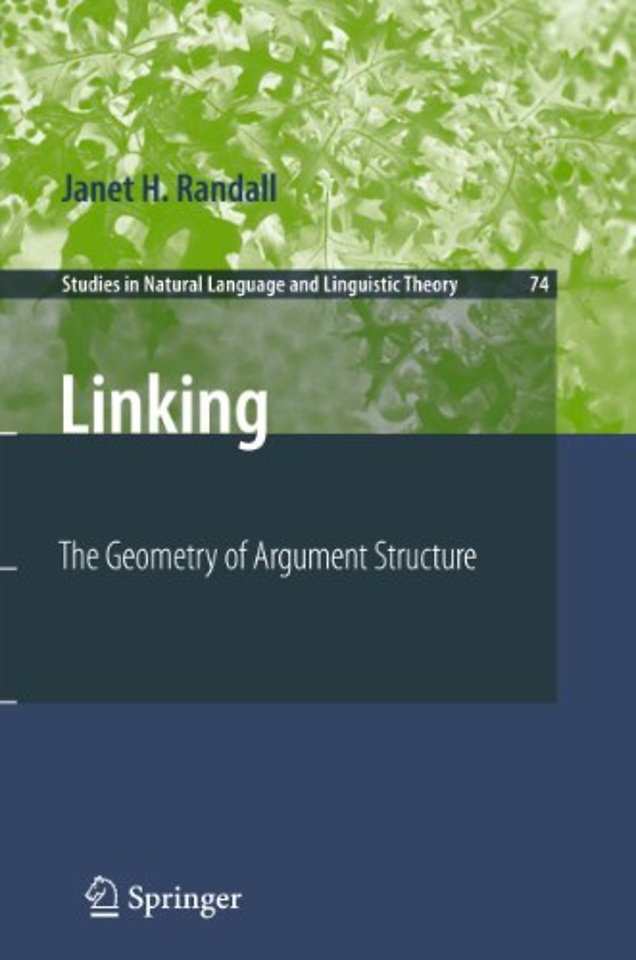
Janet H. Randall
Springer Netherlands
2010e druk, 2010
9789400705326
Linking
The Geometry of Argument Structure
Specificaties
Paperback, 326 blz.
|
Engels
Springer Netherlands |
2010e druk, 2010
ISBN13: 9789400705326
Rubricering
Onderdeel van serie
Studies in Natural Language and Linguistic Theory
Levertijd ongeveer 8 werkdagen
Samenvatting
Linking is one of the challenges for theories of the syntax-semantics interface. In this new approach, the author explores the hypothesis that the positions of syntactic arguments are strictly determined by lexical argument geometry. Through careful argumentation and original analysis, her study provides a framework for explaining the linking patterns of a range of verb classes, leading to a number of insights about lexical structure and a radical rethinking of many verb classes.
Specificaties
ISBN13:9789400705326
Taal:Engels
Bindwijze:paperback
Aantal pagina's:326
Uitgever:Springer Netherlands
Druk:2010
Hoofdrubriek:Woordenboeken en taal
Inhoudsopgave
Acknowledgements
List of Abbreviations
Introduction.- A Phenomenon and a Principle: The Isomorphic Linking Hypothesis – Representations - The Competition - Advantages of this Proposal - Going Forward.- Part I A Geometric Theory of Linking – 1. Conceptual Structure – Motivating Conceptual Structure: A Review of the Problems with Theta Grids – Representing Arguments and Satisfying the Theta Criterion – Building Conceptual Structure Representations – Argument Fusion and Selection – Constraining Fusion: The Prohibition Against Double Fusion – Streamlining the Set of CS Primitives – Argument Structure: The Interface Projection from CS.- 2 Eliminating the Direct/Indirect Internal Argument Distinction – Reasons to Eliminate Indirect Arguments – Apparent Problems and Their Solutions – Syntactic Category – Linear Order – Lexical Rules – Summary .- 3. Explaining Linking Regularities – A New Linking Proposal: The Isomorphic Linking Hypothesis – Causative Verbs – Simple Causative Verbs – Productive “double agent” Causative Verbs – Comparing the ILH to Other Linking Theories – The Thematic Hierarchy Hypothesis (THH) – The Uniformity of Theta Assignment Hypothesis (UTAH) – Why the ILH Is a Better Linking Theory than THH and UTAH – Unaccusative and Unergative Verb Linking and Some Linking Predictions – Unaccusative Verb Linking – Unergative Verb Linking – Some Linking Predictions – Some Problematic Verb Classes – Summary: The Linking Theory So Far.- 4. Syntactically Unexpressed Arguments, Incorporation, and Adjuncts – Implicit Argument Verbs and Implications for Lexical Entries – Implicit Theme Verbs: cook, eat, drink – More Implicit Theme Verbs: rain and snow – Implicit PLACE verbs: deliver (Concrete PLACE) and transform (Abstract PLACE) – Incorporated Argument Verbs – Incorporated Theme Verbs and Adjunct Fusion: butter and bone – MoreIncorporated Theme Verbs: ticket, leaflet, stone, gas – Incorporated Concrete PLACE Verbs: bag, box, bottle, file, shelve – Coindexed Argument Verbs and the Bound Argument Condition on Linking - Delinked CS Arguments: Mismatches Introduced By Word-Formation Rules – Delinked External Arguments: Passive Verbs, Middle Verbs and Deverbal Nominals – Delinked Internal Arguments: Reciprocal Verbs and Reflexive Verbs – Maintaining the Argument/Adjunct Distinction in Light of Selected Adjuncts – Syntactic Arguments – Adjuncts – Tests for the Argument/Adjunct Distinction – Additional Justifications for the Argument/Adjunct Distinction.- 5. The Linking of Resultative Verbs: Clausal Fusion – The Conceptual Structure of Resultative Verbs – The Argument Structure of Resultative Verbs – The Argumenthood of the Result XP – The Argumenthood of the Postverbal NP – The Linking of Resultative Verbs and a Better Linking Theory – The Linking of the Inherited Arguments and a Relativized Isomorphic Linking Hypothesis – A New Kind of AS-CS Mismatch: Nonlinking Themes – Clausal Fusion: Interpreting the Unlinked Theme.- 6. The Prohibition Against Double Fusion – Deriving Resultative Mismatches from the Prohibition Against Double Fusion – Independent Evidence for the Prohibition Against Double Fusion – Passive by-phrases and Agent Subjects – With-Themes and Theme Direct Objects – PP Locations and Locative Direct Objects – The Prohibition Against Double Fusion Versus Jackendoff’s (1990) Constraints on Adjunct Rules – The Prohibition Against Double Fusion and the Theta Criterion – Against an Alternative CS for Resultatives: The Means Analysis (Jackendoff, 1990) – Jackendoff’s First Argument for the Means Analysis and a Refutation: The Actor Test – Jackendoff’s Second Argument for the Means Analysis and a Refutation: “X’s Way” – One Argument in Favor of the Agent Analysis: Unaccusative Verbs – A Second
List of Abbreviations
Introduction.- A Phenomenon and a Principle: The Isomorphic Linking Hypothesis – Representations - The Competition - Advantages of this Proposal - Going Forward.- Part I A Geometric Theory of Linking – 1. Conceptual Structure – Motivating Conceptual Structure: A Review of the Problems with Theta Grids – Representing Arguments and Satisfying the Theta Criterion – Building Conceptual Structure Representations – Argument Fusion and Selection – Constraining Fusion: The Prohibition Against Double Fusion – Streamlining the Set of CS Primitives – Argument Structure: The Interface Projection from CS.- 2 Eliminating the Direct/Indirect Internal Argument Distinction – Reasons to Eliminate Indirect Arguments – Apparent Problems and Their Solutions – Syntactic Category – Linear Order – Lexical Rules – Summary .- 3. Explaining Linking Regularities – A New Linking Proposal: The Isomorphic Linking Hypothesis – Causative Verbs – Simple Causative Verbs – Productive “double agent” Causative Verbs – Comparing the ILH to Other Linking Theories – The Thematic Hierarchy Hypothesis (THH) – The Uniformity of Theta Assignment Hypothesis (UTAH) – Why the ILH Is a Better Linking Theory than THH and UTAH – Unaccusative and Unergative Verb Linking and Some Linking Predictions – Unaccusative Verb Linking – Unergative Verb Linking – Some Linking Predictions – Some Problematic Verb Classes – Summary: The Linking Theory So Far.- 4. Syntactically Unexpressed Arguments, Incorporation, and Adjuncts – Implicit Argument Verbs and Implications for Lexical Entries – Implicit Theme Verbs: cook, eat, drink – More Implicit Theme Verbs: rain and snow – Implicit PLACE verbs: deliver (Concrete PLACE) and transform (Abstract PLACE) – Incorporated Argument Verbs – Incorporated Theme Verbs and Adjunct Fusion: butter and bone – MoreIncorporated Theme Verbs: ticket, leaflet, stone, gas – Incorporated Concrete PLACE Verbs: bag, box, bottle, file, shelve – Coindexed Argument Verbs and the Bound Argument Condition on Linking - Delinked CS Arguments: Mismatches Introduced By Word-Formation Rules – Delinked External Arguments: Passive Verbs, Middle Verbs and Deverbal Nominals – Delinked Internal Arguments: Reciprocal Verbs and Reflexive Verbs – Maintaining the Argument/Adjunct Distinction in Light of Selected Adjuncts – Syntactic Arguments – Adjuncts – Tests for the Argument/Adjunct Distinction – Additional Justifications for the Argument/Adjunct Distinction.- 5. The Linking of Resultative Verbs: Clausal Fusion – The Conceptual Structure of Resultative Verbs – The Argument Structure of Resultative Verbs – The Argumenthood of the Result XP – The Argumenthood of the Postverbal NP – The Linking of Resultative Verbs and a Better Linking Theory – The Linking of the Inherited Arguments and a Relativized Isomorphic Linking Hypothesis – A New Kind of AS-CS Mismatch: Nonlinking Themes – Clausal Fusion: Interpreting the Unlinked Theme.- 6. The Prohibition Against Double Fusion – Deriving Resultative Mismatches from the Prohibition Against Double Fusion – Independent Evidence for the Prohibition Against Double Fusion – Passive by-phrases and Agent Subjects – With-Themes and Theme Direct Objects – PP Locations and Locative Direct Objects – The Prohibition Against Double Fusion Versus Jackendoff’s (1990) Constraints on Adjunct Rules – The Prohibition Against Double Fusion and the Theta Criterion – Against an Alternative CS for Resultatives: The Means Analysis (Jackendoff, 1990) – Jackendoff’s First Argument for the Means Analysis and a Refutation: The Actor Test – Jackendoff’s Second Argument for the Means Analysis and a Refutation: “X’s Way” – One Argument in Favor of the Agent Analysis: Unaccusative Verbs – A Second