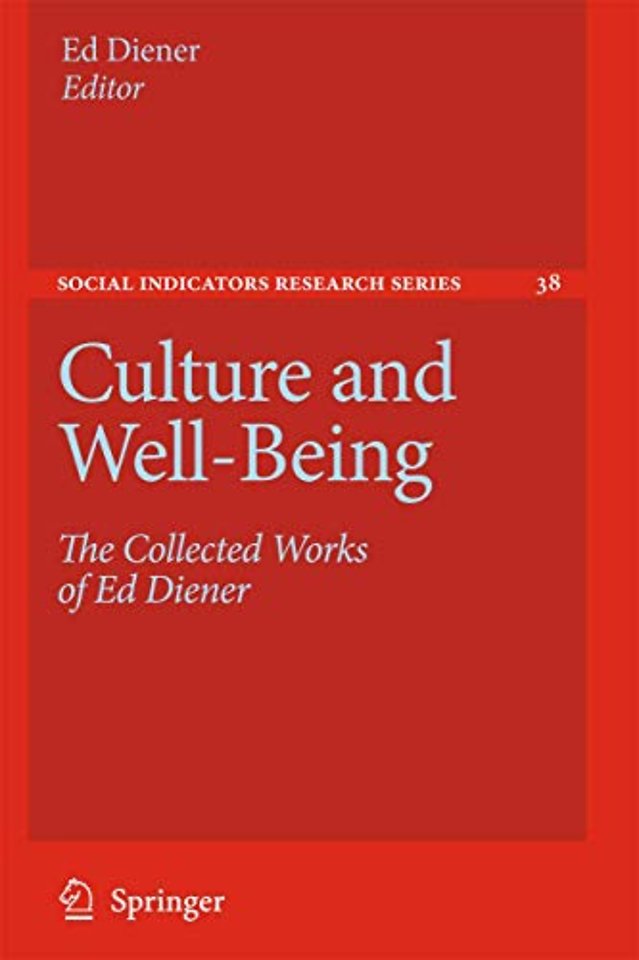
Culture and Well-Being
The Collected Works of Ed Diener
Samenvatting
material boundaries capture cultural effects? The articles contained in this volume offer initial answers to most of these questions. The culture and well-being questions are of fundamental importance to understanding in the entire eld and to scienti c knowledge in the behavioral s- ences as a whole. Unless we understand what is universal and what is speci c, we cannot hope to understand the processes governing well-being. Unfortunately, our scienti c knowledge in most behavioral science elds, including the study of we- being, has been built on a narrow database drawn from westernized, industrialized nations. This means that we have only a little knowledge of whether our ndings are generalizable to all peoples of the globe and to universal human psychol- ical processes. Fortunately, during the last decade my students and I, as well as others working in this area, have rapidly expanded our knowledge of well-being vis-a-vis ` culture. The rst attempt to summarize the ndings in this area came in 1999 with Culture and Subjective Well-Being, a book edited by Eunkook Suh and Diener. The current volume represents a renewed effort to give a broad overview of major ndings in this area and to point to the important directions for future research. Composition of This Volume I am very pleased with the articles presented in this volume because I believe that they represent true advances in our fundamental understanding of subjective we- being.
Specificaties
Inhoudsopgave
2. Culture and Subjective Well-Being - Tov & Diener
3. Factors Predicting the Subjective Well-Being of Nations - Diener, Diener & Diener
4. Cross-Cultural Correlates of Life Satisfaction and Self Esteem - Diener & Diener
5. Goals, Culture, and Subjective Well-Being - Oishi & Diener
6. Cross-Cultural Variations in Predictors of Life Satisfaction - Osihi, Diener, Lucas & Suh
7. From Culture to Printing Conditions - Suh, Diener & Updegraff
8. The Dynamics of Daily Events and Well-Being Across Cultures: When Less is More - Oishi, Diener, Choi, Kim-Prieto & Choi
9. Norms for Experiencing Emotions in Different Cultures - Eid & Diener
10. Emotions Across Cultures and Methods - Scollon, Diener, Osihi & Biswas-Diener
11. Positivity and the Construction of Life Satisfaction Judgements: Global Happiness Is Not Sum of Its Parts - Diener, Scollon, Oishi, Dzokoto & Sug
12. Most People are Pretty Happy, but There is Cultural Variation - Biswas-Diener, Vitterso & Diener
13. Making the Best of a Bad Situation: Satisfaction in the Slums of Calcutta - Biswas-Diener & Diener
14. Conclusion - Diener
Anderen die dit kochten, kochten ook
-
 Dieter Möckelmann€ 16,95
 -
Tim Fransen€ 24,99
-
Annegreet van Bergen€ 17,50
-
Farid Tabarki€ 24,99
-
Derk Sauer€ 22,99
-
Kashmir Hill€ 23,50