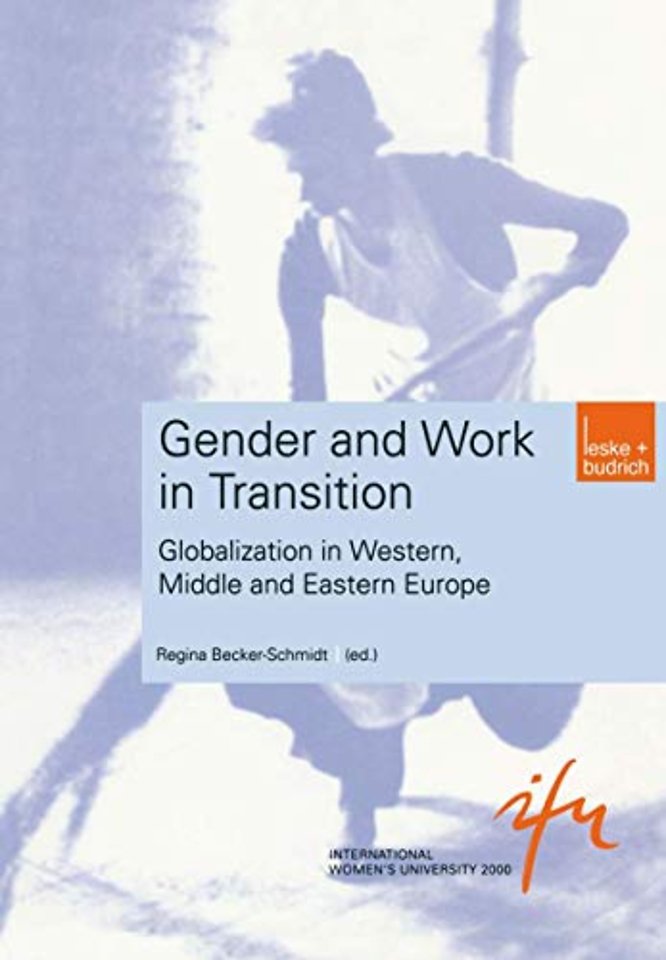
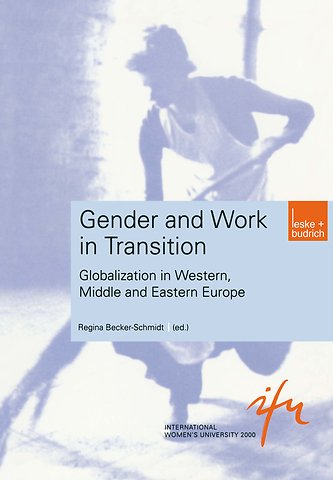
Gender and Work in Transition
Globalization in Western, Middle and Eastern Europe
Samenvatting
The contributions collected in this volume were produced on the occasion of the International Women's University (ifu), which took place in Hanover in the summer of 2000. They belong to the preparation papers and lesson materials written for the project-area "Work. " This area was one of the six faculties, along with "Information," "Body," "Migration," "City," and "Water," which formed the program of the ifu. On a world wide horizon, each project-area chose re gional centers appropriate for its special topic. Tensions between global and - cal developments and their economic, socio-cultural and political effects on gen der relationships were thematized in almost all faculties. Special attention was paid to women's new opportunities as well as worsening life conditions in a chan ging world. The cosmopolitan orientation of the Ifu corresponds on a sci entific level to internationality and interdisciplinarity as requirements for each design of the curriculum. I will come back to what this means for our project area. It was our goal to explore the connections between globalization, work and gender. This was a difficult undertaking. As "globalization" is a process that oc curs in transnational contexts and under varying local constellations, its multiple modes of operation can only become visible by studying a certain number of countries. An approach based on contrasting methods, however, demands a weIl considered plan- how many and what kind of regions should be exemplarily compared.
Specificaties
Inhoudsopgave
Anderen die dit kochten, kochten ook
-
 Jos Ahlers€ 24,95
 -
Japke-d. Bouma€ 19,99
-
Jitske Kramer€ 27,50
-
Marije van den Berg€ 27,50
-
Paul Frissen€ 29,90
-
Floor Milikowski€ 22,99