Marlies Klemisch-Ahlert
Springer Berlin Heidelberg
0e druk, 1996
9783540610489
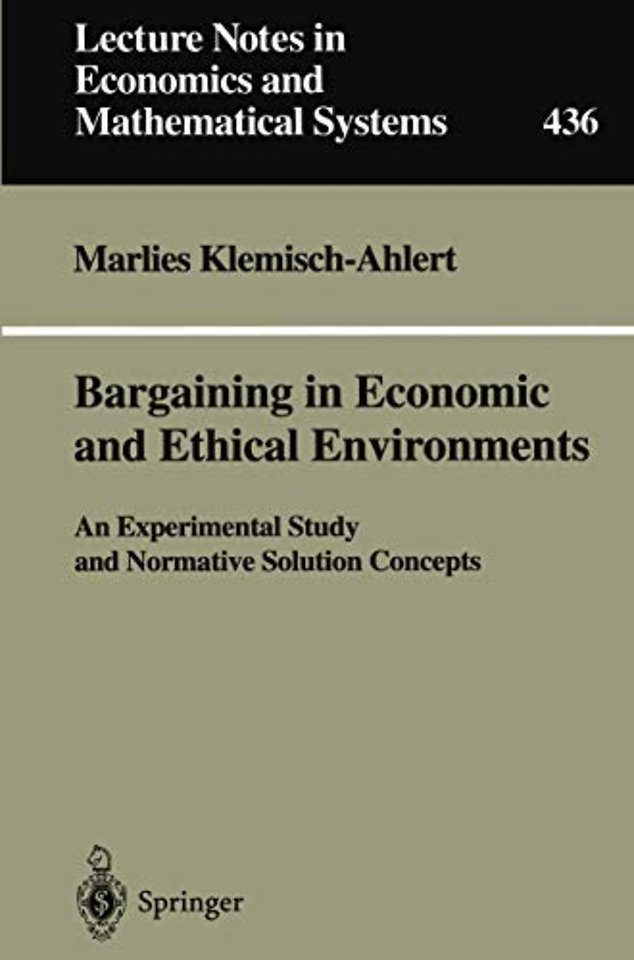
Bargaining in Economic and Ethical Environments
An Experimental Study and Normative Solution Concepts
Specificaties
Paperback, 155 blz.
|
Engels
Springer Berlin Heidelberg |
0e druk, 1996
ISBN13: 9783540610489
Rubricering
Onderdeel van serie
Lecture Notes in Economics and Mathematical Systems
Levertijd ongeveer 8 werkdagen
Samenvatting
Two features are combined in this book: the analysis of bargaining experiments and the development of axiomatic bargaining theories. Further, a new type of the latter is derived from observations in the former. The author describes bargaining experiments with different economic and ethical frames as well as developing axiomatic approaches to characterize the corresponding bargaining solutions.
Specificaties
ISBN13:9783540610489
Taal:Engels
Bindwijze:paperback
Aantal pagina's:155
Uitgever:Springer Berlin Heidelberg
Hoofdrubriek:Economie
Inhoudsopgave
1 Introduction.- I An Experimental Study on Bargaining Behavior.- 2 Motivation and Design of the Study.- 2.1 Motivation.- 2.2 Design of the Study.- 2.3 Data.- 3 Monotonicity Results.- 3.1 Introduction.- 3.2 Rank Regression Analysis.- 3.3 Monotonicity in Payoff Ratios of the Agreements.- 3.4 Monotonicity in Planned Bargaining Goals.- 4 Norms in Economic and Ethical Environments.- 4.1 Introduction.- 4.2 Strong Pareto Optimality in Payoffs or Envy?.- 4.3 Environments with Contributions.- 4.4 Environments with Payments to Indigents.- II Normative Bargaining Theories on Economic and Ethical Environments.- 5 Roemer’s Bargaining Theory on Economic Environments.- 6 Bargaining Solutions with Goals.- 6.1 Introduction.- 6.2 Economic Situations and Goals.- 6.3 Bargaining Solutions.- 6.4 A Characterization of the Proportional Solution by a Monotonicity Axiom.- 6.5 A Characterization of the Proportional Solution by a Concession Axiom.- 6.6 Goal Functions and Proportional Solutions.- 6.7 An Outlook on a Bargaining Theory on Ethical and Economic Environments.- 7 An Axiomatic Characterization of the Normalized Utilitarian Bargaining Solution.- 7.1 Introduction.- 7.2 Definitions and Notations.- 7.3 Axioms.- 7.4 Result.- 7.5 Concluding Remarks.- 8 Bargaining When Redistribution is Possible.- 8.1 Introduction.- 8.2 Notations, Definitions and Axioms.- 8.3 Solutions.- 8.4 A Characterization of the Generalized Kalai-Smorodinsky Solution on Dn.- 8.5 A Characterization of the Generalized Kalai-Smorodinsky Solution on
$$ D_0^n $$.- 8.6 A Characterization of the Generalized Kalai-Smorodinsky Solution on $$ D_0^2 $$.- 8.7 Concluding Remarks.- 9 A Combination of Part I and Part II.- Notations.
$$ D_0^n $$.- 8.6 A Characterization of the Generalized Kalai-Smorodinsky Solution on $$ D_0^2 $$.- 8.7 Concluding Remarks.- 9 A Combination of Part I and Part II.- Notations.
Anderen die dit kochten, kochten ook
-
 Barbara Minto€ 47,95
 -
Paul Schenderling€ 27,50
-
Susanne van Der Velden€ 34,99
-
Robin Wall Kimmerer€ 19,07
-
Lisa Herzog€ 24,99
-
Bas van Bavel€ 32,99