, , , e.a.

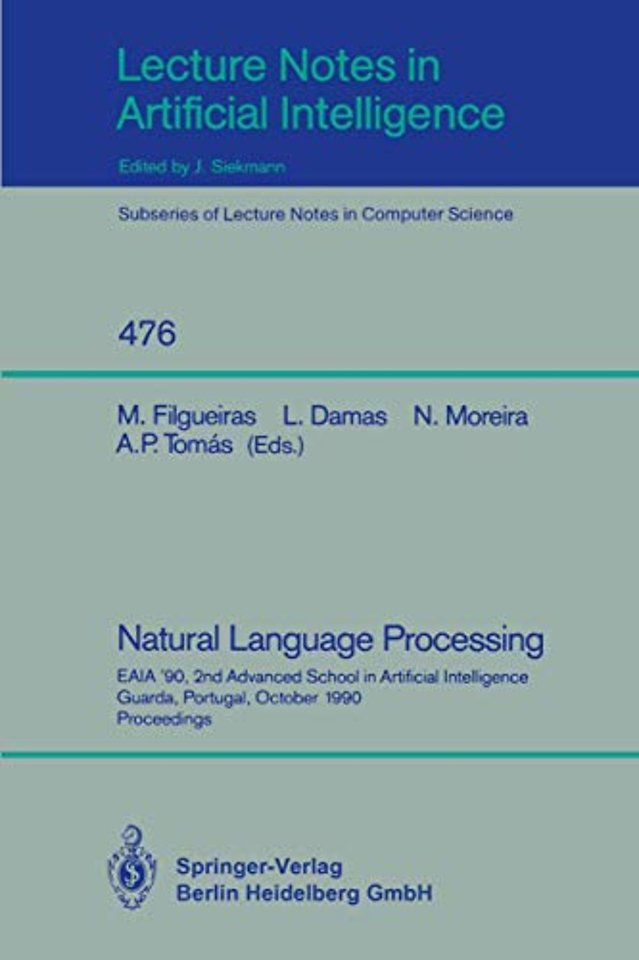
Natural Language Processing

EAIA '90, 2nd Advanced School in Artificial Intelligence Guarda, Portugal, October 8-12, 1990. Proceedings

Specificaties
Paperback, 262 blz. | Engels
Springer Berlin Heidelberg | 1991e druk, 1991
ISBN13: 9783540536789
Rubricering
Springer Berlin Heidelberg 1991e druk, 1991 9783540536789
Onderdeel van serie Lecture Notes in Computer Science
€ 60,99
Levertijd ongeveer 8 werkdagen

Samenvatting

This volume is the proceedings of the Second Advanced School on Artificial Intelligence (EAIA '90) held in Guarda, Portugal, October 8-12, 1990. The focus of the contributions is natural language processing. Two types of subject are covered: - Linguistically motivated theories, presented at an introductory level, such as X-bar theory and head- driven phrase structure grammar, - Recent trends in formalisms which will be familiar to readers with a background in AI, such as Montague semantics and situation semantics. The topics were chosen to provide a balanced overview of the most important ideas in natural language processing today. Some of the results presented were worked out very recently, are the subject of ongoing research, and have not previously appeared in book form. This book may serve as a textbook: in fact its contents were intended as lecture notes.

Specificaties

ISBN13:9783540536789
Taal:Engels
Bindwijze:paperback
Aantal pagina's:262
Uitgever:Springer Berlin Heidelberg
Druk:1991

Inhoudsopgave

General introduction.- Methods and tools for lexical acquisition.- X-bar theory: Its role in GB theory.- Information-based linguistics and head-driven phrase structure.- Three lectures on situation theoretic grammar.- Basic aspects of the theory of generalized quantifiers.- The semantics of tense and aspect.- Simplifying and correcting the treatment of intentionality in Montague semantics.- Compositionality and omniscience in situation semantics.- Some remarks on first-order intensional logic.- References.
€ 60,99
Levertijd ongeveer 8 werkdagen

Rubrieken

    Personen

      Trefwoorden

        Natural Language Processing