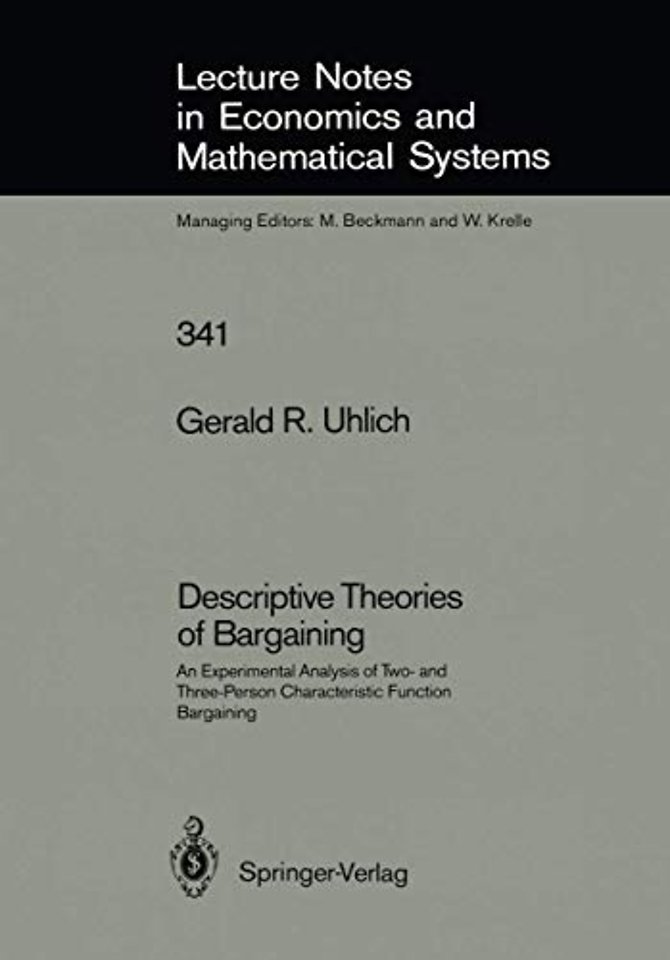
Descriptive Theories of Bargaining

An Experimental Analysis of Two- and Three-Person Characteristic Function Bargaining

Specificaties
Paperback, 165 blz. | Engels
Springer Berlin Heidelberg | 0e druk, 1990
ISBN13: 9783540524830
Rubricering
Springer Berlin Heidelberg 0e druk, 1990 9783540524830
€ 60,99
Levertijd ongeveer 8 werkdagen

Samenvatting

The aim of this book is the presentation of two new descriptive theories for experimental bargaining games and a comparison with other descriptive and normative theories. To obtain data it was necessary to develop two sets of computer programs for computer controlled ex­ periments. Moreover, data obtained by other researchers, which are available to us will be included in this study. The use of laboratory experiments in economics was introduced by THURSTONE [1931] in the field of utility theory. CHAMBERLIN [1948] was the first person to establish an expe­ rimental market for the purpose of testing a theory. The first experiment on characteristic function games was done by KALISH, MILNOR, NASH, and NERING [1954]. Today the use of experiments in controlled laboratory settings has become widespread. Earlier, economists went into the field to observe phenomena as the behavior of individuals, corporations and nations in action, then they formulated theories to explain what they saw. But unlike natural scientists, economists have not been able to test their theories under controlled conditions. Now experimental economists are able to replicate their results. Replication is very proble­ matic for field studies, because rarely the same conditions can be established again. Moreover, experimenters are able to test theories for situations described by simplified models which are not observable in the real world.

Specificaties

ISBN13:9783540524830
Taal:Engels
Bindwijze:paperback
Aantal pagina's:165
Uitgever:Springer Berlin Heidelberg
Druk:0
Hoofdrubriek:Economie

Inhoudsopgave

1. Introduction.- 2. Notations and Definitions of Characteristic Function Games.- 2.1 Measurement of Predictive Success.- 2.2 Prominence Level.- 3. Two-Person Bargaining Games.- 3.1 Programs for Computer-Controlled Two-Person Bargaining Games.- 3.1.1 System Requirements.- 3.1.2 The Two-Person Bargaining Master-Program.- 3.1.3 The Two-Person Bargaining Terminal-Program.- 3.2 Experimental Design.- 3.2.1 Experimental Procedure.- 3.2.2 The Data Base.- 3.3 The Negotiation Agreement Area.- 3.3.1 Power, Justice Norms and Aspirations.- 3.3.2 A Descriptive Theory.- 3.4 Evaluation of Two Pilot Experiments.- 3.4.1 General Results.- 3.4.2 Comparison of Different Point-Solution Concepts.- 3.4.3 Comparison of Different Area Theories.- 3.5 Summary on Two-Person Games.- 4. Three-Person Bargaining Games.- 4.1 Programs for Computer-Controlled Three-Person Bargaining Games.- 4.1.1 System Requirements.- 4.1.2 The Three-Person Bargaining Master-Program.- 4.1.3 The Three-Person Bargaining Terminal-Program.- 4.2 Experimental Design.- 4.2.1 Experimental Procedure.- 4.2.2 The Data Base.- 4.3 Theories of Coalition Formation.- 4.3.1 The Core.- 4.3.2 Bargaining Set.- 4.3.3 Equal Excess Theory.- 4.3.4 Equal Division Payoff Bounds.- 4.3.5 Proportional Division Payoff Bounds.- 4.4 Experimental Results.- 4.4.1 Overall Comparisons.- 4.4.2 Games with Zero and Positive Payoffs to the One-Person Coalitions.- 4.4.3 Additional Hypotheses.- 4.4.4 The Relevance of the Core in Games with a Thick Core.- 4.4.5 Experience of Negotiators in Bargaining Games.- 4.5 Summary on Three-Person Games.- 5. Summary and Conclusion.- A. Introduction to the Rules and the Experimental Apparatus of a Two-Person Bargaining Experiment.- B. Introduction to the Rules and the Experimental Apparatus of a Three-Person Bargaining Experiment.- C. Listing of All Results.- References.
€ 60,99
Levertijd ongeveer 8 werkdagen

Rubrieken

    Personen

      Trefwoorden

        Descriptive Theories of Bargaining