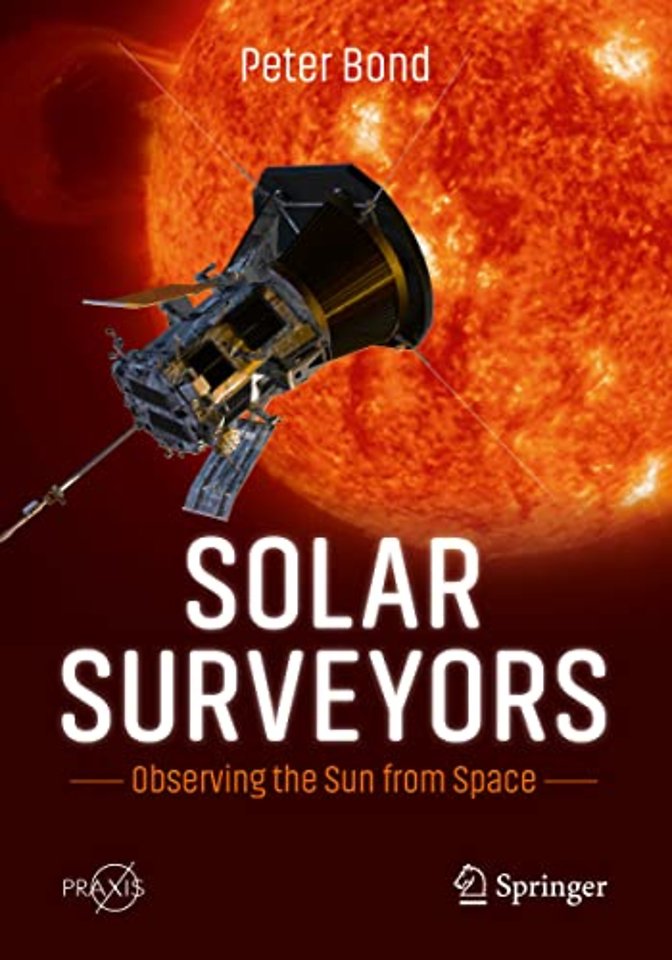
Solar Surveyors

Observing the Sun from Space

Specificaties
Paperback, blz. | Engels
Springer International Publishing | e druk, 2022
ISBN13: 9783030987879
Rubricering
Springer International Publishing e druk, 2022 9783030987879
Onderdeel van serie Springer Praxis Books
€ 43,33
Levertijd ongeveer 8 werkdagen

Samenvatting

This is the story of humankind’s quest over centuries to learn the true nature of the most dominant object in our Solar System: the Sun.Award-winning science writer Peter Bond describes in detail how our ideas about the Sun have changed over the millennia, starting with the simple observations of classical astronomy and continuing through telescopic observations to the age of nuclear physics. He shows how we discovered the Sun’s basic characteristics – its distance, size, temperature and composition – and then describes how, with evermore sophisticated instruments, we have learned about the Sun’s enormous energy output, its atmosphere and the explosive eruptions that blast clouds of magnetized gas and high-energy particles toward our world.

Most of this book focuses on the Space Age, when suborbital rockets and satellites have probed every aspect of our nearby star. Each of these missions is described in detail, with summaries of their objectives, spacecraft designs, scientific payloads and results. The book also looks forward, describing forthcoming missions that will shed new light on remaining solar mysteries, notably the source of the energy that heats the outer corona to millions of degrees.

Richly illustrated with mission photos, design diagrams, and infocharts, this book is a fascinating read for anybody interested in the Sun and our attempts to unravel its secrets.

Specificaties

ISBN13:9783030987879
Taal:Engels
Bindwijze:paperback
Uitgever:Springer International Publishing

Inhoudsopgave

<div>Section 1 - Background</div><div>1.The Sun - an introduction, including day/night, seasons, eclipses, early observations.&nbsp;</div><div>2.The main solar features: interior, corona, sunspots, coronal mass ejections, flares, prominences, filaments,&nbsp; solar wind etc.</div><div>3. Observing the Sun - the electromagnetic spectrum, capabilities and limitations of ground-based&nbsp; &nbsp;observatories. Sounding rockets.</div><div><br></div>Section 2 - The Missions<div>Technical descriptions of space-based solar missions and their main scientific contributions:</div><div><br></div><div>4.Characterising the Interplanetary Environment</div><div> The first lunar and planetary missions (Luna, Explorer etc.), missions such as Genesis, Helios&nbsp;</div><div> IBEX (Interstellar Boundary Explorer), Voyager, Interplanetary Monitoring Platforms</div><div> ISSE (International Sun-Earth Explorers), Koronas, Pioneer 6-8, Prognoz series, Solwind.</div><div>5.Exploring the Sun-Earth Connection, e.g. ACE (Advanced Composition Explorer), AcrimSat (Active Cavity Irradiance Monitor Satellite), Cluster II, Double Star, Interball, RBSP (Radiation Belt Storm Probes), WIND.&nbsp;</div><div><br></div><div>6.Solar Observatories e.g. SOHO (Solar and Heliospheric Observatory), Solar Dynamics Observatory,&nbsp; STEREO, TRACE, Parker Solar Probe, Solar Orbiter, Yohkoh, Ulysses.</div><div><br></div><div>7.Solar instruments using crewed spacecraft, e.g. Apollo Telescope Mount (Skylab), SOLAR, SolarMax, Spartan 201</div><div><br></div><div>8.Other Solar Observing Missions, e.g. GOES (Solar X-Ray Imager), PROBA-2 and -3.</div><div><br></div><div>9.Bibliography</div><div><br></div>
€ 43,33
Levertijd ongeveer 8 werkdagen

Rubrieken

    Personen

      Trefwoorden

        Solar Surveyors