, ,

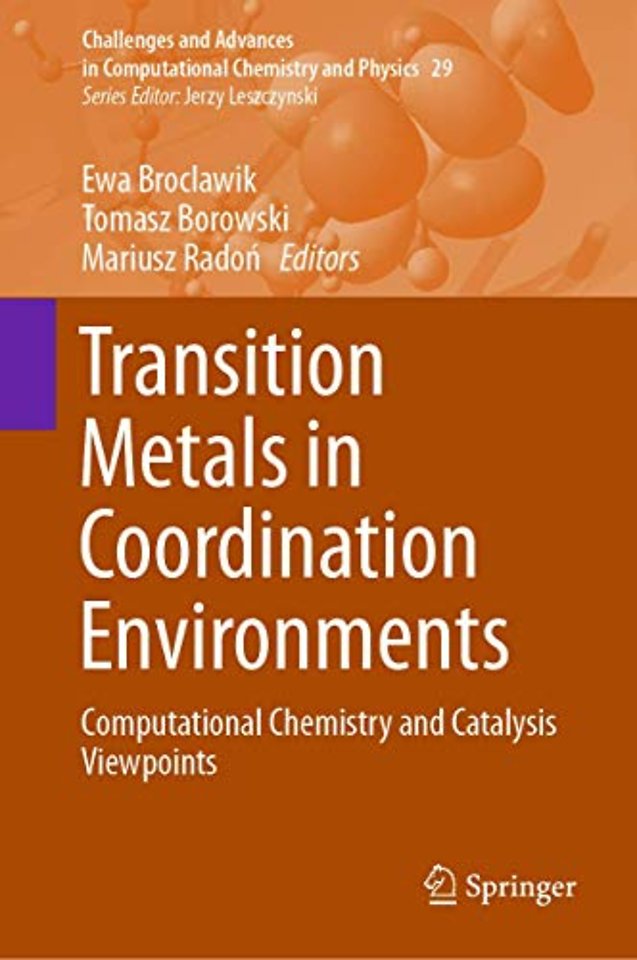
Transition Metals in Coordination Environments

Computational Chemistry and Catalysis Viewpoints

Specificaties
Gebonden, blz. | Engels
Springer International Publishing | e druk, 2019
ISBN13: 9783030117139
Rubricering
Springer International Publishing e druk, 2019 9783030117139
€ 180,99
Levertijd ongeveer 8 werkdagen

Samenvatting

This book focuses on the electronic properties of transition metals in coordination environments. These properties are responsible for the unique and intricate activity of transition metal sites in bio- and inorganic catalysis, but also pose challenges for both theoretical and experimental studies. Written by an international group of recognized experts, the book reviews recent advances in computational modeling and discusses their interplay using experiments. It covers a broad range of topics, including advanced computational methods for transition metal systems; spectroscopic, electrochemical and catalytic properties of transition metals in coordination environments; metalloenzymes and biomimetic compounds; and spin-related phenomena. As such, the book offers an invaluable resource for all researchers and postgraduate students interested in both fundamental and application-oriented research in the field of transition metal systems. 

Specificaties

ISBN13:9783030117139
Taal:Engels
Bindwijze:gebonden
Uitgever:Springer International Publishing

Inhoudsopgave

From the content: Review of the current status of knowledge in the field of recent achievements in computational modeling and their interplay with experiment.- Density matrix renormalization group (DMRG): An emerging method in bioinorganic chemistry.- Approaching magnetic interactions in oligonuclear transition metal clusters with density matrix renormalization group.- New strategies in modelling electronic structures and properties in actinides.- X-ray probes of electronic structure in transition metal complexes.- Electronic spectroscopy of cobalamins studied with density functional theory.- Spin magnetic properties of transition metal complexes.- Computational studies of transition-metal catalysis in biological and non-biological settings.- The role of non-covalent interactions in metal complexes.- Molecular electrochemistry of coordination compounds - a correlation between quantum-chemical calculations and experiment.- Computational modelling of structure and catalytic properties of supported group VI transition metal oxide species.- Catalytic properties of TM in inorganic coordination environments.- Challenges in modeling metalloenzymes and their troubleshooting.- The quest for accurate theoretical models of metalloenzymes: an aid to experiment.- Metal coordination in the active sites of selected metalloenzymes: a theoretical point of view.- Metal – redox-active ligand cooperation in biomimetic transition metal compounds to exhibit metal-centered multi-electron reactivity.- Computational vs. experimental spectroscopy for transition-metals.- The electronic determinants of spin crossover described by density functional theory.- Photodeactivation channels of transition metal complexes: a computational chemistry perspective.
€ 180,99
Levertijd ongeveer 8 werkdagen

Rubrieken

    Personen

      Trefwoorden

        Transition Metals in Coordination Environments