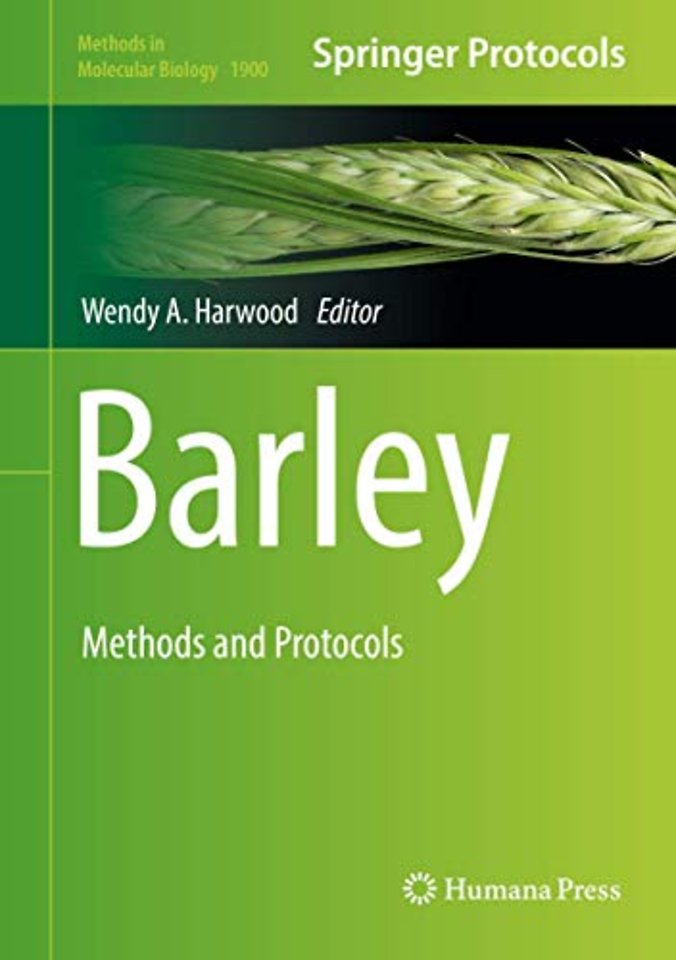

Barley
Methods and Protocols
Samenvatting
This detailed volume explores barley as both a crop and a model, with practical techniques such as crossing barley, a range of tissue culture methods, the preparation of barley tissues for different forms of microscopy, and the assessment of sensitivity to abiotic stresses. Efficient protocols are provided for transformation, TILLING, virus-induced gene silencing and genome editing. There is also particular emphasis on a range of protocols for genotyping and for the analysis of gene expression. Written for the highly successful Methods in Molecular Biology series, chapters include introductions on their respective topics, lists of the necessary materials and reagents, step-by-step, readily reproducible laboratory protocols, and tips on troubleshooting and avoiding known pitfalls.
Authoritative and easy-to-use, Barley: Methods and Protocols serves as a valuable reference volume for cereal researchers and breeders by providing detailed protocols covering important traditional skills such as crossing and tissue culture through to the latest technologies for genotyping, expression analysis, and genome editing.
Specificaties
Inhoudsopgave
<p> Wendy A. Harwood</p>
<p> </p>
<p>2. Mutation Breeding in Barley: Historical Overview</p>
<p> Ludmila Ohnoutkova</p>
<p> </p>
<p>3. A Practical Guide to Barley Crossing</p>
<p> William T.B. Thomas, Hazel Bull, Allan Booth, Ruth Hamilton, Brian P. Forster, and Jerome D. Franckowiak</p>
<p> </p>
<p>4. Barley Anther Culture</p>
<p> Ludmila Ohnoutkova, Tomas Vlcko, and Mentewab Ayalew</p>
<p> </p>
<p>5. Isolated Microspore Culture in Barley</p>
<p> Patricio Esteves and François J. Belzile</p>
<p> </p>
<p>6. TILLING in Barley</p>
<p> Matthias Jost, Miriam Szurman-Zubrzycka, Katarzyna Gajek, Iwona Szarejko, and Nils Stein</p>
<p> </p>
<p>7. Virus-Induced Gene Silencing (VIGS) for Functional Characterization of Disease Resistance Genes in Barley Seedlings</p>
<p> Lokanadha R. Gunupuru, Alexandre Perochon, Shahin S. Ali, Steven R. Scofield, and Fiona M. Doohan</p>
<p> </p>
<p>8. Agrobacterium-Mediated Transformation of Barley Immature Embryos</p>
<p> Alison Hinchliffe and Wendy A. Harwood</p>
<p> </p>
<p>9. Methods for the Simple and Reliable Assessment of Barley Sensitivity to Abiotic Stresses during Early Development</p>
<p> Agata Daszkowska-Golec, Anna Skubacz, Marzena Kurowska, Michał Słota, Dorota Swiergolik, and Iwona Szarejko</p>
<p> </p>
<p>10. Preparation of Barley Roots for Histological, Structural, and Immunolocalization Studies Using Light and Electron Microscopy</p>
<p> Marek Marzec and Michael Melzer</p>
<p> </p>
<p>11. Preparation of Barley Pollen Mother Cells for Confocal and Super Resolution Microscopy</p>
<p> Sybille Mittmann, Mikel Arrieta, Luke Ramsay, Robbie Waugh, and Isabelle Colas</p>
<p> </p>
<p>12. Microarrays for High-Throughput Gene Expression Analysis of Barley</p>
<p> Jenny A. Morris and Pete E. Hedley</p>
<p> </p>
<p>13. Genome Engineering Using TALENs</p>
<p> Goetz Hensel and Jochen Kumlehn</p>
<p> </p>
<p>14. Creating Targeted Gene Knock-Outs in Barley Using CRISPR/Cas9</p>
<p> Tom Lawrenson and Wendy Harwood</p>
<p> </p>
<p>15. Genotyping-by-Sequencing on the Ion Torrent Platform in Barley</p>
Amina Abed, Gaétan Légaré, Sonia Pomerleau, Jérôme St-Cyr, Brian Boyle, and François Belzile<p></p>
<p> </p>
<p>16. DNA Methylation Analysis in Barley and Other Species with Large Genomes</p>
<p> Karolina Chwialkowska, Urszula Korotko, and Miroslaw Kwasniewski</p>
<p> </p>
<p>17. High Resolution RT-PCR Analysis of Alternative Barley Transcripts</p>
<p> Craig G. Simpson, John Fuller, Paulo Rapazote-Flores, Claus-Dieter Mayer, Cristiane P.G. Calixto, Linda Milne, Pete E. Hedley, Clare Booth, Robbie Waugh, and John W.S. Brown</p>
<p></p>
<p>18. Exome Capture for Variant Discovery and Analysis in Barley</p>
<p> Micha Bayer, Jenny Morris, Clare Booth, Allan Booth, Niki Uzrek, Joanne R. Russell, Robbie Waugh, and Pete E. Hedley</p>