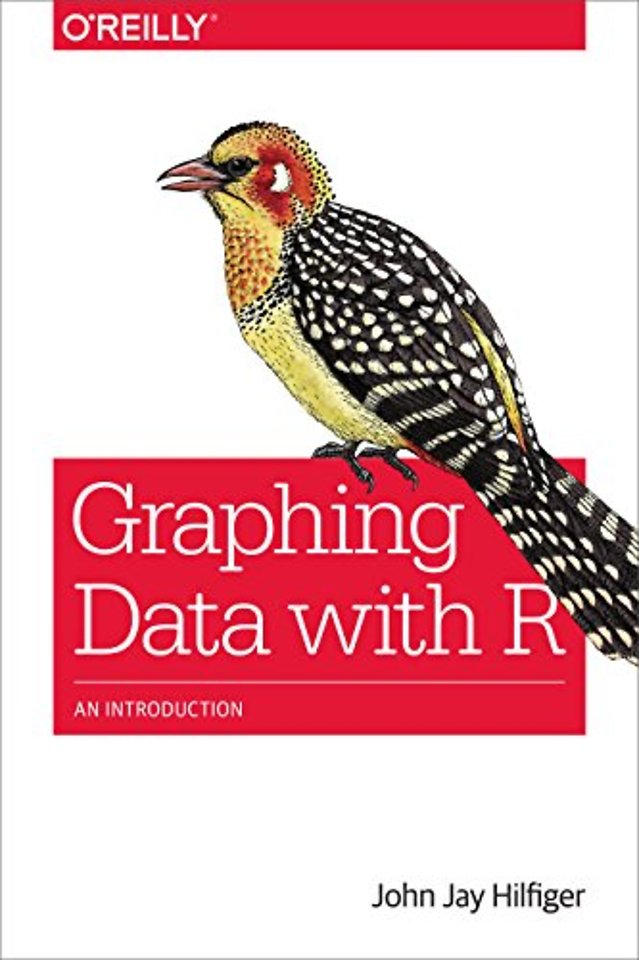
Graphing Data with R
An Introduction
Samenvatting
It’s much easier to grasp complex data relationships with a graph than by scanning numbers in a spreadsheet. This introductory guide shows you how to use the R language to create a variety of useful graphs for visualizing and analyzing complex data for science, business, media, and many other fields. You’ll learn methods for highlighting important relationships and trends, reducing data to simpler forms, and emphasizing key numbers at a glance.
Anyone who wants to analyze data will find something useful here—even if you don’t have a background in mathematics, statistics, or computer programming. If you want to examine data related to your work, this book is the ideal way to start.
- Get started with R by learning basic commands
- Build single variable graphs, such as dot and pie charts, box plots, and histograms
- Explore the relationship between two quantitative variables with scatter plots, high-density plots, and other techniques
- Use scatterplot matrices, 3D plots, clustering, heat maps, and other graphs to visualize relationships among three or more variables
- Examine an idealized SDN framwork for controllers, applications, and ecosytems
Specificaties
Inhoudsopgave
Part 1: Getting Started with R
1. R Basics
2. An Overview of R Graphics
Part 2: Single-Variable Graphs
3. Strip Charts
4. Dot Charts
5. Box Plots
6. Stem-and-Leaf Plots
7. Histograms
8. Kernel Density Plots
9. Bar Plots (Bar Charts)
10. Pie Charts
11. Rug Plots
Part 3: Two-Variable Graphs
12. Scatter Plots and Line Charts
13. High-Density Plots
14. The Bland-Altman Plot
15. QQ Plots
Part 4: Multivariable Graphs
16. Scatter plot Matrices and Corrgrams
17. Three-Dimensional Plots
18. Coplots (Conditioning Plots)
19. Clustering: Dendrograms and Heat Maps
20. Mosaic Plots
Part 5: What Now?
21. Resources for Extending Your Knowledge of Things Graphical and R Fluency
Appendix A: References
Appendix B: R Colors
Appendix C: The R Commander Graphical User Interface
Appendix D: Packages Used/Referenced
Appendix E: Importing Data from Outside of R
Appendix F: Solutions to Chapter Exercises
Appendix G: Troubleshooting: Why Doesn’t My Code Work?
Appendix H: R Functions Introduced in This Book
Index
Anderen die dit boek kochten, kochten ook
-
 Razi Rais€ 50,14
 -
Aninda Chatterjee€ 93,34
-
Bjarne Stroustrup€ 88,54
-
Mark Lutz€ 89,84
-
Chapple€ 68,04
-
Jesse Schell€ 81,44