,

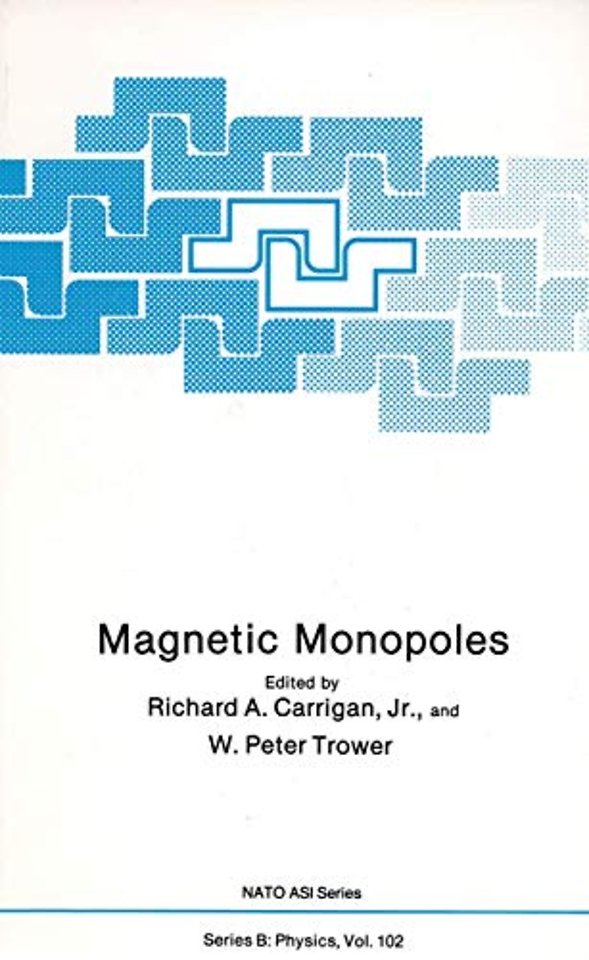
Magnetic Monopoles

Specificaties
Paperback, 337 blz. | Engels
Springer US | 0e druk, 2012
ISBN13: 9781461573722
Rubricering
Springer US 0e druk, 2012 9781461573722
Onderdeel van serie NATO Science Series B:
€ 60,99
Levertijd ongeveer 8 werkdagen

Samenvatting

In 1269 Petrus Peregrinus observed lines of force around a lodestone and noted that they were concentrated at two points which he designated as the north and south poles of the magnet. Subsequent observation has confirmed that all magnetic objects have paired regions of' opposite polarity, that is, all magnets are dipoles. It is easy to conceive of an isolated pole, which J.J. Thomson did in 1904 when he set his famous problem of the motion of an electron in the field of a magnetic charge. In 1931 P.A.M. Dirac solved this problem quantum mechanically and showed that the existence of a single magnet pole anywhere in the universe could explain the mystery of charge quantization. By late 1981, theoretical interest in monopoles had reached the point where a meeting was organized at the International Centre for Theoretical Physics in Trieste. Many mathematical properties of monopoles were discussed at length but there was only a solitary account describing experiments. This imbalance did not so much reflect the meeting's venue as it indicated the relative theoretical and experimental effort at that point.

Specificaties

ISBN13:9781461573722
Taal:Engels
Bindwijze:paperback
Aantal pagina's:337
Uitgever:Springer US
Druk:0

Inhoudsopgave

Section I: Overview.- Monopoles and Gauge Theories.- Testing GUTs: Where Do Monopoles Fit?.- Experimental Status of Monopoles.- Section II: Particle Models and Cosmology.- Monopole Compatibility with Cosmology.- Reducing the Monopole Abundance.- Catalysis of Baryon Decay.- Fractional Charge and Magnetic Monopoles.- Section III: Monopoles in the Universe.- Monopoles and Astrophysics.- Monopoles and the Galactic Magnetic Fields.- The Plasma Physics of Magnetic Monopoles in the Galaxy.- Monopolonium.- Section IV: Induction Experiments.- Status of Stanford Superconductive Monopole Detectors.- A Preview of Current Studies on Magnetic Monopole Detection Using Induction Coils.- Acoustic Detection of Monopoles.- Binding of Monopoles in Matter and Search in Large Quantities of Old Iron Ore.- Section V: Ionization Experiments.- Monopole Energy Loss and Detector Excitation Mechanisms.- Electronic Cosmic Ray Monopole Searches.- Searches for Monopoles with Track-Etch Detectors.- Search for Magnetic Monopoles in Proton-Antiproton Interactions at 540 GeV C.M. Energy.- Participants.
€ 60,99
Levertijd ongeveer 8 werkdagen

Rubrieken

    Personen

      Trefwoorden

        Magnetic Monopoles