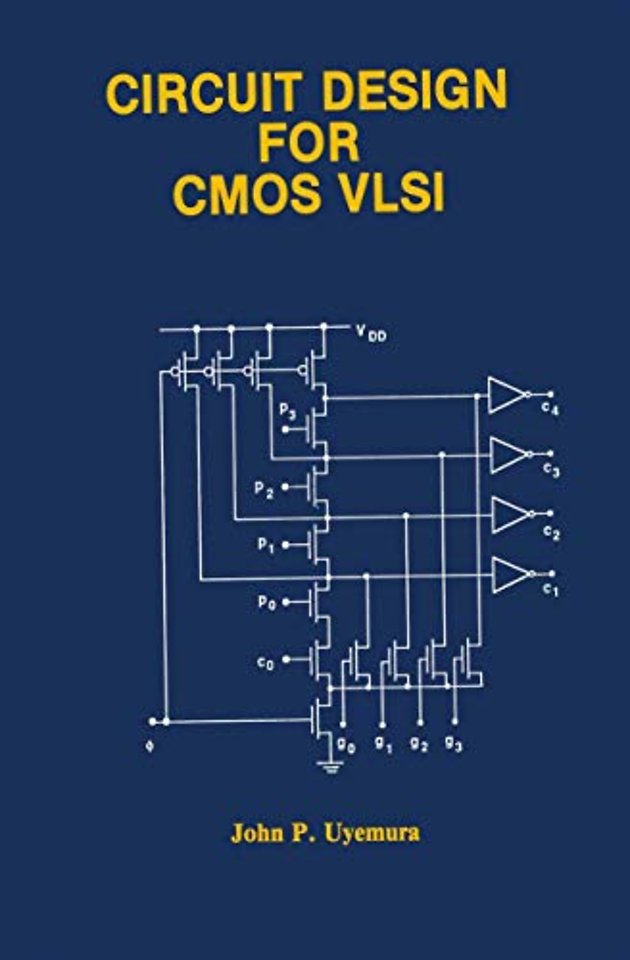
Circuit Design for CMOS VLSI

Specificaties
Paperback, 480 blz. | Engels
Springer US | 0e druk, 2011
ISBN13: 9781461366096
Rubricering
Springer US 0e druk, 2011 9781461366096
€ 60,99
Levertijd ongeveer 8 werkdagen

Samenvatting

During the last decade, CMOS has become increasingly attractive as a basic integrated circuit technology due to its low power (at moderate frequencies), good scalability, and rail-to-rail operation. There are now a variety of CMOS circuit styles, some based on static complementary con­ ductance properties, but others borrowing from earlier NMOS techniques and the advantages of using clocking disciplines for precharge-evaluate se­ quencing. In this comprehensive book, the reader is led systematically through the entire range of CMOS circuit design. Starting with the in­ dividual MOSFET, basic circuit building blocks are described, leading to a broad view of both combinatorial and sequential circuits. Once these circuits are considered in the light of CMOS process technologies, impor­ tant topics in circuit performance are considered, including characteristics of interconnect, gate delay, device sizing, and I/O buffering. Basic circuits are then composed to form macro elements such as multipliers, where the reader acquires a unified view of architectural performance through par­ allelism, and circuit performance through careful attention to circuit-level and layout design optimization. Topics in analog circuit design reflect the growing tendency for both analog and digital circuit forms to be combined on the same chip, and a careful treatment of BiCMOS forms introduces the reader to the combination of both FET and bipolar technologies on the same chip to provide improved performance.

Specificaties

ISBN13:9781461366096
Taal:Engels
Bindwijze:paperback
Aantal pagina's:480
Uitgever:Springer US
Druk:0

Inhoudsopgave

1 Introduction to CMOS.- 1.1 Why Study CMOS?.- 1.2 Basic Concepts.- 1.2.1 Switch Logic.- 1.2.2 Logic Transmission.- 1.2.3 Data storage.- 1.2.4 Dynamic CMOS.- 1.2.5 CMOS System Design.- 1.3 Plan of the Book.- 1.4 References.- 2 MOSFET Characteristics.- 2.1 Threshold Voltage.- 2.1.1 Body-Bias.- 2.2 Current-Voltage Characteristics.- 2.2.1 Square-Law Model.- 2.2.2 Bulk-Charge Model.- 2.3 p-Channel MOSFETs.- 2.4 MOSFET Capacitances.- 2.4.1 MOS-Based Capacitances.- 2.4.2 Depletion Capacitance.- 2.4.3 Channel Capacitances.- 2.4.4 Device Model.- 2.5 Junction Leakage Currents.- 2.6 Parasitic Resistances.- 2.6.1 Drain and Source Resistance.- 2.6.2 Contact Resistance.- 2.7 Non-Rectangular MOSFET Gates.- 2.8 Mobility Variations.- 2.8.1 Velocity-Saturation Effects.- 2.8.2 Gate Voltage Reduction.- 2.9 Subthreshold Current.- 2.10 Temperature Dependence.- 2.11 Scaling Theory.- 2.11.1 Full-Voltage Scaling.- 2.11.2 Constant-Voltage Scaling.- 2.11.3 Second-Order Scaling Effects.- 2.12 Short-Channel Effects.- 2.12.1 Short-Channel Definition.- 2.12.2 Threshold Voltage Reduction.- 2.12.3 Short-Channel MOSFET Model.- 2.13 Narrow-Width Threshold Voltage.- 2.14 Hot Electrons.- 2.15 MOSFET Modelling in SPICE.- 2.15.1 SPICE2 MOSFET Model.- 2.15.2 BSIM.- 2.16 References.- 3 The CMOS Inverter.- 3.1 Circuit Operation.- 3.1.1 DC Inverter Calculations.- 3.1.2 Symmetrical Inverter.- 3.2 Inverter Switching Characteristics.- 3.2.1 Switching Intervals.- 3.3 Output Capacitance.- 3.4 Secondary Parasitic Effects.- 3.4.1 Leakage Currents.- 3.4.2 Parasitic Resistances.- 3.5 Comparison with SPICE.- 3.5.1 Capacitances.- 3.5.2 MOSFET Models.- 3.5.3 Input Waveforms.- 3.6 Inverter Design.- 3.7 The Power-Delay Product.- 3.8 Temperature Dependence.- 3.9 References.- 4 Static Logic Circuits.- 4.1 General Structure.- 4.2 Series-Connected MOSFETs.- 4.2.1 Discharging Through an nMOS Chain.- 4.2.2 Charging Through a pMOS Chain.- 4.2.3 Body-Bias Effects.- 4.3 NAND Gate.- 4.3.1 DC Characteristics.- 4.3.2 Transient Characteristics.- 4.3.3 Design.- 4.3.4 N-Input NAND.- 4.4 NOR Gate.- 4.4.1 DC Characteristics.- 4.4.2 Transient Times.- 4.4.3 Design.- 4.4.4 N-Input NOR.- 4.5 Comparison of NAND and NOR Gates.- 4.6 OR and AND Gates.- 4.7 Combinational Logic.- 4.7.1 Logic Formation.- 4.7.2 Canonical Logic Forms.- 4.7.3 Circuit Design.- 4.8 Exclusive-OR and Equivalence.- 4.9 Structural Variations.- 4.10 Tri-State Output.- 4.11 Pseudo-nMOS/pMOS Logic.- 4.11.1 Pseudo-nMOS.- 4.11.2 Pseudo-pMOS.- 4.12 Flip-Flops.- 4.13 Schmitt Trigger.- 4.14 References.- 5 CMOS Switch Logic.- 5.1 CMOS Transmission Gates.- 5.1.1 nMOS Transmission Properties.- 5.1.2 pMOS Transmission Characteristics.- 5.2 Transmission Gate Model.- 5.2.1 Equivalent Resistance.- 5.2.2 Load Capacitance.- 5.3 Layout Considerations.- 5.4 TG-Based Switch Logic Gates.- 5.4.1 Path Selector.- 5.4.2 OR Gate.- 5.4.3 XOR and Equivalence.- 5.4.4 Adders.- 5.5 Latches and Flip-Flops.- 5.5.1 Basic Latch.- 5.5.2 D Flip-Flop.- 5.5.3 Toggle Flip-Flop.- 5.5.4 JK Flip-Flop.- 5.6 Array Logic.- 5.6.1 Multiplexers/Demultiplexers.- 5.6.2 Split Arrays.- 5.7 Differential CVS Logic.- 5.7.1 Basic Operation.- 5.7.2 Logic Design.- 5.8 Complementary Pass-Transistor Logic.- 5.9 DSL Logic.- 5.10 References.- 6 Chip Design.- 6.1 Isolation.- 6.1.1 LOCOS.- 6.1.2 Trench Isolation.- 6.2 CMOS Process Examples.- 6.2.1 Bulk CMOS.- 6.2.2 Latchup.- 6.2.3 Silicon-On-Insulator (SOI) Techniques.- 6.3 Design Rules.- 6.3.1 Lithography and Fabrication.- 6.3.2 Basic Design Rule Set.- 6.4 Basic Layout.- 6.4.1 General Layout Strategies.- 6.4.2 Equivalent Load Concept.- 6.4.3 Latchup Prevention.- 6.4.4 Static Gate Layout.- 6.4.5 TG-Based Logic.- 6.5 Interconnects.- 6.5.1 Parasitics.- 6.5.2 Interconnect Levels.- 6.6 Data Transmission.- 6.6.1 Basic Model.- 6.6.2 Lumped-Element Analysis.- 6.7 Transmission Line Analysis.- 6.7.1 Wave Properties.- 6.7.2 Basic Properties.- 6.7.3 Capacitive Load.- 6.7.4 Transmission Line Drivers.- 6.7.5 RC Lines.- 6.8 Crosstalk.- 6.8.1 Origin of Crosstalk.- 6.8.2 Interconnect Coupling.- 6.8.3 Circuit Coupling.- 6.9 Gate Arrays in CMOS.- 6.10 References.- 7 Synchronous Logic.- 7.1 Clock Signals.- 7.2 Clock Distribution and Skew.- 7.3 Clocked Static Logic.- 7.3.1 Design Factors.- 7.3.2 Complex Logic Cascades.- 7.4 Charge Storage Nodes.- 7.5 Charge Leakage.- 7.5.1 Constant Current and Capacitance.- 7.5.2 Voltage-Dependent Current.- 7.5.3 Complete Solution.- 7.5.4 Single-Polarity MOSFET Storage Nodes.- 7.6 Charge Sharing.- 7.7 Dynamic Logic.- 7.7.1 Dynamic nMOS Inverter.- 7.7.2 Dynamic pMOS Inverter.- 7.7.3 Complex Logic.- 7.7.4 Dynamic Cascades.- 7.8 Domino Logic.- 7.8.1 Analysis.- 7.8.2 Maximum Clock Frequency.- 7.8.3 Transistor Sizing.- 7.8.4 Charge Leakage and Charge Sharing.- 7.9 Multiple-Output Domino Logic.- 7.9.1 MODL Carry-Look-Ahead Adder.- 7.10 Latched Domino Logic.- 7.11 NORA Logic.- 7.11.1 Signal Races.- 7.11.2 Data Control Using Dynamic Latches.- 7.11.3 Clocked-CMOS Latches.- 7.11.4 NORA Structuring.- 7.11.5 NORA Serial Adder.- 7.11.6 NORA Serial-Parallel Multiplier.- 7.12 Zipper CMOS Logic.- 7.13 References.- 8 Design of Basic Circuits.- 8.1 Chip Floorplan.- 8.2 Input Protection Circuits.- 8.3 Static Gate Sizing.- 8.3.1 Single Inverter Model.- 8.3.2 Inverter Chain Analysis.- 8.3.3 Application of the Results.- 8.4 Off-Chip Driver Circuits.- 8.4.1 Basic Off-Chip Driver Design.- 8.4.2 Tri-State and Bidirectional I/O.- 8.5 Timing and Clock Distribution.- 8.5.1 Clocks and Timing Circles.- 8.5.2 Clock Generation Circuits.- 8.5.3 Clock Drivers and Distribution Techniques.- 8.6 Memory Circuits.- 8.6.1 Static RAM Cell.- 8.6.2 Dynamic RAM Cell.- 8.6.3 Architecture.- 8.6.4 Address Decoders.- 8.6.5 Column Selector and Sense Amplifiers.- 8.6.6 Summary.- 8.7 References.- 9 Analog CMOS Circuits.- 9.1 MOSFET Equations.- 9.2 Small-Signal MOSFET Model.- 9.3 Basic Amplifier.- 9.3.1 Small-Signal Gain.- 9.3.2 Frequency Response.- 9.4 Voltage References.- 9.5 Current Sources.- 9.6 Differential Amplifier.- 9.7 A CMOS Operational Amplifier.- 9.8 Summary.- 9.9 References.- 10 BiCMOS Circuits.- 10.1 Bipolar Junction Transistors.- 10.1.1 Structure and Operation.- 10.1.2 Bipolar Transistor Capacitances.- 10.2 BiCMOS Technology.- 10.3 BiCMOS Inverter.- 10.3.1 DC Characteristics.- 10.3.2 Transient Switching Characteristics.- 10.4 Comparison of CMOS and BiCMOS Performance.- 10.5 Circuit Variations.- 10.5.1 Pull-Down MOSFETs.- 10.5.2 Logic Swing.- 10.6 Logic Formation.- 10.6.1 NAND Gate.- 10.6.2 NOR Gate.- 10.6.3 AOI and OAI Logic.- 10.6.4 Pseudo-nMOS Input Circuits.- 10.7 Tri-state Output.- 10.8 Level Conversion.- 10.9 Summary.- 10.10 References.
€ 60,99
Levertijd ongeveer 8 werkdagen

Rubrieken

    Personen

      Trefwoorden

        Circuit Design for CMOS VLSI