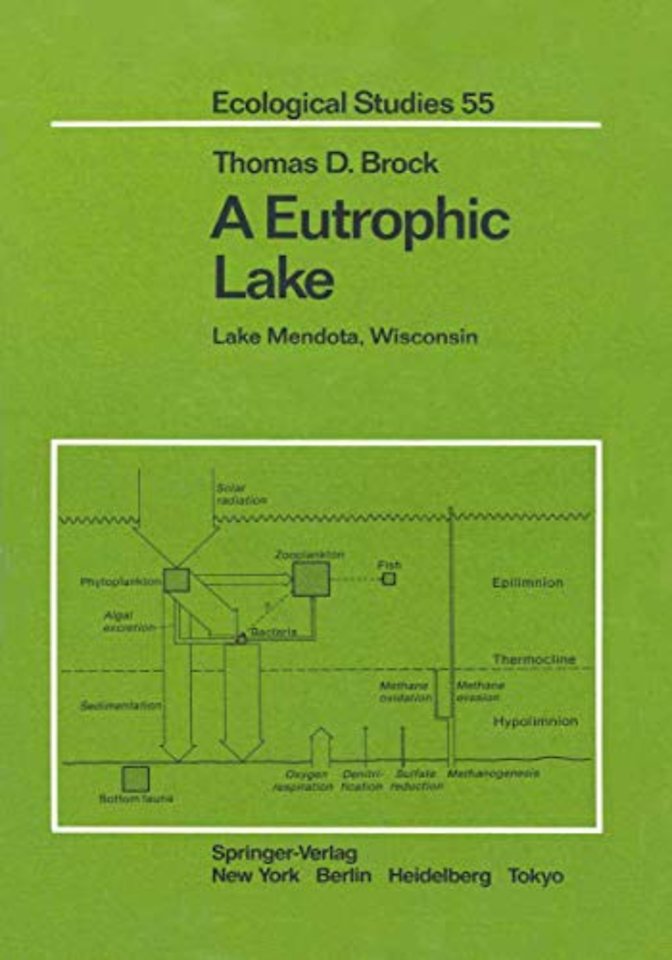
A Eutrophic Lake

Lake Mendota, Wisconsin

Specificaties
Paperback, 308 blz. | Engels
Springer New York | 0e druk, 2012
ISBN13: 9781461264514
Rubricering
Springer New York 0e druk, 2012 9781461264514
Onderdeel van serie Ecological Studies
€ 60,99
Levertijd ongeveer 8 werkdagen

Samenvatting

Lake Mendota has often been called "the most studied lake in the world. " Beginning in the "classic" period of limnology in the late 19th century and continuing through the present time, this lake has been the subject of a wide variety of studies. Although many of these studies have been published in accessible journals, a significant number have appeared in local monographs and reports, ephemeral documents, or poorly distributed journals. To date, there has been no attempt at a synthetic treatment ofthe vast amount of work that has been published. One intent of the present book is to present a com­ prehensive compilation of the major early studies on Lake Mendota and to examine how they impinge on important present-day biological questions. In addition, this book presents a summary of field and laboratory work carried out in my own laboratory over a period of about 6 years and shows where correlations with earlier work exist. The book should be ofinterest to limnologists desiring a ready reference to data and published papers on this important lake, to biogeochemists, ocean­ ographers, and low-temperature geochemists interested in lakes as model sys­ tems for global processes, and to lake managers interested in understanding short-term and long-term changes in lake systems. Although the major thrust ofthe present book is ecologicaland environmental, sufficient background has been presented on other aspects ofLake Mendota's limnology so that the book should also be useful to nonbiologists.

Specificaties

ISBN13:9781461264514
Taal:Engels
Bindwijze:paperback
Aantal pagina's:308
Uitgever:Springer New York
Druk:0

Inhoudsopgave

1. Introduction.- The origin of the lake.- The naming of the Madison lakes.- Ownership of Lake Mendota.- The regional setting.- 2. Physical Limnology.- Morphometry and Hydrography.- General Features of the Lake.- Hypsometry of Lake Mendota.- Climate of the Lake Mendota area.- Water budget of the lake.- Thermal structure and heat budget.- Water movement.- Summary. The four seasons in Lake Mendota.- 3. Chemistry and nutrient loading.- Chemistry of the lake water.- Nutrient loading studies.- Sediment composition and chemistry.- Recent sediments in Lake Mendota.- Oxygen in Lake Mendota.- Nitrogen in Lake Mendota.- Phosphorus in Lake Mendota.- Iron and manganese.- Sulfate.- Chloride.- Silica.- Inorganic carbon in Lake Mendota.- Summary.- 4. Phytoplankton.- Methodology for studying phytoplankton populations in Lake Mendota.- Annual cycles of phytoplankton.- Mean depth of chlorophyll.- Surface/volume ratios of phytoplankton cells.- Diatom blooms in Lake Mendota.- Blue-green algae of Lake Mendota.- Buoyancy of the blue-green algae of Lake Mendota.- Where do the algae go?.- Summary.- 5. Phytoplankton photosynthesis and primary production.- Methods.- Calculating whole lake productivity from incubator data.- Photosynthesis/light (P/I) relationship.- Photosynthetic efficiency of Lake Mendota phytoplankton 125.- Primary production in Lake Mendota.- A model for Lake Mendota production.- 6. Zooplankton.- Methods for studying Lake Mendota Zooplankton.- Species composition.- Zooplankton abundance.- Biomass of Zooplankton.- Conclusions.- 7. Bacteria, carbon cycling, and biogeochemical processes.- Methods.- Bacterial biomass and production in the water column.- The impact of Zooplankton feeding on bacteria.- Importance of bacterial attachment to particles.- A model for bacterioplankton growth and disappearance.- Significance of algal excretory products for epilimnetic bacteria.- Bacterial processes in the anaerobic deep-water sediments.- Sulfate reduction in Lake Mendota.- Conclusion.- 8. Higher Trophic Levels.- Bottom fauna.- Fish.- Summary.- 9. Long-term Change in Lake Mendota.- Chemistry and nutrient loading.- Oxygen in Lake Mendota.- Secchi transparency.- Phytoplankton.- Zooplankton.- Bacteria.- Fish.- Conclusion.- 10. Energy flow in the Lake Mendota ecosystem.- Appendix 1. Physical and chemical data.- Appendix 2. Phytoplankton data.
€ 60,99
Levertijd ongeveer 8 werkdagen

Rubrieken

    Personen

      Trefwoorden

        A Eutrophic Lake