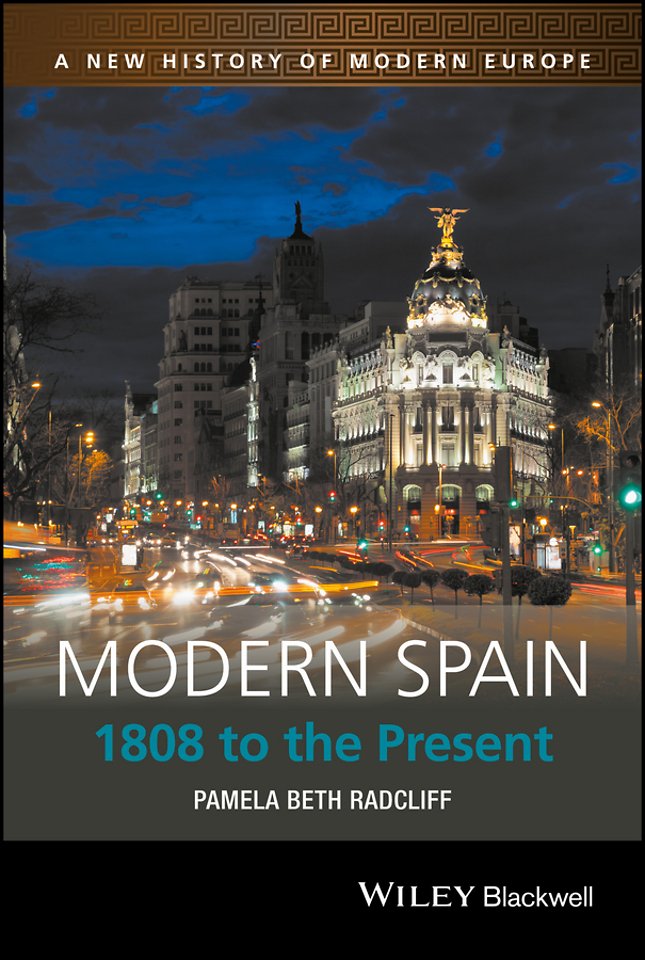
Pamela Beth Radcliff,
PB Radcliff
John Wiley & Sons
e druk, 2017
9781405186803
Modern Spain – 1808 to the Present
1808 to the Present
Specificaties
Paperback, 384 blz.
|
Engels
John Wiley & Sons |
e druk, 2017
ISBN13: 9781405186803
Rubricering
Onderdeel van serie
A New History of Modern Europe
Levertijd ongeveer 8 werkdagen
Samenvatting
Modern Spain: 1808 to the Present is a comprehensive overview of Spanish history from the Napoleonic era to the present day.
Places a large emphasis on Spain′s place within broader European and global history
The chronological political narrative is enriched by separate chapters on long term economic, social and cultural developments
This presentation of modern Spanish history incorporates the latest thinking on key issues of modernity, social movements, nationalism, democratization and democracy
Specificaties
Inhoudsopgave
<p>List of Maps xi</p>
<p>Preface xii</p>
<p>Acknowledgments xvi</p>
<p>Abbreviations and Glossary of Foreign Terms xviii</p>
<p>Political Chronology of Spanish History, 1808 2016 xxii</p>
<p>Part I: 1808 1868: The Era of the Liberal Revolution 1</p>
<p>1 Spain in the Age of Revolutions 3</p>
<p>Spain in Europe and the World, 1780s 1820 4</p>
<p>A Snapshot of the Economy: Gradual Growth 7</p>
<p>Uneven Regional Development: Center/Periphery Divide 10</p>
<p>The Mediterranean Regional Network 10</p>
<p>The North Atlantic Regional Network 11</p>
<p>Regional Networks of the Center 12</p>
<p>Demography: A Growth Pattern 14</p>
<p>Characteristics of the Population: Occupation and Social Structure 15</p>
<p>Culture and Community 18</p>
<p>Political Crisis, 1808 1814 20</p>
<p>Dynastic Crisis 20</p>
<p>War and Resistance 21</p>
<p>The Cortes of Cádiz and the Constitution of 1812 22</p>
<p>A Spanish Constitutional Culture 23</p>
<p>The End of the Revolutionary Era 25</p>
<p>Conclusion 26</p>
<p>2 Political Transformation: From the Old Regime to the Liberal State, 1814 1868 28</p>
<p>Introduction: The Liberal Revolution in Comparative Context 28</p>
<p>The Major Players 31</p>
<p>Moderate and Progressive Parties 31</p>
<p>The Military and Pronunciamientos 32</p>
<p>The Crown 32</p>
<p>Popular/Local Mobilization 33</p>
<p>Counter ]revolution: Carlists 33</p>
<p>The Catholic Church 34</p>
<p>Chronology: From the Restoration of Absolutism to the Construction and Crisis of the Liberal State, 1814 1868 35</p>
<p>1814 1833: The Restoration and Demise of the Absolutist State 35</p>
<p>Restoration of Absolutism, 1814 1820 35</p>
<p>The Liberal Trienio, 1820 23 36</p>
<p>Return to Absolutism, 1823 34 38</p>
<p>1833 1845: The Construction of the Liberal State 39</p>
<p>The Carlist War 39</p>
<p>Moderate and Progressive Constitutions and Platforms 40</p>
<p>The Parameters of a Liberal Political, Juridical and Administrative Order, 1833 45 42</p>
<p>1845 1868: The Liberal State: From Consolidation to Crisis 44</p>
<p>Conclusion: Achievements and Limits of the Liberal Political Transformation 45</p>
<p>Part II: 1868 1923: The Emergence of Mass Politics 49</p>
<p>3 Politics on the Margins of the Liberal State: From 1848 to the Sexenio (1868 1874) 51</p>
<p>Introduction: Mid ]Nineteenth ]century Popular Politics in Comparative Perspective 51</p>
<p>The Major Players 54</p>
<p>Carlists 54</p>
<p>Cuban Separatists 55</p>
<p>Democrats and Republicans 56</p>
<p>The Labor Movement and the First International 58</p>
<p>The First Democracy: The Sexenio, 1868 1874 60</p>
<p>The September 1868 Revolution 60</p>
<p>The Democratic Monarchy (June 1869 February 1873) 61</p>
<p>The Republic (February 12, 1873 January 4, 1874) 63</p>
<p>Conclusion 65</p>
<p>4 A New Era of Liberal Politics: The Second Restoration, 1875 1898 67</p>
<p>The Restoration in Comparative Context: State,</p>
<p>Nation, Empire and Democracy 68</p>
<p>The Multiple Faces of the Restoration Regime 71</p>
<p>Constructing a New Constitutional Regime: Antonio Cánovas del Castillo and the turno pacífico 71</p>
<p>The Dark Side of the Turno: Electoral Fraud and Caciquismo 74</p>
<p>Evaluating the Constraints and Opportunities of Restoration Politics 75</p>
<p>Constraints on Political Liberties Imposed by the State 75</p>
<p>Political Constraints and Opportunities: The View From Below 77</p>
<p>The Disaster of 1898: The Start of a New Era? 80</p>
<p>5 Restoration Politics: From Fin de Siècle to Postwar Crisis, 1898 1923 83</p>
<p>Introduction: Early Twentieth ]Century Spanish Politics in Comparative Context 83</p>
<p>1898 1914: Efforts to Reform the Regime From Above 85</p>
<p>The Conservative Party and Antonio Maura 86</p>
<p>The Liberal Party and José Canalejas 87</p>
<p>1914 23: From Elite Reform to Mass Mobilization: Alternative Political Projects 90</p>
<p>The First World War in Spain 90</p>
<p>From the Turno to Fragmentation of the Liberal and Conservative Parties, 1913 23 91</p>
<p>Movements on the Right 92</p>
<p>Catholic Mobilization 92</p>
<p>Basque Nationalism (PNV/CNV) 93</p>
<p>Mauristas/Spanish Nationalism 94</p>
<p>Movements on the Left 95</p>
<p>Socialists (PSOE/UGT) 95</p>
<p>Anarcho ]syndicalists (CNT) 96</p>
<p>Movements of the Center 97</p>
<p>Republicanism 97</p>
<p>Catalanism/LLiga 98</p>
<p>Turning Points in the Crisis of the Restoration, 1917 23 99</p>
<p>The Democratic Assembly Movement, 1917 100</p>
<p>The La Canadiense Strike, 1919 101</p>
<p>A Last Effort at Reform From Above, 1920 23? 102</p>
<p>Conclusion 103</p>
<p>Part III: The Long View: Social, Economic and Cultural Change, 1830 1930 105</p>
<p>6 Economic and Demographic Evolution: 1830 1930 107</p>
<p>Spain in the World Economy, 1830 1930 108</p>
<p>General Economic and Population Trends: Gradual Growth and Structural Evolution 110</p>
<p>The Agricultural Sector 113</p>
<p>The Industrial Sector 115</p>
<p>Uneven Regional Development: Center/Periphery Divide 118</p>
<p>Conclusion: Missed Opportunities or Inherent Constraints? 120</p>
<p>7 Culture and Society, 1830 1930 122</p>
<p>Introduction: Social and Cultural Evolution in Comparative Perspective 122</p>
<p>The Social Order: Evolution and Diversity 124</p>
<p>A Hybrid Elite 125</p>
<p>The Urban Middle Classes 126</p>
<p>The Popular Classes or el pueblo 127</p>
<p>Rural Society 128</p>
<p>Sociability and Identity: A Diverse and Evolving Cultural Landscape 129</p>
<p>A New Urban Culture: Encoding Social Hierarchy in the Public Sphere 130</p>
<p>On the Margins of Middle Class Culture: The Avant ]Garde and the Modern Woman 133</p>
<p>Urban Popular Sociability and Mass Culture 134</p>
<p>The Catholic Church, Religion and Rural Society 136</p>
<p>Local, Regional and National Cultures and Identities 139</p>
<p>Conclusion 142</p>
<p>Part IV: Dictatorship and Democracy, 1923 Present 143</p>
<p>8 The First Dictatorship: The Primo de Rivera Regime, 1923 1930 145</p>
<p>Introduction: The Primo Regime in Comparative Perspective 145</p>
<p>From Coup to Temporary Dictatorship, 1923 1925 148</p>
<p>Elements of a New Kind of Dictatorship: The Civil Directory, 1925 1929 149</p>
<p>Labor Relations 150</p>
<p>Nationalization Campaigns 151</p>
<p>Authoritarian Development 153</p>
<p>End of the Dictatorship, 1929 1930 154</p>
<p>Political Transition to a Republic, 1930 1931 155</p>
<p>Conclusion 156</p>
<p>9 The Second Republic: 1931 1936 158</p>
<p>The Second Republic in Comparative Perspective 159</p>
<p>Periodization: The Shifting Majority Coalitions of the Second Republic 161</p>
<p>The First Biennium (1931 1933): Pursuing a Center/Left Majority Coalition 164</p>
<p>What Went Wrong with the First Biennium? 167</p>
<p>Mobilizing against the Coalition 167</p>
<p>A Disintegrating Majority Coalition 169</p>
<p>The Second Biennium, 1933 1935: Pursuing a Center/Right Majority Coalition 173</p>
<p>What Went Wrong with the Second Biennium? 175</p>
<p>Mobilizing against the Coalition 176</p>
<p>An Unconsolidated Majority Coalition 178</p>
<p>The Popular Front, February July 1936 180</p>
<p>What Went Wrong with the Popular Front? 181</p>
<p>Conclusion 182</p>
<p>10 The Civil War: 1936 1939 184</p>
<p>The Civil War in Comparative Perspective 185</p>
<p>From Military Coup to Civil War: The Summer of 1936 187</p>
<p>The Rebel Forces in the Summer of 1936 188</p>
<p>Ideology and Violence in Rebel Territory 190</p>
<p>The Loyalist Forces during the Summer of 1936 191</p>
<p>Revolution in Republican Territory 191</p>
<p>Violence in Republican Territory 194</p>
<p>Organizing for the Long War: The Republicans 195</p>
<p>Foreign Aid 196</p>
<p>Reconstructing a Republican State 198</p>
<p>Organizing for the Long War: The Nationalists 201</p>
<p>Constructing a New State 201</p>
<p>Foreign Aid 203</p>
<p>The Military Stages of the War 204</p>
<p>Conclusion 207</p>
<p>11 The Second Dictatorship: The Franco Regime, 1939 1976 209</p>
<p>The Franco Regime in Comparative Perspective 210</p>
<p>Periodization: The Stages of the Franco Dictatorship 212</p>
<p>Phase One, 1936 1945: Militarization, Fascist Influence and Extreme Repression 214</p>
<p>Phase II, 1945 1957: National Catholicism, Monarchist Restoration and International Integration 218</p>
<p>Phase III, 1957 1969: Authoritarian Development and Institutionalization 221</p>
<p>Phase IV, 1969 1975: Collapse of the Coalition and Death of the Dictator 227</p>
<p>Conclusion 229</p>
<p>12 Economic, Social and Cultural Transformation, 1930s 1970s 230</p>
<p>Economy, Society and Culture in Comparative Perspective 230</p>
<p>Economic and Demographic Trends 232</p>
<p>The Years of Hunger : Deprivation, Disease and Death in the 1940s 232</p>
<p>From Economic Stagnation to Rapid Growth: 1950s 1970s 234</p>
<p>Structural shift from Agriculture to Industry and Service Sectors 235</p>
<p>Consumption and Population Trends 236</p>
<p>Uneven Benefits 237</p>
<p>Social and Cultural Trends 238</p>
<p>Society and Culture in the Years of Hunger 239</p>
<p>Rupture and Restitution for Winners and Losers 239</p>
<p>Family and Gender 240</p>
<p>The Church, Religion and Education 241</p>
<p>The Public Sphere: Associations and Sociability 242</p>
<p>Social and Cultural Evolution in the Growth Years: 1960s 1970s 244</p>
<p>Migration and Social Mobility 244</p>
<p>Diversification of the Public Sphere 245</p>
<p>The Decline of Tradition : Youth, Gender and Religion 247</p>
<p>Conclusion 248</p>
<p>13 The Last Democratic Transition: 1976 1982 250</p>
<p>The Transition to Democracy in Comparative Perspective 251</p>
<p>Origins of the Transition: Favorable Factors vs. the 1930s 252</p>
<p>Economic Development 252</p>
<p>Geographic Location: Western Europe 252</p>
<p>Civil Society Mobilization 253</p>
<p>Francoist Elites: Reformers and the Bunker 254</p>
<p>The Institutional Transition: July 1976 December 1978 254</p>
<p>Elite Actors and the Push from Below, 1976 77 255</p>
<p>The June 1977 Elections and Building Consensus Through Pacts 257</p>
<p>The Constitution of 1978 259</p>
<p>The Basque Exception 261</p>
<p>From Transition to Consolidation, 1978 1982 261</p>
<p>Autonomous Governments 262</p>
<p>Local Governments 262</p>
<p>Leadership Crisis and Attempted Coup, 1981 263</p>
<p>The 1982 Election 264</p>
<p>Conclusion 265</p>
<p>14 Democratic State and Social Transformation, 1982 2016 266</p>
<p>The Democratic Era in Comparative Perspective 266</p>
<p>Democratic government under PSOE leadership: 1982 1996 270</p>
<p>Institutionalization and European Integration 270</p>
<p>Neo ]Liberalism and Social Welfare 272</p>
<p>The End of the PSOE Era 273</p>
<p>From Consolidation to Crispación: PP and PSOE alternation from 1996 to 2011 274</p>
<p>Political Polarization 275</p>
<p>State/Regional Polarization 277</p>
<p>Democratic Society 277</p>
<p>2008 2016: Crisis and Uncertainty 278</p>
<p>Conclusion 280</p>
<p>Notes 282</p>
<p>Works Cited 314</p>
<p>Index 336</p>
<p>Preface xii</p>
<p>Acknowledgments xvi</p>
<p>Abbreviations and Glossary of Foreign Terms xviii</p>
<p>Political Chronology of Spanish History, 1808 2016 xxii</p>
<p>Part I: 1808 1868: The Era of the Liberal Revolution 1</p>
<p>1 Spain in the Age of Revolutions 3</p>
<p>Spain in Europe and the World, 1780s 1820 4</p>
<p>A Snapshot of the Economy: Gradual Growth 7</p>
<p>Uneven Regional Development: Center/Periphery Divide 10</p>
<p>The Mediterranean Regional Network 10</p>
<p>The North Atlantic Regional Network 11</p>
<p>Regional Networks of the Center 12</p>
<p>Demography: A Growth Pattern 14</p>
<p>Characteristics of the Population: Occupation and Social Structure 15</p>
<p>Culture and Community 18</p>
<p>Political Crisis, 1808 1814 20</p>
<p>Dynastic Crisis 20</p>
<p>War and Resistance 21</p>
<p>The Cortes of Cádiz and the Constitution of 1812 22</p>
<p>A Spanish Constitutional Culture 23</p>
<p>The End of the Revolutionary Era 25</p>
<p>Conclusion 26</p>
<p>2 Political Transformation: From the Old Regime to the Liberal State, 1814 1868 28</p>
<p>Introduction: The Liberal Revolution in Comparative Context 28</p>
<p>The Major Players 31</p>
<p>Moderate and Progressive Parties 31</p>
<p>The Military and Pronunciamientos 32</p>
<p>The Crown 32</p>
<p>Popular/Local Mobilization 33</p>
<p>Counter ]revolution: Carlists 33</p>
<p>The Catholic Church 34</p>
<p>Chronology: From the Restoration of Absolutism to the Construction and Crisis of the Liberal State, 1814 1868 35</p>
<p>1814 1833: The Restoration and Demise of the Absolutist State 35</p>
<p>Restoration of Absolutism, 1814 1820 35</p>
<p>The Liberal Trienio, 1820 23 36</p>
<p>Return to Absolutism, 1823 34 38</p>
<p>1833 1845: The Construction of the Liberal State 39</p>
<p>The Carlist War 39</p>
<p>Moderate and Progressive Constitutions and Platforms 40</p>
<p>The Parameters of a Liberal Political, Juridical and Administrative Order, 1833 45 42</p>
<p>1845 1868: The Liberal State: From Consolidation to Crisis 44</p>
<p>Conclusion: Achievements and Limits of the Liberal Political Transformation 45</p>
<p>Part II: 1868 1923: The Emergence of Mass Politics 49</p>
<p>3 Politics on the Margins of the Liberal State: From 1848 to the Sexenio (1868 1874) 51</p>
<p>Introduction: Mid ]Nineteenth ]century Popular Politics in Comparative Perspective 51</p>
<p>The Major Players 54</p>
<p>Carlists 54</p>
<p>Cuban Separatists 55</p>
<p>Democrats and Republicans 56</p>
<p>The Labor Movement and the First International 58</p>
<p>The First Democracy: The Sexenio, 1868 1874 60</p>
<p>The September 1868 Revolution 60</p>
<p>The Democratic Monarchy (June 1869 February 1873) 61</p>
<p>The Republic (February 12, 1873 January 4, 1874) 63</p>
<p>Conclusion 65</p>
<p>4 A New Era of Liberal Politics: The Second Restoration, 1875 1898 67</p>
<p>The Restoration in Comparative Context: State,</p>
<p>Nation, Empire and Democracy 68</p>
<p>The Multiple Faces of the Restoration Regime 71</p>
<p>Constructing a New Constitutional Regime: Antonio Cánovas del Castillo and the turno pacífico 71</p>
<p>The Dark Side of the Turno: Electoral Fraud and Caciquismo 74</p>
<p>Evaluating the Constraints and Opportunities of Restoration Politics 75</p>
<p>Constraints on Political Liberties Imposed by the State 75</p>
<p>Political Constraints and Opportunities: The View From Below 77</p>
<p>The Disaster of 1898: The Start of a New Era? 80</p>
<p>5 Restoration Politics: From Fin de Siècle to Postwar Crisis, 1898 1923 83</p>
<p>Introduction: Early Twentieth ]Century Spanish Politics in Comparative Context 83</p>
<p>1898 1914: Efforts to Reform the Regime From Above 85</p>
<p>The Conservative Party and Antonio Maura 86</p>
<p>The Liberal Party and José Canalejas 87</p>
<p>1914 23: From Elite Reform to Mass Mobilization: Alternative Political Projects 90</p>
<p>The First World War in Spain 90</p>
<p>From the Turno to Fragmentation of the Liberal and Conservative Parties, 1913 23 91</p>
<p>Movements on the Right 92</p>
<p>Catholic Mobilization 92</p>
<p>Basque Nationalism (PNV/CNV) 93</p>
<p>Mauristas/Spanish Nationalism 94</p>
<p>Movements on the Left 95</p>
<p>Socialists (PSOE/UGT) 95</p>
<p>Anarcho ]syndicalists (CNT) 96</p>
<p>Movements of the Center 97</p>
<p>Republicanism 97</p>
<p>Catalanism/LLiga 98</p>
<p>Turning Points in the Crisis of the Restoration, 1917 23 99</p>
<p>The Democratic Assembly Movement, 1917 100</p>
<p>The La Canadiense Strike, 1919 101</p>
<p>A Last Effort at Reform From Above, 1920 23? 102</p>
<p>Conclusion 103</p>
<p>Part III: The Long View: Social, Economic and Cultural Change, 1830 1930 105</p>
<p>6 Economic and Demographic Evolution: 1830 1930 107</p>
<p>Spain in the World Economy, 1830 1930 108</p>
<p>General Economic and Population Trends: Gradual Growth and Structural Evolution 110</p>
<p>The Agricultural Sector 113</p>
<p>The Industrial Sector 115</p>
<p>Uneven Regional Development: Center/Periphery Divide 118</p>
<p>Conclusion: Missed Opportunities or Inherent Constraints? 120</p>
<p>7 Culture and Society, 1830 1930 122</p>
<p>Introduction: Social and Cultural Evolution in Comparative Perspective 122</p>
<p>The Social Order: Evolution and Diversity 124</p>
<p>A Hybrid Elite 125</p>
<p>The Urban Middle Classes 126</p>
<p>The Popular Classes or el pueblo 127</p>
<p>Rural Society 128</p>
<p>Sociability and Identity: A Diverse and Evolving Cultural Landscape 129</p>
<p>A New Urban Culture: Encoding Social Hierarchy in the Public Sphere 130</p>
<p>On the Margins of Middle Class Culture: The Avant ]Garde and the Modern Woman 133</p>
<p>Urban Popular Sociability and Mass Culture 134</p>
<p>The Catholic Church, Religion and Rural Society 136</p>
<p>Local, Regional and National Cultures and Identities 139</p>
<p>Conclusion 142</p>
<p>Part IV: Dictatorship and Democracy, 1923 Present 143</p>
<p>8 The First Dictatorship: The Primo de Rivera Regime, 1923 1930 145</p>
<p>Introduction: The Primo Regime in Comparative Perspective 145</p>
<p>From Coup to Temporary Dictatorship, 1923 1925 148</p>
<p>Elements of a New Kind of Dictatorship: The Civil Directory, 1925 1929 149</p>
<p>Labor Relations 150</p>
<p>Nationalization Campaigns 151</p>
<p>Authoritarian Development 153</p>
<p>End of the Dictatorship, 1929 1930 154</p>
<p>Political Transition to a Republic, 1930 1931 155</p>
<p>Conclusion 156</p>
<p>9 The Second Republic: 1931 1936 158</p>
<p>The Second Republic in Comparative Perspective 159</p>
<p>Periodization: The Shifting Majority Coalitions of the Second Republic 161</p>
<p>The First Biennium (1931 1933): Pursuing a Center/Left Majority Coalition 164</p>
<p>What Went Wrong with the First Biennium? 167</p>
<p>Mobilizing against the Coalition 167</p>
<p>A Disintegrating Majority Coalition 169</p>
<p>The Second Biennium, 1933 1935: Pursuing a Center/Right Majority Coalition 173</p>
<p>What Went Wrong with the Second Biennium? 175</p>
<p>Mobilizing against the Coalition 176</p>
<p>An Unconsolidated Majority Coalition 178</p>
<p>The Popular Front, February July 1936 180</p>
<p>What Went Wrong with the Popular Front? 181</p>
<p>Conclusion 182</p>
<p>10 The Civil War: 1936 1939 184</p>
<p>The Civil War in Comparative Perspective 185</p>
<p>From Military Coup to Civil War: The Summer of 1936 187</p>
<p>The Rebel Forces in the Summer of 1936 188</p>
<p>Ideology and Violence in Rebel Territory 190</p>
<p>The Loyalist Forces during the Summer of 1936 191</p>
<p>Revolution in Republican Territory 191</p>
<p>Violence in Republican Territory 194</p>
<p>Organizing for the Long War: The Republicans 195</p>
<p>Foreign Aid 196</p>
<p>Reconstructing a Republican State 198</p>
<p>Organizing for the Long War: The Nationalists 201</p>
<p>Constructing a New State 201</p>
<p>Foreign Aid 203</p>
<p>The Military Stages of the War 204</p>
<p>Conclusion 207</p>
<p>11 The Second Dictatorship: The Franco Regime, 1939 1976 209</p>
<p>The Franco Regime in Comparative Perspective 210</p>
<p>Periodization: The Stages of the Franco Dictatorship 212</p>
<p>Phase One, 1936 1945: Militarization, Fascist Influence and Extreme Repression 214</p>
<p>Phase II, 1945 1957: National Catholicism, Monarchist Restoration and International Integration 218</p>
<p>Phase III, 1957 1969: Authoritarian Development and Institutionalization 221</p>
<p>Phase IV, 1969 1975: Collapse of the Coalition and Death of the Dictator 227</p>
<p>Conclusion 229</p>
<p>12 Economic, Social and Cultural Transformation, 1930s 1970s 230</p>
<p>Economy, Society and Culture in Comparative Perspective 230</p>
<p>Economic and Demographic Trends 232</p>
<p>The Years of Hunger : Deprivation, Disease and Death in the 1940s 232</p>
<p>From Economic Stagnation to Rapid Growth: 1950s 1970s 234</p>
<p>Structural shift from Agriculture to Industry and Service Sectors 235</p>
<p>Consumption and Population Trends 236</p>
<p>Uneven Benefits 237</p>
<p>Social and Cultural Trends 238</p>
<p>Society and Culture in the Years of Hunger 239</p>
<p>Rupture and Restitution for Winners and Losers 239</p>
<p>Family and Gender 240</p>
<p>The Church, Religion and Education 241</p>
<p>The Public Sphere: Associations and Sociability 242</p>
<p>Social and Cultural Evolution in the Growth Years: 1960s 1970s 244</p>
<p>Migration and Social Mobility 244</p>
<p>Diversification of the Public Sphere 245</p>
<p>The Decline of Tradition : Youth, Gender and Religion 247</p>
<p>Conclusion 248</p>
<p>13 The Last Democratic Transition: 1976 1982 250</p>
<p>The Transition to Democracy in Comparative Perspective 251</p>
<p>Origins of the Transition: Favorable Factors vs. the 1930s 252</p>
<p>Economic Development 252</p>
<p>Geographic Location: Western Europe 252</p>
<p>Civil Society Mobilization 253</p>
<p>Francoist Elites: Reformers and the Bunker 254</p>
<p>The Institutional Transition: July 1976 December 1978 254</p>
<p>Elite Actors and the Push from Below, 1976 77 255</p>
<p>The June 1977 Elections and Building Consensus Through Pacts 257</p>
<p>The Constitution of 1978 259</p>
<p>The Basque Exception 261</p>
<p>From Transition to Consolidation, 1978 1982 261</p>
<p>Autonomous Governments 262</p>
<p>Local Governments 262</p>
<p>Leadership Crisis and Attempted Coup, 1981 263</p>
<p>The 1982 Election 264</p>
<p>Conclusion 265</p>
<p>14 Democratic State and Social Transformation, 1982 2016 266</p>
<p>The Democratic Era in Comparative Perspective 266</p>
<p>Democratic government under PSOE leadership: 1982 1996 270</p>
<p>Institutionalization and European Integration 270</p>
<p>Neo ]Liberalism and Social Welfare 272</p>
<p>The End of the PSOE Era 273</p>
<p>From Consolidation to Crispación: PP and PSOE alternation from 1996 to 2011 274</p>
<p>Political Polarization 275</p>
<p>State/Regional Polarization 277</p>
<p>Democratic Society 277</p>
<p>2008 2016: Crisis and Uncertainty 278</p>
<p>Conclusion 280</p>
<p>Notes 282</p>
<p>Works Cited 314</p>
<p>Index 336</p>