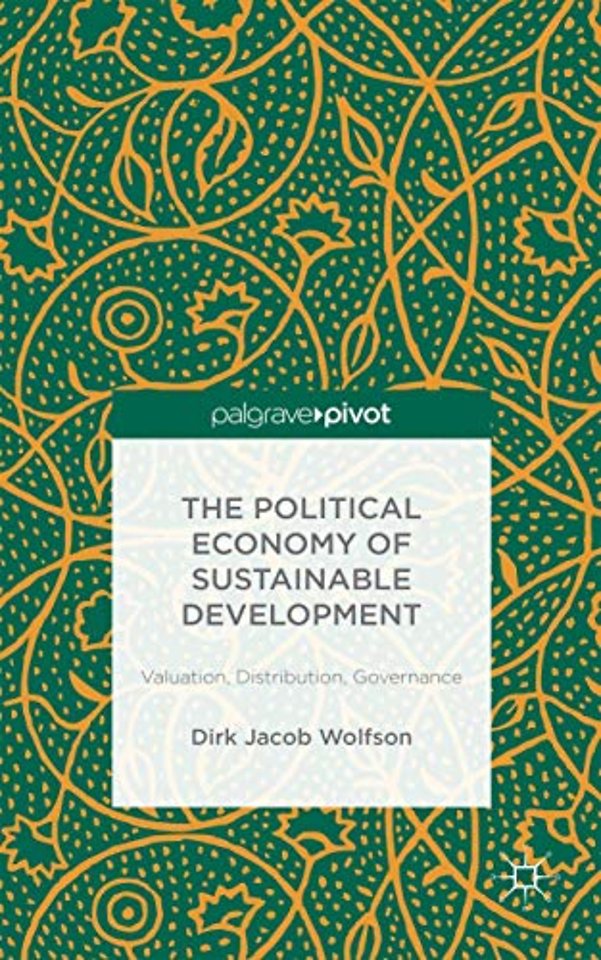
Dirk Jacob Wolfson
Palgrave Macmillan UK
e druk, 2015
9781137552747
The Political Economy of Sustainable Development
Valuation, Distribution, Governance
Specificaties
Gebonden, blz.
|
Engels
Palgrave Macmillan UK |
e druk, 2015
ISBN13: 9781137552747
Rubricering
Levertijd ongeveer 8 werkdagen
Samenvatting
The author shows how sustainable development may be organized, valued and distributed by introducing situational contracting as an interactive and contextual mode of governance. Situational contracting provides a road map for where we want to go, serving the prevailing ideology in implementing the trade between efficiency and fairness.
Specificaties
ISBN13:9781137552747
Taal:Engels
Bindwijze:gebonden
Uitgever:Palgrave Macmillan UK
Hoofdrubriek:Mens en maatschappij
Inhoudsopgave
1. Introduction<BR>1.1. About this book<BR>1.2. Economic analysis and environmental policy: scope and limits <BR>1.3. Cost-benefit analysis: a preview <BR>1.4. Valuation, distribution and legitimacy<BR>1.5. Short cuts: cost-effectiveness, standards, multi-criteria and workable competition <BR>1.6. Global economic development and ecological constraints <BR>2. Valuation<BR>2.1. The ' 'Coase-solution ' ' and emissions trading<BR>2.2. Hedonic pricing, travel cost method and averting behaviour<BR>2.3. Stated preferences: contingent valuation and choice experiments <BR>2.4. Co- valuation and externalities in production functions<BR>2.5. Persuasion<BR>2.6. Fiscal instruments for managing preference<BR>2.7. Innovation as externality on the supply side <BR>2.8. Shadow prices or regulation?<BR>2.9. Combining results, and sensitivity analysis<BR>3. Distribution<BR>3.1. Optimal allocation and fairness in distribution <BR>3.2. Fiscal solutions <BR>3.3. Distributional weights<BR>3.4. Visions of justice <BR>4. Governance<BR>4.1. Cost-benefit analysis revisited<BR>4.2. Interactive governance and information management <BR>4.3. Situational contracting: implementation and empirical evidence<BR>4.4. Situational solutions in the valuation and distribution of environmental policy<BR>4.5. Summary and conclusions<BR>
Anderen die dit kochten, kochten ook
-
 Pepijn Dousi€ 32,50
 -
Bram Schaper€ 24,99
-
Gijsbrecht Sies€ 12,99
-
Richard Lewis€ 12,95
-
David Mandel€ 36,50
-
Lenny Kruit€ 30,95