
Roland X. (MD, PhD, FHRS Professor of Medicine Ghent University Hospital Ghent, Belgium) Stroobandt
Meer over de auteurs
Roland X. (MD, PhD, FHRS Professor of Medicine Ghent University Hospital Ghent, Belgium) Stroobandt,
R Stroobandt,
S. Serge (Clinical Professor of Medicine Emeritus, Department of Medicine, Rochester General Hospital and University of Rochester School of Medicine and Dentistry) Barold,
Alfons F. (Professor Emeritus of Electronic Engineering, Technical University KHBO, Department of Electronics, Ostend, Belgium) Sinnaeve
e.a.
John Wiley & Sons
e druk, 2016
9781119066415
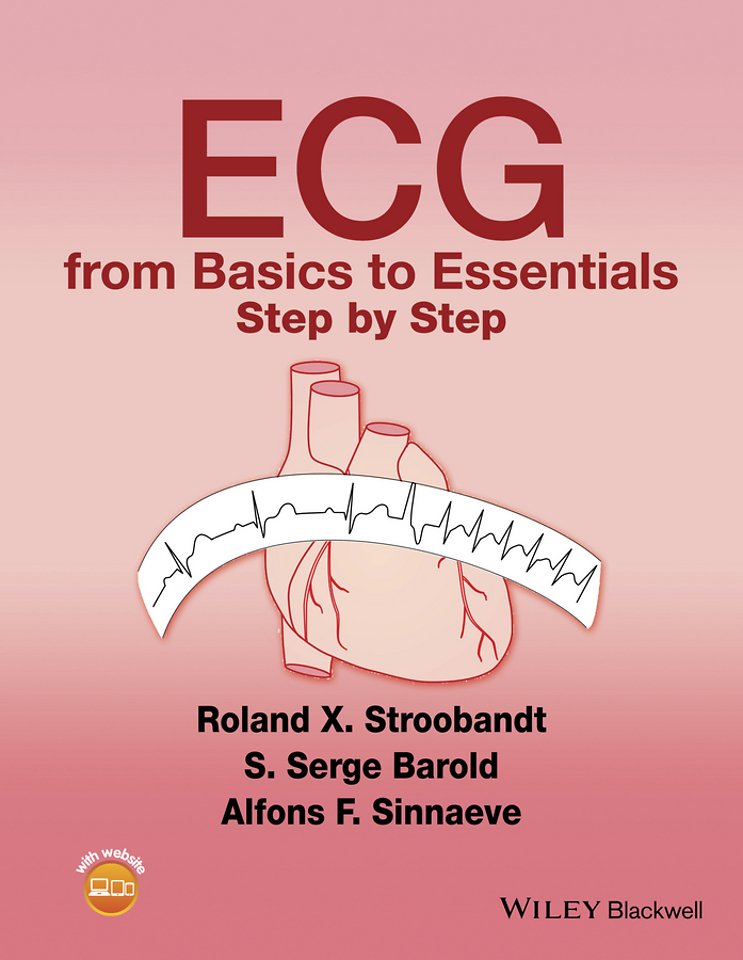
ECG from Basics to Essentials
Step by Step
Specificaties
Paperback, 440 blz.
|
Engels
John Wiley & Sons |
e druk, 2016
ISBN13: 9781119066415
Rubricering
Levertijd ongeveer 8 werkdagen
Samenvatting
This brand new guide assists students, interns and residents in developing a functional understanding of the set–up, workings and interpretation of ECGs
Step–by–step graphics and short, bite–sized explanations
Covers all major cardiac abnormalities including hypertrophy, arrhythmias, conduction blocks, and pre–excitation syndromes
Begins with a section on physiology of the heart and the basic set up of ECG recording
Features top tips on what to look for, complete with illustrated examples
Supported by a companion website featuring additional practice tracings
Specificaties
Inhoudsopgave
Preface, vi
<p>About the companion website, vii</p>
<p>1 Anatomy and Basic Physiology, 1</p>
<p>2 ECG Recording and ECG Leads, 21</p>
<p>3 The Normal ECG and the Frontal Plane QRS Axis, 53</p>
<p>4 The Components of the ECG Waves and Intervals, 73</p>
<p>5 P waves and Atrial Abnormalities, 85</p>
<p>6 Chamber Enlargement and Hypertrophy, 99</p>
<p>7 Intraventricular Conduction Defects, 105</p>
<p>8 Coronary Artery Disease and Acute Coronary Syndromes, 123</p>
<p>9 Acute Pericarditis, 187</p>
<p>10 The ECG in Extracardiac Disease, 193</p>
<p>11 Sinus Node Dysfunction, 203</p>
<p>12 Premature Ventricular Complexes (PVC), 217</p>
<p>13 Atrioventricular Block, 227</p>
<p>14 Atrial Rhythm Disorders, 243</p>
<p>15 Ventricular Tachycardias, 279</p>
<p>16 Ventricular Fibrillation and Ventricular Flutter, 305</p>
<p>17 Preexcitation and Wolff –Parkinson–White Syndrome (WPW), 311</p>
<p>18 Electrolyte Abnormalities, 327</p>
<p>19 Electrophysiologic Concepts, 333</p>
<p>20 Antiarrhythmic Drugs, 351</p>
<p>21 Pacemakers and their ECGs, 359</p>
<p>22 Errors in Electrocardiography Monitoring, Computerized ECG, Other Sites of ECG Recording, 391</p>
<p>23 How to Read an ECG, 407</p>
<p>Index, 425</p>
<p>About the companion website, vii</p>
<p>1 Anatomy and Basic Physiology, 1</p>
<p>2 ECG Recording and ECG Leads, 21</p>
<p>3 The Normal ECG and the Frontal Plane QRS Axis, 53</p>
<p>4 The Components of the ECG Waves and Intervals, 73</p>
<p>5 P waves and Atrial Abnormalities, 85</p>
<p>6 Chamber Enlargement and Hypertrophy, 99</p>
<p>7 Intraventricular Conduction Defects, 105</p>
<p>8 Coronary Artery Disease and Acute Coronary Syndromes, 123</p>
<p>9 Acute Pericarditis, 187</p>
<p>10 The ECG in Extracardiac Disease, 193</p>
<p>11 Sinus Node Dysfunction, 203</p>
<p>12 Premature Ventricular Complexes (PVC), 217</p>
<p>13 Atrioventricular Block, 227</p>
<p>14 Atrial Rhythm Disorders, 243</p>
<p>15 Ventricular Tachycardias, 279</p>
<p>16 Ventricular Fibrillation and Ventricular Flutter, 305</p>
<p>17 Preexcitation and Wolff –Parkinson–White Syndrome (WPW), 311</p>
<p>18 Electrolyte Abnormalities, 327</p>
<p>19 Electrophysiologic Concepts, 333</p>
<p>20 Antiarrhythmic Drugs, 351</p>
<p>21 Pacemakers and their ECGs, 359</p>
<p>22 Errors in Electrocardiography Monitoring, Computerized ECG, Other Sites of ECG Recording, 391</p>
<p>23 How to Read an ECG, 407</p>
<p>Index, 425</p>