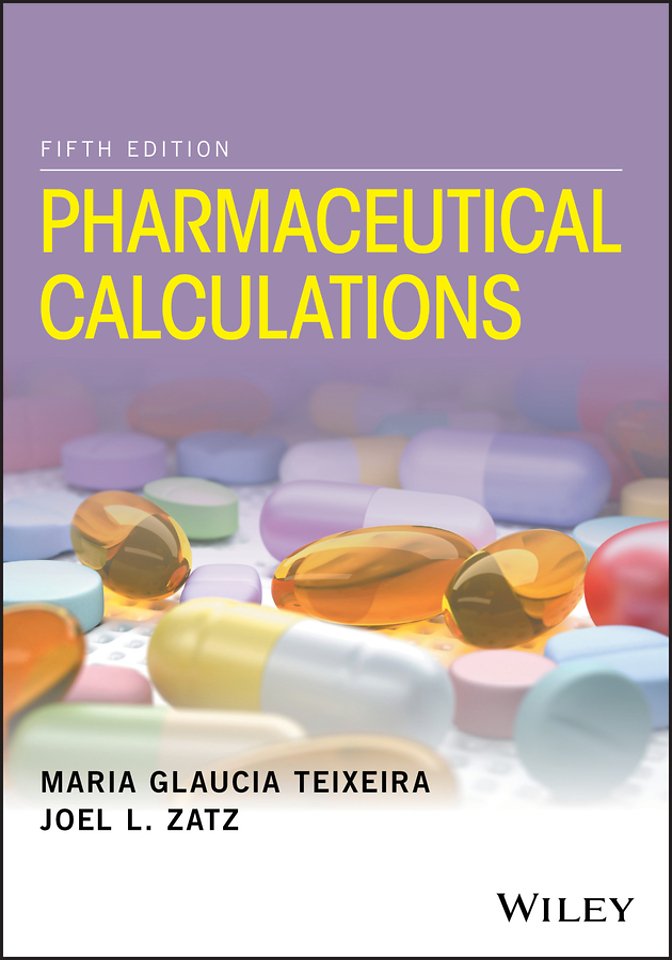
Pharmaceutical Calculations 5e
Samenvatting
Retaining the successful previous editions′ programmed instructional format, this book improves and updates an authoritative textbook to keep pace with compounding trends and calculations addressing real–world calculations pharmacists perform and allowing students to learn at their own pace through examples.
Connects well with the current emphasis on self–paced and active learning in pharmacy schools
Adds a new chapter dedicated to practical calculations used in contemporary compounding, new appendices, and solutions and answers for all problems
Maintains value for teaching pharmacy students the principles while also serving as a reference for review by students in preparation for licensure exams
Rearranges chapters and rewrites topics of the previous edition, making its content ideal to be used as the primary textbook in a typical dosage calculations course for any health care professional
Reviews of the prior edition: "...a well–structured approach to the topic..." (Drug Development and Industrial Pharmacy) and "...a perfectly organized manual that serves as a expert guide..." (Electric Review)
Specificaties
Inhoudsopgave
<p>CHAPTER 1 REVIEW OF BASIC MATHEMATICAL PRINCIPLES 1</p>
<p>1.1. Significant Figures 2</p>
<p>1.2. Rounding Off 4</p>
<p>1.3. Fractions 5</p>
<p>1.4. Exponents and Powers 8</p>
<p>1.5. Estimation 10</p>
<p>1.6. Units 12</p>
<p>1.7. Ratio 15</p>
<p>1.8. Proportion 15</p>
<p>1.9. Dimensional Analysis 18</p>
<p>Practice Problems 21</p>
<p>CHAPTER 2 SYSTEMS OF MEASUREMENT 31</p>
<p>2.1. Metrology 31</p>
<p>2.2. The Metric System 32</p>
<p>2.3. The English Systems 33</p>
<p>2.4. Measurement of Weight 33</p>
<p>2.5. Measurement of Volume 38</p>
<p>2.6. Measurement of Length 41</p>
<p>2.7. Intersystem Relationships 43</p>
<p>2.8. Household Equivalents and Metric Estimation 44</p>
<p>Practice Problems 49</p>
<p>CHAPTER 3 PRESCRIPTIONS AND MEDICATION ORDERS 54</p>
<p>3.1. Prescribing Authority 55</p>
<p>3.2. Components 57</p>
<p>3.3. Practices To Prevent Medication Errors 58</p>
<p>3.4. Common Abbreviations 60</p>
<p>3.5. Outpatient Prescription Drug Orders 69</p>
<p>3.6. Inpatient Medication Orders 72</p>
<p>3.7. Interpretation 77</p>
<p>3.8. Calculations To Check DEA Numbers 77</p>
<p>3.9. Reducing and Enlarging Formulas 80</p>
<p>3.10. Parts Formulas 87</p>
<p>Practice Problems 90</p>
<p>CHAPTER 4 WEIGHING AND MEASURING IN PHARMACY PRACTICE 103</p>
<p>4.1. Measurement Errors 103</p>
<p>4.2. Indication of Error 104</p>
<p>4.3. Tolerance In Prescription Compounding and Pharmaceutical Manufacturing 108</p>
<p>4.4. Weighing and Measuring 109</p>
<p>4.5. Aliquot Method and Triturations 119</p>
<p>4.6. Density 142</p>
<p>4.7. Specific Gravity 144</p>
<p>Practice Problems 145</p>
<p>CHAPTER 5 DOSAGE CALCULATIONS 160</p>
<p>5.1. Calculations Involving Dose, Size, Number of Doses, Amount Dispensed, and Quanity of a Specific Ingredient in a Dose 161</p>
<p>5.2. Dosage Measured By Drops 169</p>
<p>5.3. Dosage Based on Body Weight 171</p>
<p>5.4. Dosage Based on Body Surface Area (BSA) 174</p>
<p>5.5. Pediatric and Geriatric Dose Calculations 181</p>
<p>5.6. Chemotherapy Dose Calculations 184</p>
<p>Practice Problems 187</p>
<p>CHAPTER 6 DRUG CONCENTRATION EXPRESSIONS 203</p>
<p>6.1. Concentration 204</p>
<p>6.2. Percentage Strength Expressions 204</p>
<p>6.3. Stock Solutions, Concentrates, and Triturations 218</p>
<p>6.4. Saturated Solutions 222</p>
<p>6.5. Ratio Strength Expressions 224</p>
<p>6.6. Other Pharmaceutical Expressions of Drug Concentration 230</p>
<p>Practice Problems 235</p>
<p>CHAPTER 7 DILUTION AND CONCENTRATION 257</p>
<p>7.1. Problem–Solving Methodologies 258</p>
<p>7.2. So, Which Method Should I Use? 291</p>
<p>Practice Problems 296</p>
<p>CHAPTER 8 ISOTONICITY 310</p>
<p>8.1. Principles 310</p>
<p>8.2. Sodium Chloride Equivalent Values 312</p>
<p>8.3. Isotonicity by the Sodium Chloride Equivalent Method 315</p>
<p>8.4. Other Tonicity Agents 319</p>
<p>8.5. Isotonicity When One Ingredient is Already Isotonic 321</p>
<p>8.6. Isotonic Buffered Solutions 323</p>
<p>8.7. Other Methods 326</p>
<p>8.8. Determination of the Tonicity of a Solution (Hypotonic, Isotonic, or Hypertonic) 329</p>
<p>Practice Problems 330</p>
<p>CHAPTER 9 DOSAGE CALCULATIONS OF ELECTROLYTES 340</p>
<p>9.1. Molarity and Molality 341</p>
<p>9.2. Electrolyte Dissociation, Valence, Equivalent, and Equivalent Weight 344</p>
<p>9.3. Milliequivalents, mEq/mL, mEq/L 347</p>
<p>9.4. Osmolarity (Osmolar Strength) 354</p>
<p>Practice Problems 366</p>
<p>CHAPTER 10 CALCULATIONS FOR INJECTABLE MEDICATIONS AND STERILE FLUIDS 378</p>
<p>10.1. Reconstitution of Dry Powders 378</p>
<p>10.2. Calculations Related to Units/ml (Insulin, Heparin) and Other Units of Potency 386</p>
<p>10.3. Intravenous Admixtures 392</p>
<p>10.4. Extemporaneous IV Fluids 395</p>
<p>10.5. Flow Rates in Intravenous Sets 397</p>
<p>Practice Problems 399</p>
<p>CHAPTER 11 ENTERAL AND PARENTERAL NUTRITION 413</p>
<p>11.1. Screening and Assessment of Nutritional Needs 414</p>
<p>11.2. Enteral Nutrition 416</p>
<p>11.3. Parenteral Nutrition (PN): 2–in–1 and 3–in–1 Formulations 418</p>
<p>11.4. Calculation of Nutritional Requirements 420</p>
<p>11.5. Calculations for Compounding Parenteral Nutrition 429</p>
<p>11.6. Calculations Related to the Design of a PN 444</p>
<p>Practice Problems 446</p>
<p>CHAPTER 12 MISCELLANEOUS PRACTICAL CALCULATIONS IN CONTEMPORARY COMPOUNDING 458</p>
<p>12.1. Compounding with Manufactured Dosage Forms 459</p>
<p>12.2. Suppository Calculations 465</p>
<p>12.3. Determination of Amount of Base/powder Occupied by the Drug(s): Solid Dosage Forms 466</p>
<p>12.4. Lozenges and Lollipops 479</p>
<p>12.5. Selecting a Capsule Size 480</p>
<p>12.6. Primary Emulsion Calculations (4:2:1 Ratio) 485</p>
<p>12.7. A Little Touch of Veterinary Compounding 487</p>
<p>Practice Problems 489</p>
<p>APPENDICES 499</p>
<p>APPENDIX 1 Systems of Measurement 500</p>
<p>APPENDIX 2 Chemical Elements and Atomic Weights 502</p>
<p>APPENDIX 3 Calibration of Medicinal Dropper 503</p>
<p>APPENDIX 4 Solutions Used to Compound PN 504</p>
<p>APPENDIX 5 Conversions: Temperature, Time, Proof Strength 507</p>
<p>APPENDIX 6 HLB System 511</p>
<p>APPENDIX 7 Drug as a Base Versus Salt or Ester 514</p>
<p>APPENDIX 8 pH, Buffers, and Buffer Capacity 517</p>
<p>APPENDIX 9 Normal Concentration 525</p>
<p>APPENDIX 10 Biologics for Immunization 527</p>
<p>LITERATURE CONSULTED 529</p>
<p>INDEX 531</p>