T. A. (University College Dublin, Ireland) McGeady,
TA McGeady,
P. J. (University College Dublin, Ireland) Quinn,
E. S. (University College Dublin, Ireland) Fitzpatrick,
M. T. (University College Dublin, Ireland) Ryan,
D. (University College Dublin, Ireland) Kilroy,
P. (University College Dublin, Ireland) Lonergan
e.a.
John Wiley & Sons
e druk, 2017
9781118940617
Veterinary Embryology 2e
Specificaties
Paperback, 400 blz.
|
Engels
John Wiley & Sons |
e druk, 2017
ISBN13: 9781118940617
Rubricering
Levertijd ongeveer 8 werkdagen
Samenvatting
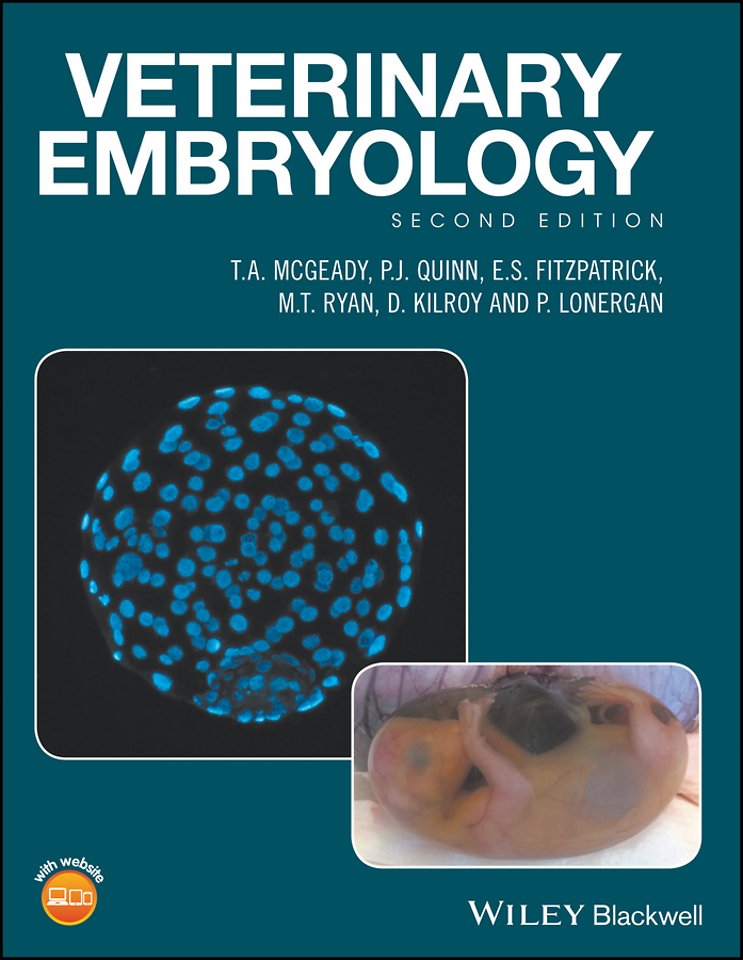
Veterinary Embryology, 2nd Edition, has been updated to reflect the many changes that have developed in the field; the text has been fully revised and expanded and is now in full colour and many pedagogical features and a companion website have been developed.
A new edition of this highly successful student textbook, updated to reflect the latest developments in the field of embryology, with the inclusion of four new chapters
Written by a team of authors with extensive experience of teaching this subject
Short concise chapters on key topics describe complex concepts in a user–friendly way
Additional tables, flow diagrams and numerous hand–drawn illustrations support the concepts presented in the text
Specificaties
Inhoudsopgave
<p>About the authors</p>
<p>Preface</p>
<p>Acknowledgements</p>
<p>About the companion website</p>
<p>1 Historical aspects of embryology</p>
<p>2 Division, growth and differentiation of cells</p>
<p>3 Gametogenesis</p>
<p>4 Fertilisation</p>
<p>5 Cleavage</p>
<p>6 Gastrulation</p>
<p>7 Cell signalling and gene functioning during development</p>
<p>8 Stem cells</p>
<p>9 Establishment of the basic body plan</p>
<p>10 Coelomic cavities</p>
<p>11 Foetal membranes</p>
<p>12 Forms of implantation and placentation</p>
<p>13 Embryo mortality in domestic species</p>
<p>14 Cardiovascular system</p>
<p>15 Embryological and postnatal features of haematopoiesis</p>
<p>16 Nervous system</p>
<p>17 Muscular and skeletal systems</p>
<p>18 Digestive system</p>
<p>19 Respiratory system</p>
<p>20 Urinary system</p>
<p>21 Male and female reproductive systems</p>
<p>22 Structures in the head and neck</p>
<p>23 Endocrine system</p>
<p>24 Eye and ear</p>
<p>25 Integumentary system</p>
<p>26 Age determination of the embryo and foetus</p>
<p>27 Assisted reproductive technologies used in domestic species</p>
<p>28 Genetic, chromosomal and environmental factors which adversely affect prenatal development</p>
<p>Glossary</p>
<p>Useful websites</p>
<p>Index</p>
<p>Preface</p>
<p>Acknowledgements</p>
<p>About the companion website</p>
<p>1 Historical aspects of embryology</p>
<p>2 Division, growth and differentiation of cells</p>
<p>3 Gametogenesis</p>
<p>4 Fertilisation</p>
<p>5 Cleavage</p>
<p>6 Gastrulation</p>
<p>7 Cell signalling and gene functioning during development</p>
<p>8 Stem cells</p>
<p>9 Establishment of the basic body plan</p>
<p>10 Coelomic cavities</p>
<p>11 Foetal membranes</p>
<p>12 Forms of implantation and placentation</p>
<p>13 Embryo mortality in domestic species</p>
<p>14 Cardiovascular system</p>
<p>15 Embryological and postnatal features of haematopoiesis</p>
<p>16 Nervous system</p>
<p>17 Muscular and skeletal systems</p>
<p>18 Digestive system</p>
<p>19 Respiratory system</p>
<p>20 Urinary system</p>
<p>21 Male and female reproductive systems</p>
<p>22 Structures in the head and neck</p>
<p>23 Endocrine system</p>
<p>24 Eye and ear</p>
<p>25 Integumentary system</p>
<p>26 Age determination of the embryo and foetus</p>
<p>27 Assisted reproductive technologies used in domestic species</p>
<p>28 Genetic, chromosomal and environmental factors which adversely affect prenatal development</p>
<p>Glossary</p>
<p>Useful websites</p>
<p>Index</p>