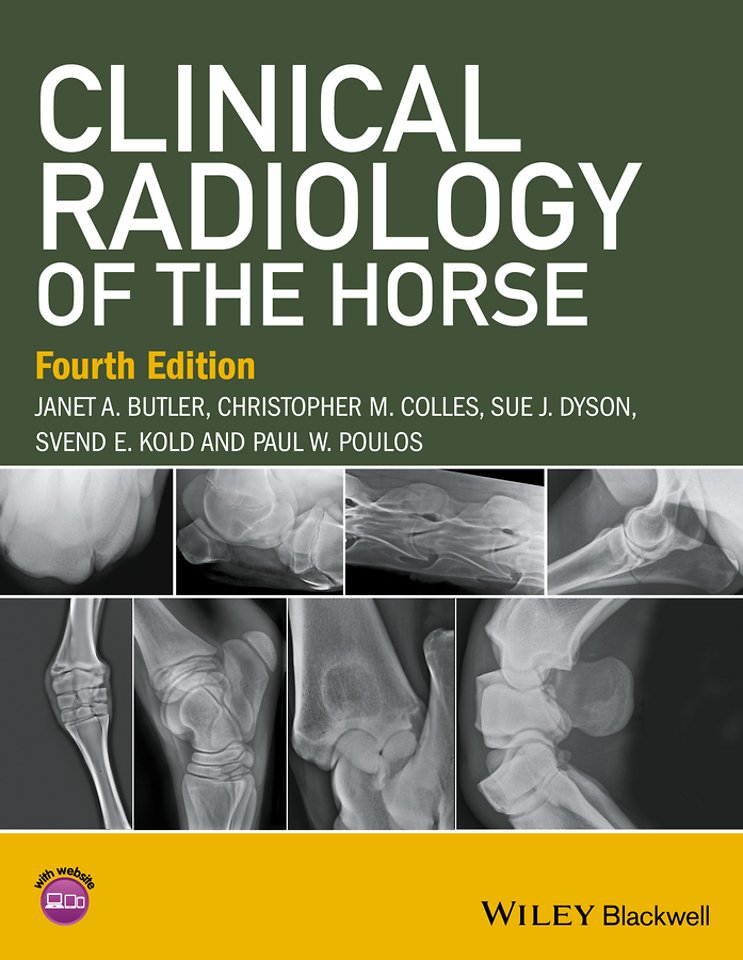
Clinical Radiology of the Horse, 4th Edition
Samenvatting
Clinical Radiology of the Horse is the best–selling, practical guide to all areas of equine radiography and radiology written by an experienced group of clinicians with a broad range of backgrounds.
Offers an atlas of normal and clinical images, as well as a comprehensive guide to techniques, equipment, positioning, and interpretation for general veterinary practitioners and specialists in imaging and orthopaedics
Updates to this fourth edition fully reflect the move to digital imaging with many new figures in the book and major revisions to the chapters on the head, thorax, and abdomen
Contains expanded coverage of the foot, pastern, and fetlock (now in separate chapters)
Includes a password–protected website with all the images from the book as well as over 200 additional images with examples of more subtle lesions, more fractures, correct technique and positioning versus incorrect, immature horses, progression of disease, and pathological images
Specificaties
Inhoudsopgave
<p>PREFACE to the fourth edition</p>
<p>ABOUT THE COMPANION WEBSITE</p>
<p>1 General principles</p>
<p>Introduction; Principles of radiography; Principles of radiographic interpretation: radiology; Radiological appearance of physiological changes and some common pathological lesions</p>
<p>2 Computed and digital radiography</p>
<p>3 The foot</p>
<p>Distal phalanx (pedal bone); Hoof; Navicular bone</p>
<p>4 The proximal and middle phalanges and the proximal interphalangeal joint</p>
<p>5 Metacarpophalangeal and metatarsophalangeal (fetlock) joints</p>
<p>6 The metacarpal and metatarsal regions</p>
<p>7 The carpus and antebrachium</p>
<p>8 The shoulder, humerus, elbow and radius</p>
<p>Scapulohumeral (shoulder) joint and humerus; Humeroradial, humeroulnar and radioulnar (elbow or cubital) joints and radius</p>
<p>9 The tarsus</p>
<p>10 The stifle and tibia</p>
<p>Stifle; Tibia</p>
<p>11 The head</p>
<p>Cranium; Paranasal sinuses (frontal, maxillary, conchal) and maxilla; Teeth and mandible; Pharynx, larynx and Eustachian tube diverticulum</p>
<p>12 The vertebral column</p>
<p>Cervical vertebrae; Thoracolumbar vertebrae; Sacrum and coccygeal vertebrae</p>
<p>13 The pelvis and femur</p>
<p>Pelvis; Femur</p>
<p>14 The thorax</p>
<p>15 The alimentary and urinary systems</p>
<p>Oesophagus; Abdomen and gastrointestinal tract; Urinary system</p>
<p>16 Miscellaneous techniques</p>
<p>Arthrography and bursography; Tendonography; Angiography; Venography; Myelography; Pneumocystography;</p>
<p>Intravenous Pyelography; Other techniques</p>
<p>Appendix A: Fusion times of physes and suture lines</p>
<p>Appendix B: Exposure guide, image quality and film processing faults</p>
<p>Appendix C: Glossary</p>
<p>INDEX</p>