
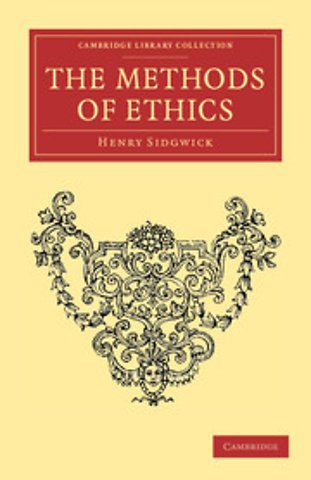
The Methods of Ethics

Specificaties
Paperback, 634 blz. | Engels
Cambridge University Press | e druk, 2011
ISBN13: 9781108040365
Rubricering
Cambridge University Press e druk, 2011 9781108040365
Onderdeel van serie Cambridge Library Co
€ 63,19
Levertijd ongeveer 8 werkdagen

Samenvatting

One of the most influential of the Victorian philosophers, Henry Sidgwick (1838–1900) also made important contributions to fields such as economics, political theory, and classics. An active promoter of higher education for women, he founded Cambridge's Newnham College in 1871. He attended Rugby School and then Trinity College, Cambridge, where he remained his whole career. In 1859 he took up a lectureship in classics, and held this post for ten years. In 1869, he moved to a lectureship in moral philosophy, the subject where he left arguably his greatest mark when he produced this work, regarded as his masterpiece. Published in 1874, the book argues the utilitarian approach to ethics, and a systematic and historically sensitive approach to ethical research that influenced utilitarian philosophers well into the twentieth century. It remains a valuable introduction to the philosophy, practice and history of ethics. This reissue includes the 1877 supplement.

Specificaties

ISBN13:9781108040365
Taal:Engels
Bindwijze:Paperback
Aantal pagina's:634

Inhoudsopgave

Preface; Book I: 1. Introduction; 2. Morality and law; 3. Moral reason; 4. Pleasure and desire; 5. Free will; 6. The methods of ethics; 7. Egoism and self-love; 8. Intuitionism; 9. Good; Book II. Egoism: 1. The principle and method of egoism; 2. Empirical hedonism; 3. Empirical hedonism (continued); 4. Hedonism and common sense; 5. Happiness and duty; 6. Other forms of the egoistic method; Book III. Intuitionism: 1. Intuitionism; 2. Virtue and duty; 3. The intellectual virtues; 4. Benevolence; 5. Justice; 6. Law and contract; 7. Classification of duties. Truth; 8. Other social duties and virtues; 9. Selfregarding virtues; 10. Courage, humility, &c.; 11. Review of the morality of common sense; 12. Motives or springs of action as subjects of moral judgment; 13. Philosophical intuitionism; 14. The summum bonum; Book IV. Utilitarianism: 1. The meaning of utilitarianism; 2. The proof of utilitarianism; 3. The proof of utilitarianism (continued); 4. The method of utilitarianism; 5. The method of utilitarianism (continued); 6. The sanctions of utilitarianism; Supplement to the first edition of The Methods of Ethics, containing all the important additions and alterations in the second edition, 1877.
€ 63,19
Levertijd ongeveer 8 werkdagen

Rubrieken

    Personen

      Trefwoorden

        The Methods of Ethics